

9 Consider a bowl of cake batter after only a few beats of a mixing spoon.
Univariant reaction
Divariant reaction
Discontinuity
Velocity
Depth
Gradient
Velocity
Depth
Phase compositions remain
constant across boundary.
Phase compositions vary
with depth in transition region.
Composition
Pressure
Phase β
Phase α
Phases
+
α β
Composition
Pressure
Phase β
Phase α
Fig. 3.8-11 Schematic phase diagrams showing the relation between the
nature of a phase change and the corresponding velocity discontinuity.
(Bina and Wood, 1987. J. Geophys. Res., 92, 4853–66, copyright by the
American Geophysical Union.)
0.6
0.4
0.2
0
Vol. (%)
Stis h
α
Ca-Pyx
Depth (km)
200
400
600
Opx
β
γ
Gar.
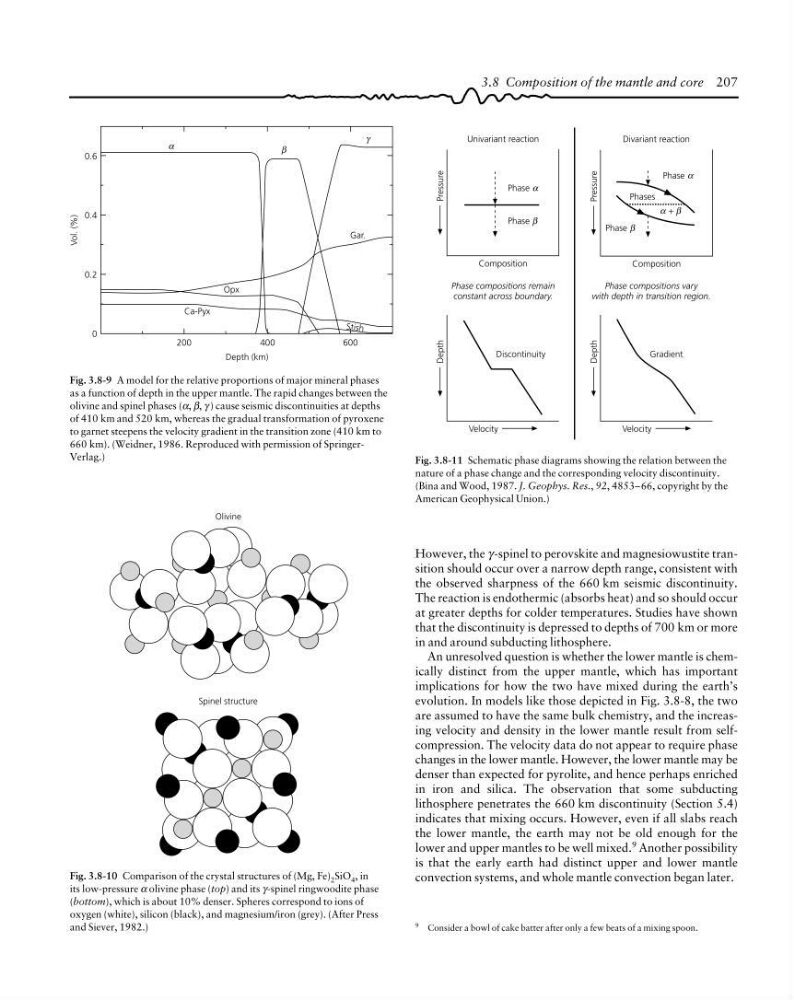
Fig. 3.8-9 A model for the relative proportions of major mineral phases
as a function of depth in the upper mantle. The rapid changes between the
olivine and spinel phases (α, β, γ ) cause seismic discontinuities at depths
of 410 km and 520 km, whereas the gradual transformation of pyroxene
to garnet steepens the velocity gradient in the transition zone (410 km to
660 km). (Weidner, 1986. Reproduced with permission of SpringerVerlag.)
3.8 Composition of the mantle and core 207
Fig. 3.8-10 Comparison of the crystal structures of (Mg, Fe) 2 SiO 4 , in
its low-pressure α olivine phase (top) and its γ-spinel ringwoodite phase
(bottom), which is about 10% denser. Spheres correspond to ions of
oxygen (white), silicon (black), and magnesium/iron (grey). (After Press
and Siever, 1982.)
Spinel structure
Olivine
However, the γ -spinel to perovskite and magnesiowustite transition should occur over a narrow depth range, consistent with
the observed sharpness of the 660 km seismic discontinuity.
The reaction is endothermic (absorbs heat) and so should occur
at greater depths for colder temperatures. Studies have shown
that the discontinuity is depressed to depths of 700 km or more
in and around subducting lithosphere.
An unresolved question is whether the lower mantle is chemically distinct from the upper mantle, which has important
implications for how the two have mixed during the earth’s
evolution. In models like those depicted in Fig. 3.8-8, the two
are assumed to have the same bulk chemistry, and the increasing velocity and density in the lower mantle result from selfcompression. The velocity data do not appear to require phase
changes in the lower mantle. However, the lower mantle may be
denser than expected for pyrolite, and hence perhaps enriched
in iron and silica. The observation that some subducting
lithosphere penetrates the 660 km discontinuity (Section 5.4)
indicates that mixing occurs. However, even if all slabs reach
the lower mantle, the earth may not be old enough for the
lower and upper mantles to be well mixed. 9 Another possibility
is that the early earth had distinct upper and lower mantle
convection systems, and whole mantle convection began later.
Univariant reaction
Divariant reaction
Discontinuity
Velocity
Depth
Gradient
Velocity
Depth
Phase compositions remain
constant across boundary.
Phase compositions vary
with depth in transition region.
Composition
Pressure
Phase β
Phase α
Phases
+
α β
Composition
Pressure
Phase β
Phase α
Fig. 3.8-11 Schematic phase diagrams showing the relation between the
nature of a phase change and the corresponding velocity discontinuity.
(Bina and Wood, 1987. J. Geophys. Res., 92, 4853–66, copyright by the
American Geophysical Union.)
0.6
0.4
0.2
0
Vol. (%)
Stis h
α
Ca-Pyx
Depth (km)
200
400
600
Opx
β
γ
Gar.
Fig. 3.8-9 A model for the relative proportions of major mineral phases
as a function of depth in the upper mantle. The rapid changes between the
olivine and spinel phases (α, β, γ ) cause seismic discontinuities at depths
of 410 km and 520 km, whereas the gradual transformation of pyroxene
to garnet steepens the velocity gradient in the transition zone (410 km to
660 km). (Weidner, 1986. Reproduced with permission of SpringerVerlag.)
3.8 Composition of the mantle and core 207
Fig. 3.8-10 Comparison of the crystal structures of (Mg, Fe) 2 SiO 4 , in
its low-pressure α olivine phase (top) and its γ-spinel ringwoodite phase
(bottom), which is about 10% denser. Spheres correspond to ions of
oxygen (white), silicon (black), and magnesium/iron (grey). (After Press
and Siever, 1982.)
Spinel structure
Olivine
However, the γ -spinel to perovskite and magnesiowustite transition should occur over a narrow depth range, consistent with
the observed sharpness of the 660 km seismic discontinuity.
The reaction is endothermic (absorbs heat) and so should occur
at greater depths for colder temperatures. Studies have shown
that the discontinuity is depressed to depths of 700 km or more
in and around subducting lithosphere.
An unresolved question is whether the lower mantle is chemically distinct from the upper mantle, which has important
implications for how the two have mixed during the earth’s
evolution. In models like those depicted in Fig. 3.8-8, the two
are assumed to have the same bulk chemistry, and the increasing velocity and density in the lower mantle result from selfcompression. The velocity data do not appear to require phase
changes in the lower mantle. However, the lower mantle may be
denser than expected for pyrolite, and hence perhaps enriched
in iron and silica. The observation that some subducting
lithosphere penetrates the 660 km discontinuity (Section 5.4)
indicates that mixing occurs. However, even if all slabs reach
the lower mantle, the earth may not be old enough for the
lower and upper mantles to be well mixed. 9 Another possibility
is that the early earth had distinct upper and lower mantle
convection systems, and whole mantle convection began later.