

204 Seismology and Earth Structure
6 Although our instincts based on water make it strange to think of temperatures
near 5000° as “freezing,” this occurs as the solid inner core forms from the liquid
outer core.
7 Temperatures in the deep earth are often given as absolute (Kelvin) temperatures,
equal to the Celsius temperatures plus 273.15°.
4000
3000
2000
1000
Temperature (K)
0
Upper
mantle
Lower
mantle
Asthenosphere
6000
Radius (km)
Temperature (T)
D″
Solidus
(T M )
Depth (km)
5000
4000
1000
2000
2891
3480
Fig. 3.8-6 A sample mantle geotherm with steep temperature gradients
in the thermal boundary layers at the top and bottom of the mantle and a
near-adiabatic gradient in the lower mantle. The melting curve, or solidus,
is also shown. Temperatures are given in absolute temperature. (Stacey,
1992. From Physics of the Earth, 3rd edn, copyright © 1992 by John
Wiley & Sons, Inc. (New York). Reprinted by permission.)
is transferred upward in the earth. Thermal convection, heat
transfer by the motions of material due to the density changes
resulting from temperature, occurs in the mantle. The most
obvious manifestations of this convection are the mid-ocean
ridges, which are its hot upwelling limbs, and subducting
plates, which are its cold downwelling limbs. A separate convection system in the fluid outer core is believed to cause the
earth’s magnetic field. In addition, heat is transferred by conduction through the lithosphere, the core–mantle boundary,
and the inner core, which may also be convecting.
The geotherm is harder to estimate than the pressure profile
and remains a subject of debate. A geotherm is inferred by
modeling radioactive generation of heat in the crust and the
mantle, conduction of heat across the lithosphere, CMB, and
inner core, and adiabatic temperature gradients associated
with convection in the mantle and the outer core. The predicted
temperatures are required to match the expected temperatures
of the phase transitions in the transition zone and the expected
freezing point of iron at the ICB. 6 Given the uncertainties
involved, estimates of the temperature at the center of the
earth vary from 5000 K to almost 7000 K,
7 with recent work
favoring the lower end of this range.
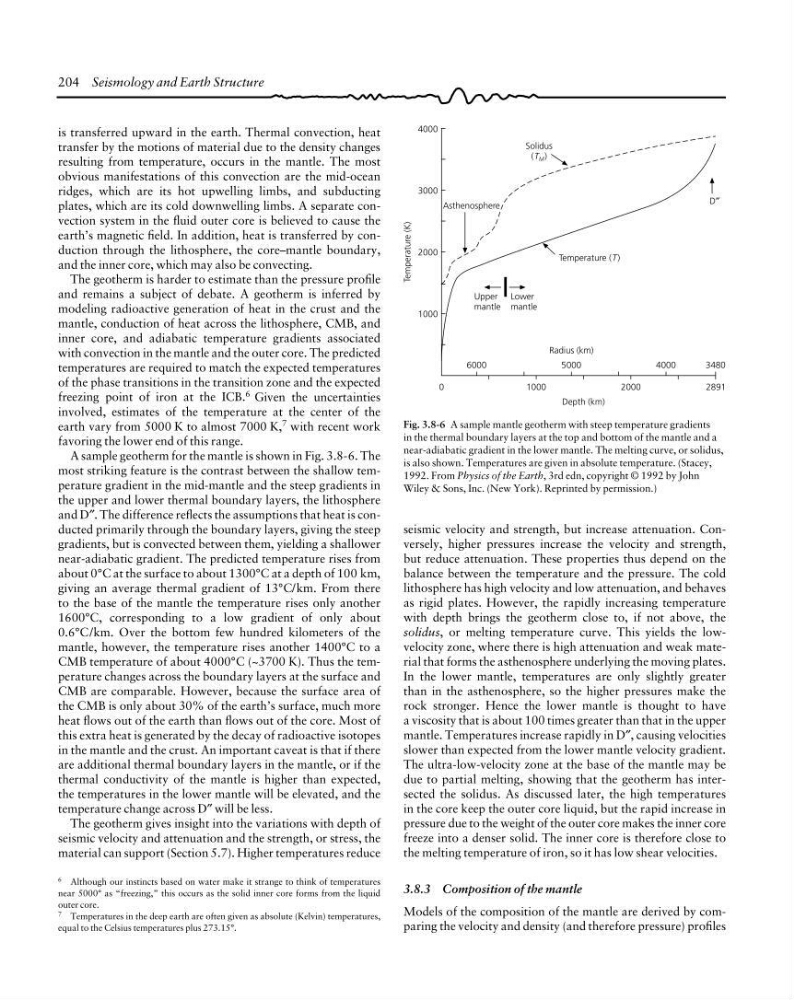
A sample geotherm for the mantle is shown in Fig. 3.8-6. The
most striking feature is the contrast between the shallow temperature gradient in the mid-mantle and the steep gradients in
the upper and lower thermal boundary layers, the lithosphere
and D″. The difference reflects the assumptions that heat is conducted primarily through the boundary layers, giving the steep
gradients, but is convected between them, yielding a shallower
near-adiabatic gradient. The predicted temperature rises from
about 0°C at the surface to about 1300°C at a depth of 100 km,
giving an average thermal gradient of 13°C/km. From there
to the base of the mantle the temperature rises only another
1600°C, corresponding to a low gradient of only about
0.6°C/km. Over the bottom few hundred kilometers of the
mantle, however, the temperature rises another 1400°C to a
CMB temperature of about 4000°C (~3700 K). Thus the temperature changes across the boundary layers at the surface and
CMB are comparable. However, because the surface area of
the CMB is only about 30% of the earth’s surface, much more
heat flows out of the earth than flows out of the core. Most of
this extra heat is generated by the decay of radioactive isotopes
in the mantle and the crust. An important caveat is that if there
are additional thermal boundary layers in the mantle, or if the
thermal conductivity of the mantle is higher than expected,
the temperatures in the lower mantle will be elevated, and the
temperature change across D″ will be less.
The geotherm gives insight into the variations with depth of
seismic velocity and attenuation and the strength, or stress, the
material can support (Section 5.7). Higher temperatures reduce
seismic velocity and strength, but increase attenuation. Conversely, higher pressures increase the velocity and strength,
but reduce attenuation. These properties thus depend on the
balance between the temperature and the pressure. The cold
lithosphere has high velocity and low attenuation, and behaves
as rigid plates. However, the rapidly increasing temperature
with depth brings the geotherm close to, if not above, the
solidus, or melting temperature curve. This yields the lowvelocity zone, where there is high attenuation and weak material that forms the asthenosphere underlying the moving plates.
In the lower mantle, temperatures are only slightly greater
than in the asthenosphere, so the higher pressures make the
rock stronger. Hence the lower mantle is thought to have
a viscosity that is about 100 times greater than that in the upper
mantle. Temperatures increase rapidly in D″, causing velocities
slower than expected from the lower mantle velocity gradient.
The ultra-low-velocity zone at the base of the mantle may be
due to partial melting, showing that the geotherm has intersected the solidus. As discussed later, the high temperatures
in the core keep the outer core liquid, but the rapid increase in
pressure due to the weight of the outer core makes the inner core
freeze into a denser solid. The inner core is therefore close to
the melting temperature of iron, so it has low shear velocities.
3.8.3 Composition of the mantle
Models of the composition of the mantle are derived by comparing the velocity and density (and therefore pressure) profiles
6 Although our instincts based on water make it strange to think of temperatures
near 5000° as “freezing,” this occurs as the solid inner core forms from the liquid
outer core.
7 Temperatures in the deep earth are often given as absolute (Kelvin) temperatures,
equal to the Celsius temperatures plus 273.15°.
4000
3000
2000
1000
Temperature (K)
0
Upper
mantle
Lower
mantle
Asthenosphere
6000
Radius (km)
Temperature (T)
D″
Solidus
(T M )
Depth (km)
5000
4000
1000
2000
2891
3480
Fig. 3.8-6 A sample mantle geotherm with steep temperature gradients
in the thermal boundary layers at the top and bottom of the mantle and a
near-adiabatic gradient in the lower mantle. The melting curve, or solidus,
is also shown. Temperatures are given in absolute temperature. (Stacey,
1992. From Physics of the Earth, 3rd edn, copyright © 1992 by John
Wiley & Sons, Inc. (New York). Reprinted by permission.)
is transferred upward in the earth. Thermal convection, heat
transfer by the motions of material due to the density changes
resulting from temperature, occurs in the mantle. The most
obvious manifestations of this convection are the mid-ocean
ridges, which are its hot upwelling limbs, and subducting
plates, which are its cold downwelling limbs. A separate convection system in the fluid outer core is believed to cause the
earth’s magnetic field. In addition, heat is transferred by conduction through the lithosphere, the core–mantle boundary,
and the inner core, which may also be convecting.
The geotherm is harder to estimate than the pressure profile
and remains a subject of debate. A geotherm is inferred by
modeling radioactive generation of heat in the crust and the
mantle, conduction of heat across the lithosphere, CMB, and
inner core, and adiabatic temperature gradients associated
with convection in the mantle and the outer core. The predicted
temperatures are required to match the expected temperatures
of the phase transitions in the transition zone and the expected
freezing point of iron at the ICB. 6 Given the uncertainties
involved, estimates of the temperature at the center of the
earth vary from 5000 K to almost 7000 K,
7 with recent work
favoring the lower end of this range.
A sample geotherm for the mantle is shown in Fig. 3.8-6. The
most striking feature is the contrast between the shallow temperature gradient in the mid-mantle and the steep gradients in
the upper and lower thermal boundary layers, the lithosphere
and D″. The difference reflects the assumptions that heat is conducted primarily through the boundary layers, giving the steep
gradients, but is convected between them, yielding a shallower
near-adiabatic gradient. The predicted temperature rises from
about 0°C at the surface to about 1300°C at a depth of 100 km,
giving an average thermal gradient of 13°C/km. From there
to the base of the mantle the temperature rises only another
1600°C, corresponding to a low gradient of only about
0.6°C/km. Over the bottom few hundred kilometers of the
mantle, however, the temperature rises another 1400°C to a
CMB temperature of about 4000°C (~3700 K). Thus the temperature changes across the boundary layers at the surface and
CMB are comparable. However, because the surface area of
the CMB is only about 30% of the earth’s surface, much more
heat flows out of the earth than flows out of the core. Most of
this extra heat is generated by the decay of radioactive isotopes
in the mantle and the crust. An important caveat is that if there
are additional thermal boundary layers in the mantle, or if the
thermal conductivity of the mantle is higher than expected,
the temperatures in the lower mantle will be elevated, and the
temperature change across D″ will be less.
The geotherm gives insight into the variations with depth of
seismic velocity and attenuation and the strength, or stress, the
material can support (Section 5.7). Higher temperatures reduce
seismic velocity and strength, but increase attenuation. Conversely, higher pressures increase the velocity and strength,
but reduce attenuation. These properties thus depend on the
balance between the temperature and the pressure. The cold
lithosphere has high velocity and low attenuation, and behaves
as rigid plates. However, the rapidly increasing temperature
with depth brings the geotherm close to, if not above, the
solidus, or melting temperature curve. This yields the lowvelocity zone, where there is high attenuation and weak material that forms the asthenosphere underlying the moving plates.
In the lower mantle, temperatures are only slightly greater
than in the asthenosphere, so the higher pressures make the
rock stronger. Hence the lower mantle is thought to have
a viscosity that is about 100 times greater than that in the upper
mantle. Temperatures increase rapidly in D″, causing velocities
slower than expected from the lower mantle velocity gradient.
The ultra-low-velocity zone at the base of the mantle may be
due to partial melting, showing that the geotherm has intersected the solidus. As discussed later, the high temperatures
in the core keep the outer core liquid, but the rapid increase in
pressure due to the weight of the outer core makes the inner core
freeze into a denser solid. The inner core is therefore close to
the melting temperature of iron, so it has low shear velocities.
3.8.3 Composition of the mantle
Models of the composition of the mantle are derived by comparing the velocity and density (and therefore pressure) profiles