

200 Seismology and Earth Structure
Values similar to those for the earth (ρ c = 12 g/cm 3 , ρ m =
5 g/cm
3 , r c = 3480 km) yield a moment of inertia ratio of
C/Ma 2 = 0.35. This value is less than the 0.4 which a uniform
planet would have, because the material is concentrated toward
the center. It is similar to the value of C/Ma
2 for the earth
determined from the earth’s shape and gravity field. The earth’s
value, about 0.33, thus indicates the presence of a dense core.
Although the mass and moment of inertia give only integral
constraints on the density, seismic velocities give information
on the variation of density with depth. We first consider a
region of uniform material and see how the density increases
with depth as the material is self-compressed by its own weight.
At a radius r, the gradient of the hydrostatic pressure P(r) is
dP
dr
g ,
= − ρ
(8)
where ρ(r) and g(r) are the density and the acceleration of gravity at that depth. The derivative is negative, because pressure
increases with depth. The local value of gravity, g(r), depends
on the total mass m(r) within the sphere of radius r, 1
g = Gm/r 2 .
(9)
The pressure derivative can then be written as
dP
dr
Gm
r
.
=
−ρ
2
(10)
The elastic constants of the material are introduced using the
definitions of the density and the dilatation θ (Eqn 2.3.60),
ρ = m/V, dθ = dV/V,
(11)
so that differentiation yields
dρ = −(m/V 2 )dV = −ρdθ.
(12)
Thus the bulk modulus K can be expressed, starting with its
definition (Eqn 2.3.74), as
K
dP
d
dP
d
d
d
dP
d
.
= −
= −
=
θ
ρ
ρ
θ
ρ ρ
(13)
Combining this with the pressure derivative equation (Eqn 10)
gives the change in density with depth
Spin axis
l
r
dv
θ
(r, , )
θ φ
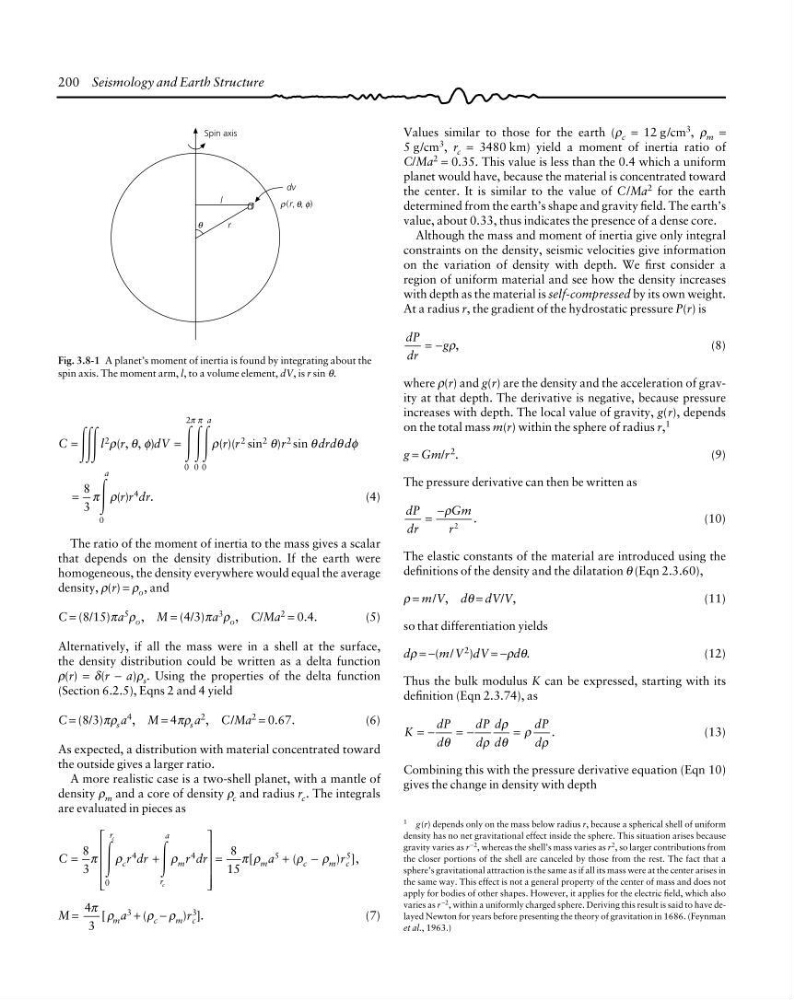
ρ
Fig. 3.8-1 A planet’s moment of inertia is found by integrating about the
spin axis. The moment arm, l, to a volume element, dV, is r sin θ.
C
l r
dV
r r
r
drd d
a
( , , )
( )( sin ) sin
=
=
ΎΎΎ
ΎΎΎ
2
0
2
0 0
2
2
2
ρ θ φ
ρ
θ
θ
θ φ
π π
=
( )
.
8
3
0
4
π ρ
Ύ
a
r r dr
(4)
The ratio of the moment of inertia to the mass gives a scalar
that depends on the density distribution. If the earth were
homogeneous, the density everywhere would equal the average
density, ρ(r) = ρ o , and
C = (8/15)πa 5 ρ o , M = (4/3)πa 3 ρ o , C/Ma 2 = 0.4.
(5)
Alternatively, if all the mass were in a shell at the surface,
the density distribution could be written as a delta function
ρ(r) = δ(r − a)ρ s . Using the properties of the delta function
(Section 6.2.5), Eqns 2 and 4 yield
C = (8/3)πρ s a 4 , M = 4πρ s a 2 , C/Ma 2 = 0.67.
(6)
As expected, a distribution with material concentrated toward
the outside gives a larger ratio.
A more realistic case is a two-shell planet, with a mantle of
density ρ m and a core of density ρ c and radius r c . The integrals
are evaluated in pieces as
C
rd r
rd r
a
r
r
c
r
a
m
m
c
mc
c
c
[
(
) ],
=
+
⎡
⎣
⎢
⎢
⎢
⎢
⎤
⎦
⎥
⎥
⎥
⎥
=
+
−
8
3
8
15
0
4
4
5
5
π ρ
ρ
π ρ
ρ
ρ
Ύ
Ύ
M =
4
3
π [ ρ m a 3 + (ρ c − ρ m )r 3
c ].
(7)
1 g(r) depends only on the mass below radius r, because a spherical shell of uniform
density has no net gravitational effect inside the sphere. This situation arises because
gravity varies as r
−2
, whereas the shell’s mass varies as r
2 , so larger contributions from
the closer portions of the shell are canceled by those from the rest. The fact that a
sphere’s gravitational attraction is the same as if all its mass were at the center arises in
the same way. This effect is not a general property of the center of mass and does not
apply for bodies of other shapes. However, it applies for the electric field, which also
varies as r −2 , within a uniformly charged sphere. Deriving this result is said to have delayed Newton for years before presenting the theory of gravitation in 1686. (Feynman
et al., 1963.)
Values similar to those for the earth (ρ c = 12 g/cm 3 , ρ m =
5 g/cm
3 , r c = 3480 km) yield a moment of inertia ratio of
C/Ma 2 = 0.35. This value is less than the 0.4 which a uniform
planet would have, because the material is concentrated toward
the center. It is similar to the value of C/Ma
2 for the earth
determined from the earth’s shape and gravity field. The earth’s
value, about 0.33, thus indicates the presence of a dense core.
Although the mass and moment of inertia give only integral
constraints on the density, seismic velocities give information
on the variation of density with depth. We first consider a
region of uniform material and see how the density increases
with depth as the material is self-compressed by its own weight.
At a radius r, the gradient of the hydrostatic pressure P(r) is
dP
dr
g ,
= − ρ
(8)
where ρ(r) and g(r) are the density and the acceleration of gravity at that depth. The derivative is negative, because pressure
increases with depth. The local value of gravity, g(r), depends
on the total mass m(r) within the sphere of radius r, 1
g = Gm/r 2 .
(9)
The pressure derivative can then be written as
dP
dr
Gm
r
.
=
−ρ
2
(10)
The elastic constants of the material are introduced using the
definitions of the density and the dilatation θ (Eqn 2.3.60),
ρ = m/V, dθ = dV/V,
(11)
so that differentiation yields
dρ = −(m/V 2 )dV = −ρdθ.
(12)
Thus the bulk modulus K can be expressed, starting with its
definition (Eqn 2.3.74), as
K
dP
d
dP
d
d
d
dP
d
.
= −
= −
=
θ
ρ
ρ
θ
ρ ρ
(13)
Combining this with the pressure derivative equation (Eqn 10)
gives the change in density with depth
Spin axis
l
r
dv
θ
(r, , )
θ φ
ρ
Fig. 3.8-1 A planet’s moment of inertia is found by integrating about the
spin axis. The moment arm, l, to a volume element, dV, is r sin θ.
C
l r
dV
r r
r
drd d
a
( , , )
( )( sin ) sin
=
=
ΎΎΎ
ΎΎΎ
2
0
2
0 0
2
2
2
ρ θ φ
ρ
θ
θ
θ φ
π π
=
( )
.
8
3
0
4
π ρ
Ύ
a
r r dr
(4)
The ratio of the moment of inertia to the mass gives a scalar
that depends on the density distribution. If the earth were
homogeneous, the density everywhere would equal the average
density, ρ(r) = ρ o , and
C = (8/15)πa 5 ρ o , M = (4/3)πa 3 ρ o , C/Ma 2 = 0.4.
(5)
Alternatively, if all the mass were in a shell at the surface,
the density distribution could be written as a delta function
ρ(r) = δ(r − a)ρ s . Using the properties of the delta function
(Section 6.2.5), Eqns 2 and 4 yield
C = (8/3)πρ s a 4 , M = 4πρ s a 2 , C/Ma 2 = 0.67.
(6)
As expected, a distribution with material concentrated toward
the outside gives a larger ratio.
A more realistic case is a two-shell planet, with a mantle of
density ρ m and a core of density ρ c and radius r c . The integrals
are evaluated in pieces as
C
rd r
rd r
a
r
r
c
r
a
m
m
c
mc
c
c
[
(
) ],
=
+
⎡
⎣
⎢
⎢
⎢
⎢
⎤
⎦
⎥
⎥
⎥
⎥
=
+
−
8
3
8
15
0
4
4
5
5
π ρ
ρ
π ρ
ρ
ρ
Ύ
Ύ
M =
4
3
π [ ρ m a 3 + (ρ c − ρ m )r 3
c ].
(7)
1 g(r) depends only on the mass below radius r, because a spherical shell of uniform
density has no net gravitational effect inside the sphere. This situation arises because
gravity varies as r
−2
, whereas the shell’s mass varies as r
2 , so larger contributions from
the closer portions of the shell are canceled by those from the rest. The fact that a
sphere’s gravitational attraction is the same as if all its mass were at the center arises in
the same way. This effect is not a general property of the center of mass and does not
apply for bodies of other shapes. However, it applies for the electric field, which also
varies as r −2 , within a uniformly charged sphere. Deriving this result is said to have delayed Newton for years before presenting the theory of gravitation in 1686. (Feynman
et al., 1963.)