

chemistry of materials at high temperature and pressure. A
general view of the earth’s composition has emerged, although
aspects are still under investigation. This view is a cornerstone
of our thinking about the evolution of the earth and other
planets. We will summarize some basic ideas that are presently
under discussion, and the suggested readings provide more
information.
3.8.1 Density within the earth
A starting point for analysis of the earth’s composition is a
model of the variation in density with depth. The density is
3.8 Composition of the mantle and core 199
600
500
400
300
200
100
0
Q
Average Q model
Depth (km)
0
QR19
QL6
PREM
QM1
100 200 300 400 500
600 700
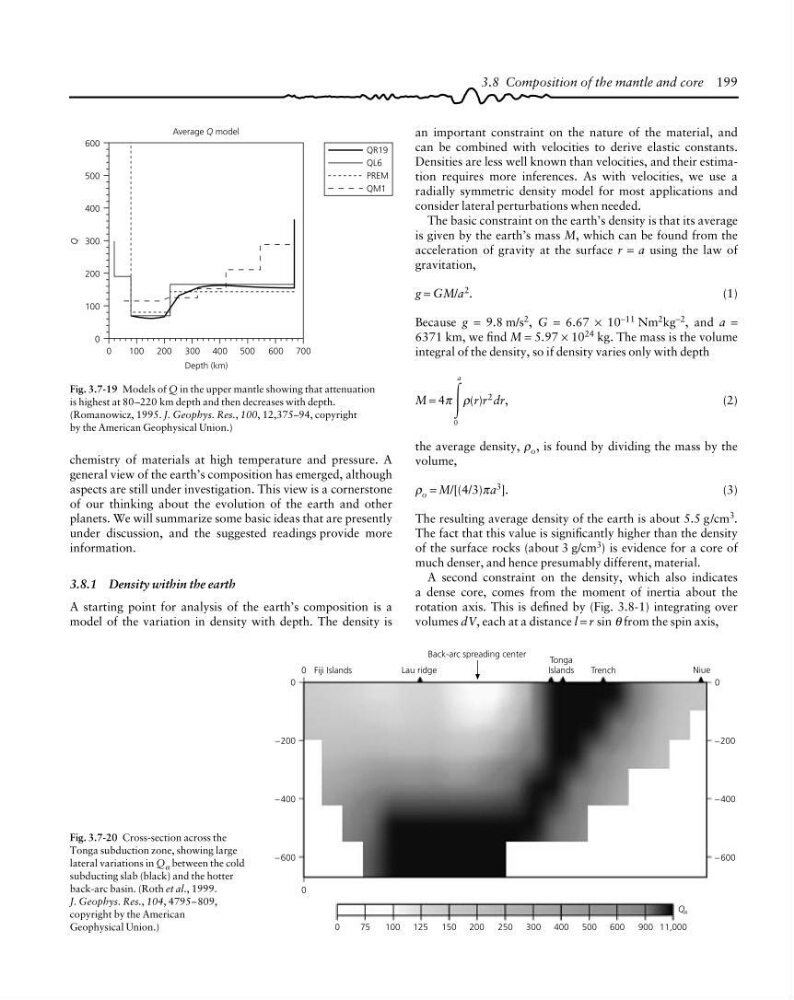
Fig. 3.7-19 Models of Q in the upper mantle showing that attenuation
is highest at 80–220 km depth and then decreases with depth.
(Romanowicz, 1995. J. Geophys. Res., 100, 12,375–94, copyright
by the American Geophysical Union.)
0
−200
− 400
− 600
0
Lau ridge
Tonga
Islands
Niue
Back-arc spreading center
0
Q α
Fiji Islands
0
Trench
0
−200
− 400
− 600
75
100 125
150 200
250 300 400 500 600
900 11,000
Fig. 3.7-20 Cross-section across the
Tonga subduction zone, showing large
lateral variations in Q α between the cold
subducting slab (black) and the hotter
back-arc basin. (Roth et al., 1999.
J. Geophys. Res., 104, 4795–809,
copyright by the American
Geophysical Union.)
an important constraint on the nature of the material, and
can be combined with velocities to derive elastic constants.
Densities are less well known than velocities, and their estimation requires more inferences. As with velocities, we use a
radially symmetric density model for most applications and
consider lateral perturbations when needed.
The basic constraint on the earth’s density is that its average
is given by the earth’s mass M, which can be found from the
acceleration of gravity at the surface r = a using the law of
gravitation,
g = GM/a 2 .
(1)
Because g = 9.8 m/s
2 , G = 6.67 × 10
−11 Nm
2 kg
−2
, and a =
6371 km, we find M = 5.97 × 10 24 kg. The mass is the volume
integral of the density, so if density varies only with depth
M = 4π
Ύ
0
a
ρ(r)r 2 dr,
(2)
the average density, ρ o , is found by dividing the mass by the
volume,
ρ o = M/[(4/3)πa 3 ].
(3)
The resulting average density of the earth is about 5.5 g/cm
3
.
The fact that this value is significantly higher than the density
of the surface rocks (about 3 g/cm 3 ) is evidence for a core of
much denser, and hence presumably different, material.
A second constraint on the density, which also indicates
a dense core, comes from the moment of inertia about the
rotation axis. This is defined by (Fig. 3.8-1) integrating over
volumes dV, each at a distance l = r sin θ from the spin axis,
general view of the earth’s composition has emerged, although
aspects are still under investigation. This view is a cornerstone
of our thinking about the evolution of the earth and other
planets. We will summarize some basic ideas that are presently
under discussion, and the suggested readings provide more
information.
3.8.1 Density within the earth
A starting point for analysis of the earth’s composition is a
model of the variation in density with depth. The density is
3.8 Composition of the mantle and core 199
600
500
400
300
200
100
0
Q
Average Q model
Depth (km)
0
QR19
QL6
PREM
QM1
100 200 300 400 500
600 700
Fig. 3.7-19 Models of Q in the upper mantle showing that attenuation
is highest at 80–220 km depth and then decreases with depth.
(Romanowicz, 1995. J. Geophys. Res., 100, 12,375–94, copyright
by the American Geophysical Union.)
0
−200
− 400
− 600
0
Lau ridge
Tonga
Islands
Niue
Back-arc spreading center
0
Q α
Fiji Islands
0
Trench
0
−200
− 400
− 600
75
100 125
150 200
250 300 400 500 600
900 11,000
Fig. 3.7-20 Cross-section across the
Tonga subduction zone, showing large
lateral variations in Q α between the cold
subducting slab (black) and the hotter
back-arc basin. (Roth et al., 1999.
J. Geophys. Res., 104, 4795–809,
copyright by the American
Geophysical Union.)
an important constraint on the nature of the material, and
can be combined with velocities to derive elastic constants.
Densities are less well known than velocities, and their estimation requires more inferences. As with velocities, we use a
radially symmetric density model for most applications and
consider lateral perturbations when needed.
The basic constraint on the earth’s density is that its average
is given by the earth’s mass M, which can be found from the
acceleration of gravity at the surface r = a using the law of
gravitation,
g = GM/a 2 .
(1)
Because g = 9.8 m/s
2 , G = 6.67 × 10
−11 Nm
2 kg
−2
, and a =
6371 km, we find M = 5.97 × 10 24 kg. The mass is the volume
integral of the density, so if density varies only with depth
M = 4π
Ύ
0
a
ρ(r)r 2 dr,
(2)
the average density, ρ o , is found by dividing the mass by the
volume,
ρ o = M/[(4/3)πa 3 ].
(3)
The resulting average density of the earth is about 5.5 g/cm
3
.
The fact that this value is significantly higher than the density
of the surface rocks (about 3 g/cm 3 ) is evidence for a core of
much denser, and hence presumably different, material.
A second constraint on the density, which also indicates
a dense core, comes from the moment of inertia about the
rotation axis. This is defined by (Fig. 3.8-1) integrating over
volumes dV, each at a distance l = r sin θ from the spin axis,