

190 Seismology and Earth Structure
3.7.5 Intrinsic attenuation
We can gain insight into the intrinsic attenuation of seismic
waves by examining a simple system, a damped harmonic oscillator composed of a spring and a dashpot. We use Newton’s
second law, F = ma, to describe the displacement u(t) of a mass
m. The restoring force of the spring is proportional to minus
the spring constant k times the spring extension or displacement from the equilibrium positions, so
m
d u t
dt
ku t
2
2
0
( )
( )
.
+
=
(2)
Once set in motion by an impulse, this frictionless system has
a purely elastic response described by a perpetual harmonic
oscillation
u(t) = Ae iω 0 t + Be −iω
0t ,
(3)
where A and B are constants, and the mass moves back and
forth with a natural frequency
ω 0 = (k/m) 1/2 .
(4)
One example of this general solution is
u(t) = A 0 cos (ω 0 t).
(5)
Once the motion is started, this undamped oscillation continues forever, because no energy is lost. However, this is no
longer the case if the system contains a dashpot, or damping
term. The damping force is proportional to the velocity of the
mass and opposes its motion. Hence the equation of motion
(Eqn 2) becomes
m
d u t
dt
m
du t
dt
k u t
2
2
0
( )
( )
( )
,
+
+
=
γ
(6)
where γ is the damping factor. To simplify this, we define the
quality factor
(No scattering)
Energy
arrival
time
EQ
STA
EQ
STA
Ellipsoidal
scattering
surfaces
EQ
STA
Earthquake at station CCM
Moonquake at Apollo 12
0
15
30
45
60
0
15
30
45
60
Time (min)
Time (min)
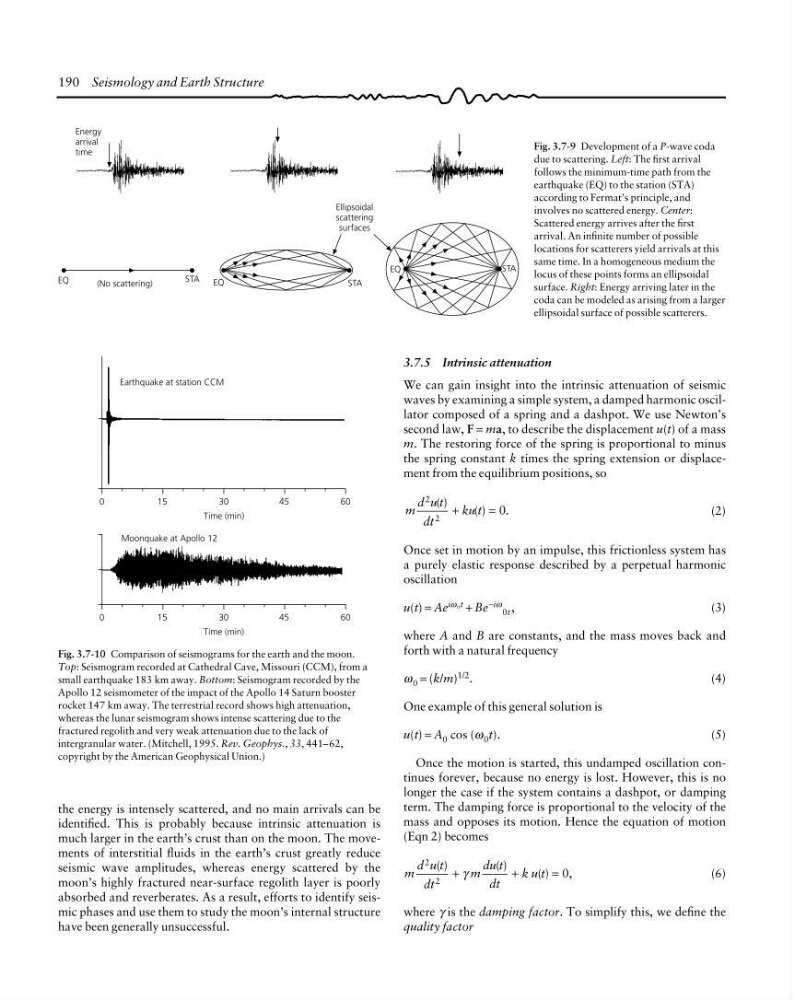
Fig. 3.7-10 Comparison of seismograms for the earth and the moon.
Top: Seismogram recorded at Cathedral Cave, Missouri (CCM), from a
small earthquake 183 km away. Bottom: Seismogram recorded by the
Apollo 12 seismometer of the impact of the Apollo 14 Saturn booster
rocket 147 km away. The terrestrial record shows high attenuation,
whereas the lunar seismogram shows intense scattering due to the
fractured regolith and very weak attenuation due to the lack of
intergranular water. (Mitchell, 1995. Rev. Geophys., 33, 441–62,
copyright by the American Geophysical Union.)
the energy is intensely scattered, and no main arrivals can be
identified. This is probably because intrinsic attenuation is
much larger in the earth’s crust than on the moon. The movements of interstitial fluids in the earth’s crust greatly reduce
seismic wave amplitudes, whereas energy scattered by the
moon’s highly fractured near-surface regolith layer is poorly
absorbed and reverberates. As a result, efforts to identify seismic phases and use them to study the moon’s internal structure
have been generally unsuccessful.
Fig. 3.7-9 Development of a P-wave coda
due to scattering. Left: The first arrival
follows the minimum-time path from the
earthquake (EQ) to the station (STA)
according to Fermat’s principle, and
involves no scattered energy. Center:
Scattered energy arrives after the first
arrival. An infinite number of possible
locations for scatterers yield arrivals at this
same time. In a homogeneous medium the
locus of these points forms an ellipsoidal
surface. Right: Energy arriving later in the
coda can be modeled as arising from a larger
ellipsoidal surface of possible scatterers.
3.7.5 Intrinsic attenuation
We can gain insight into the intrinsic attenuation of seismic
waves by examining a simple system, a damped harmonic oscillator composed of a spring and a dashpot. We use Newton’s
second law, F = ma, to describe the displacement u(t) of a mass
m. The restoring force of the spring is proportional to minus
the spring constant k times the spring extension or displacement from the equilibrium positions, so
m
d u t
dt
ku t
2
2
0
( )
( )
.
+
=
(2)
Once set in motion by an impulse, this frictionless system has
a purely elastic response described by a perpetual harmonic
oscillation
u(t) = Ae iω 0 t + Be −iω
0t ,
(3)
where A and B are constants, and the mass moves back and
forth with a natural frequency
ω 0 = (k/m) 1/2 .
(4)
One example of this general solution is
u(t) = A 0 cos (ω 0 t).
(5)
Once the motion is started, this undamped oscillation continues forever, because no energy is lost. However, this is no
longer the case if the system contains a dashpot, or damping
term. The damping force is proportional to the velocity of the
mass and opposes its motion. Hence the equation of motion
(Eqn 2) becomes
m
d u t
dt
m
du t
dt
k u t
2
2
0
( )
( )
( )
,
+
+
=
γ
(6)
where γ is the damping factor. To simplify this, we define the
quality factor
(No scattering)
Energy
arrival
time
EQ
STA
EQ
STA
Ellipsoidal
scattering
surfaces
EQ
STA
Earthquake at station CCM
Moonquake at Apollo 12
0
15
30
45
60
0
15
30
45
60
Time (min)
Time (min)
Fig. 3.7-10 Comparison of seismograms for the earth and the moon.
Top: Seismogram recorded at Cathedral Cave, Missouri (CCM), from a
small earthquake 183 km away. Bottom: Seismogram recorded by the
Apollo 12 seismometer of the impact of the Apollo 14 Saturn booster
rocket 147 km away. The terrestrial record shows high attenuation,
whereas the lunar seismogram shows intense scattering due to the
fractured regolith and very weak attenuation due to the lack of
intergranular water. (Mitchell, 1995. Rev. Geophys., 33, 441–62,
copyright by the American Geophysical Union.)
the energy is intensely scattered, and no main arrivals can be
identified. This is probably because intrinsic attenuation is
much larger in the earth’s crust than on the moon. The movements of interstitial fluids in the earth’s crust greatly reduce
seismic wave amplitudes, whereas energy scattered by the
moon’s highly fractured near-surface regolith layer is poorly
absorbed and reverberates. As a result, efforts to identify seismic phases and use them to study the moon’s internal structure
have been generally unsuccessful.
Fig. 3.7-9 Development of a P-wave coda
due to scattering. Left: The first arrival
follows the minimum-time path from the
earthquake (EQ) to the station (STA)
according to Fermat’s principle, and
involves no scattered energy. Center:
Scattered energy arrives after the first
arrival. An infinite number of possible
locations for scatterers yield arrivals at this
same time. In a homogeneous medium the
locus of these points forms an ellipsoidal
surface. Right: Energy arriving later in the
coda can be modeled as arising from a larger
ellipsoidal surface of possible scatterers.