

Q = ω 0 /γ,
(7)
and rewrite Eqn 6 as
d u t
dt
Q
du t
dt
u t
2
2
0
0
2
0
( )
( )
( )
.
+
+
=
ω
ω
(8)
This differential equation, which describes the damped harmonic oscillator, can be solved assuming that the displacement
is the real part of a complex exponential
u(t) = A 0 e ipt ,
(9)
where p is a complex number. Substituting Eqn 9 into Eqn 8
yields
(−p 2 + ipω 0 /Q + ω 2
0 ) A 0 e i(pt) = 0.
(10)
For this to be satisfied for all values of t,
−p 2 + ipω 0 /Q + ω 2
0 = 0.
(11)
Because p is complex, we break it into its real and imaginary
parts,
p = a + ib, p 2 = a 2 + 2iab − b 2 ,
(12)
so Eqn 11 gives
−a 2 − 2iab + b 2 + iaω 0 /Q − bω 0 /Q + ω 2
0 = 0,
(13)
which can be split into equations for the real and imaginary
parts and solved separately:
Real:
−a
2
+ b
2
− bω 0 /Q + ω
2
0 = 0,
(14)
Imaginary: −2ab + aω 0 /Q = 0.
Solving the imaginary part for b gives
b = ω 0 /2Q,
(15)
and putting this into the equation for the real part gives
a 2 = ω 2
0 − ω 2
0 /4Q 2 = ω 2
0 (1 − 1/4Q 2 ).
(16)
Thus we define
ω = a = ω 0 (1 − 1/4Q 2 ) 1/2 ,
(17)
and rewrite Eqn 9 with separate real and imaginary parts,
u(t) = A 0 e i(ωt+ibt) = A 0 e −bt e iωt .
(18)
The real part is the solution for the damped harmonic
displacement,
3.7 Attenuation and anelasticity 191
Amplitude
0
+A 0
2π
4π
6π
8π
t
ω
0
−A 0
A 0 e
− 0t/2Q
ω
−A 0 e
− 0t/2Q
ω
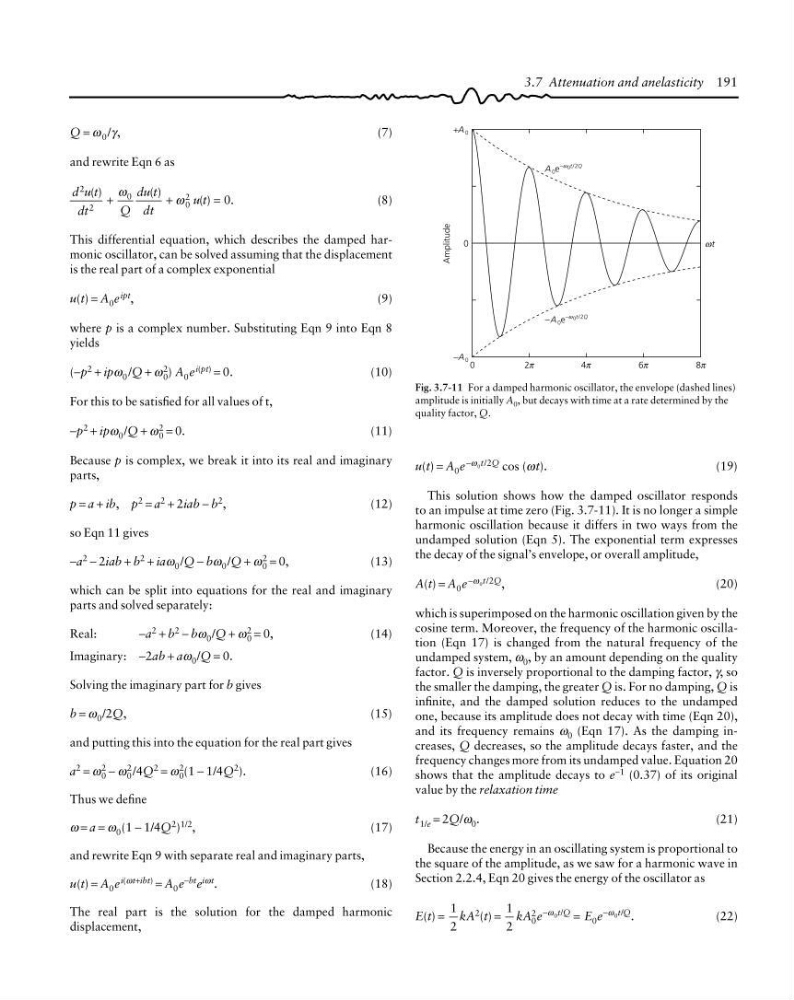
Fig. 3.7-11 For a damped harmonic oscillator, the envelope (dashed lines)
amplitude is initially A 0 , but decays with time at a rate determined by the
quality factor, Q.
u(t) = A 0 e −ω 0 t/2Q cos (ωt).
(19)
This solution shows how the damped oscillator responds
to an impulse at time zero (Fig. 3.7-11). It is no longer a simple
harmonic oscillation because it differs in two ways from the
undamped solution (Eqn 5). The exponential term expresses
the decay of the signal’s envelope, or overall amplitude,
A(t) = A 0 e −ω 0 t/2Q ,
(20)
which is superimposed on the harmonic oscillation given by the
cosine term. Moreover, the frequency of the harmonic oscillation (Eqn 17) is changed from the natural frequency of the
undamped system, ω 0 , by an amount depending on the quality
factor. Q is inversely proportional to the damping factor, γ, so
the smaller the damping, the greater Q is. For no damping, Q is
infinite, and the damped solution reduces to the undamped
one, because its amplitude does not decay with time (Eqn 20),
and its frequency remains ω 0 (Eqn 17). As the damping increases, Q decreases, so the amplitude decays faster, and the
frequency changes more from its undamped value. Equation 20
shows that the amplitude decays to e −1 (0.37) of its original
value by the relaxation time
t 1/e = 2Q/ω 0 .
(21)
Because the energy in an oscillating system is proportional to
the square of the amplitude, as we saw for a harmonic wave in
Section 2.2.4, Eqn 20 gives the energy of the oscillator as
E(t) =
1
2
kA 2 (t) =
1
2
0
2
0
0
0
kA e
E e
t Q
t Q
−
−
=
ω
ω
/
/ .
(22)
(7)
and rewrite Eqn 6 as
d u t
dt
Q
du t
dt
u t
2
2
0
0
2
0
( )
( )
( )
.
+
+
=
ω
ω
(8)
This differential equation, which describes the damped harmonic oscillator, can be solved assuming that the displacement
is the real part of a complex exponential
u(t) = A 0 e ipt ,
(9)
where p is a complex number. Substituting Eqn 9 into Eqn 8
yields
(−p 2 + ipω 0 /Q + ω 2
0 ) A 0 e i(pt) = 0.
(10)
For this to be satisfied for all values of t,
−p 2 + ipω 0 /Q + ω 2
0 = 0.
(11)
Because p is complex, we break it into its real and imaginary
parts,
p = a + ib, p 2 = a 2 + 2iab − b 2 ,
(12)
so Eqn 11 gives
−a 2 − 2iab + b 2 + iaω 0 /Q − bω 0 /Q + ω 2
0 = 0,
(13)
which can be split into equations for the real and imaginary
parts and solved separately:
Real:
−a
2
+ b
2
− bω 0 /Q + ω
2
0 = 0,
(14)
Imaginary: −2ab + aω 0 /Q = 0.
Solving the imaginary part for b gives
b = ω 0 /2Q,
(15)
and putting this into the equation for the real part gives
a 2 = ω 2
0 − ω 2
0 /4Q 2 = ω 2
0 (1 − 1/4Q 2 ).
(16)
Thus we define
ω = a = ω 0 (1 − 1/4Q 2 ) 1/2 ,
(17)
and rewrite Eqn 9 with separate real and imaginary parts,
u(t) = A 0 e i(ωt+ibt) = A 0 e −bt e iωt .
(18)
The real part is the solution for the damped harmonic
displacement,
3.7 Attenuation and anelasticity 191
Amplitude
0
+A 0
2π
4π
6π
8π
t
ω
0
−A 0
A 0 e
− 0t/2Q
ω
−A 0 e
− 0t/2Q
ω
Fig. 3.7-11 For a damped harmonic oscillator, the envelope (dashed lines)
amplitude is initially A 0 , but decays with time at a rate determined by the
quality factor, Q.
u(t) = A 0 e −ω 0 t/2Q cos (ωt).
(19)
This solution shows how the damped oscillator responds
to an impulse at time zero (Fig. 3.7-11). It is no longer a simple
harmonic oscillation because it differs in two ways from the
undamped solution (Eqn 5). The exponential term expresses
the decay of the signal’s envelope, or overall amplitude,
A(t) = A 0 e −ω 0 t/2Q ,
(20)
which is superimposed on the harmonic oscillation given by the
cosine term. Moreover, the frequency of the harmonic oscillation (Eqn 17) is changed from the natural frequency of the
undamped system, ω 0 , by an amount depending on the quality
factor. Q is inversely proportional to the damping factor, γ, so
the smaller the damping, the greater Q is. For no damping, Q is
infinite, and the damped solution reduces to the undamped
one, because its amplitude does not decay with time (Eqn 20),
and its frequency remains ω 0 (Eqn 17). As the damping increases, Q decreases, so the amplitude decays faster, and the
frequency changes more from its undamped value. Equation 20
shows that the amplitude decays to e −1 (0.37) of its original
value by the relaxation time
t 1/e = 2Q/ω 0 .
(21)
Because the energy in an oscillating system is proportional to
the square of the amplitude, as we saw for a harmonic wave in
Section 2.2.4, Eqn 20 gives the energy of the oscillator as
E(t) =
1
2
kA 2 (t) =
1
2
0
2
0
0
0
kA e
E e
t Q
t Q
−
−
=
ω
ω
/
/ .
(22)