

3.7 Attenuation and anelasticity 187
Depth (km)
1
3
5
0
2
4
6
8
−8
0.95
0.55
0.15
–0.25
–0.65
–1.05
–1.45
0.05
0.04
0.03
0.02
0.01
0.00
1/Q
∆V p km/s
−6
−4
−2
0
2
4
6
8
Range (km)
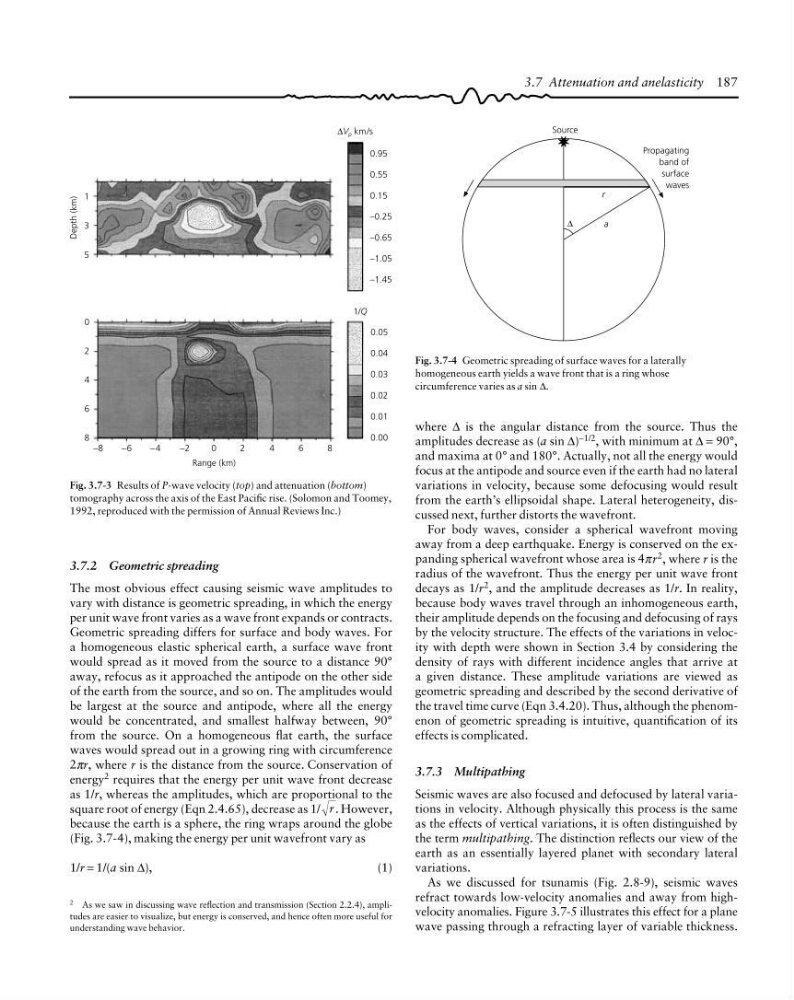
Fig. 3.7-3 Results of P-wave velocity (top) and attenuation (bottom)
tomography across the axis of the East Pacific rise. (Solomon and Toomey,
1992, reproduced with the permission of Annual Reviews Inc.)
2 As we saw in discussing wave reflection and transmission (Section 2.2.4), amplitudes are easier to visualize, but energy is conserved, and hence often more useful for
understanding wave behavior.
Propagating
band of
surface
waves
Source
r
a
∆
Fig. 3.7-4 Geometric spreading of surface waves for a laterally
homogeneous earth yields a wave front that is a ring whose
circumference varies as a sin ∆.
where ∆ is the angular distance from the source. Thus the
amplitudes decrease as (a sin ∆) −1/2 , with minimum at ∆ = 90°,
and maxima at 0° and 180°. Actually, not all the energy would
focus at the antipode and source even if the earth had no lateral
variations in velocity, because some defocusing would result
from the earth’s ellipsoidal shape. Lateral heterogeneity, discussed next, further distorts the wavefront.
For body waves, consider a spherical wavefront moving
away from a deep earthquake. Energy is conserved on the expanding spherical wavefront whose area is 4πr 2 , where r is the
radius of the wavefront. Thus the energy per unit wave front
decays as 1/r 2 , and the amplitude decreases as 1/r. In reality,
because body waves travel through an inhomogeneous earth,
their amplitude depends on the focusing and defocusing of rays
by the velocity structure. The effects of the variations in velocity with depth were shown in Section 3.4 by considering the
density of rays with different incidence angles that arrive at
a given distance. These amplitude variations are viewed as
geometric spreading and described by the second derivative of
the travel time curve (Eqn 3.4.20). Thus, although the phenomenon of geometric spreading is intuitive, quantification of its
effects is complicated.
3.7.3 Multipathing
Seismic waves are also focused and defocused by lateral variations in velocity. Although physically this process is the same
as the effects of vertical variations, it is often distinguished by
the term multipathing. The distinction reflects our view of the
earth as an essentially layered planet with secondary lateral
variations.
As we discussed for tsunamis (Fig. 2.8-9), seismic waves
refract towards low-velocity anomalies and away from highvelocity anomalies. Figure 3.7-5 illustrates this effect for a plane
wave passing through a refracting layer of variable thickness.
3.7.2 Geometric spreading
The most obvious effect causing seismic wave amplitudes to
vary with distance is geometric spreading, in which the energy
per unit wave front varies as a wave front expands or contracts.
Geometric spreading differs for surface and body waves. For
a homogeneous elastic spherical earth, a surface wave front
would spread as it moved from the source to a distance 90°
away, refocus as it approached the antipode on the other side
of the earth from the source, and so on. The amplitudes would
be largest at the source and antipode, where all the energy
would be concentrated, and smallest halfway between, 90°
from the source. On a homogeneous flat earth, the surface
waves would spread out in a growing ring with circumference
2πr, where r is the distance from the source. Conservation of
energy 2 requires that the energy per unit wave front decrease
as 1/r, whereas the amplitudes, which are proportional to the
square root of energy (Eqn 2.4.65), decrease as 1/ r . However,
because the earth is a sphere, the ring wraps around the globe
(Fig. 3.7-4), making the energy per unit wavefront vary as
1/r = 1/(a sin ∆),
(1)
Depth (km)
1
3
5
0
2
4
6
8
−8
0.95
0.55
0.15
–0.25
–0.65
–1.05
–1.45
0.05
0.04
0.03
0.02
0.01
0.00
1/Q
∆V p km/s
−6
−4
−2
0
2
4
6
8
Range (km)
Fig. 3.7-3 Results of P-wave velocity (top) and attenuation (bottom)
tomography across the axis of the East Pacific rise. (Solomon and Toomey,
1992, reproduced with the permission of Annual Reviews Inc.)
2 As we saw in discussing wave reflection and transmission (Section 2.2.4), amplitudes are easier to visualize, but energy is conserved, and hence often more useful for
understanding wave behavior.
Propagating
band of
surface
waves
Source
r
a
∆
Fig. 3.7-4 Geometric spreading of surface waves for a laterally
homogeneous earth yields a wave front that is a ring whose
circumference varies as a sin ∆.
where ∆ is the angular distance from the source. Thus the
amplitudes decrease as (a sin ∆) −1/2 , with minimum at ∆ = 90°,
and maxima at 0° and 180°. Actually, not all the energy would
focus at the antipode and source even if the earth had no lateral
variations in velocity, because some defocusing would result
from the earth’s ellipsoidal shape. Lateral heterogeneity, discussed next, further distorts the wavefront.
For body waves, consider a spherical wavefront moving
away from a deep earthquake. Energy is conserved on the expanding spherical wavefront whose area is 4πr 2 , where r is the
radius of the wavefront. Thus the energy per unit wave front
decays as 1/r 2 , and the amplitude decreases as 1/r. In reality,
because body waves travel through an inhomogeneous earth,
their amplitude depends on the focusing and defocusing of rays
by the velocity structure. The effects of the variations in velocity with depth were shown in Section 3.4 by considering the
density of rays with different incidence angles that arrive at
a given distance. These amplitude variations are viewed as
geometric spreading and described by the second derivative of
the travel time curve (Eqn 3.4.20). Thus, although the phenomenon of geometric spreading is intuitive, quantification of its
effects is complicated.
3.7.3 Multipathing
Seismic waves are also focused and defocused by lateral variations in velocity. Although physically this process is the same
as the effects of vertical variations, it is often distinguished by
the term multipathing. The distinction reflects our view of the
earth as an essentially layered planet with secondary lateral
variations.
As we discussed for tsunamis (Fig. 2.8-9), seismic waves
refract towards low-velocity anomalies and away from highvelocity anomalies. Figure 3.7-5 illustrates this effect for a plane
wave passing through a refracting layer of variable thickness.
3.7.2 Geometric spreading
The most obvious effect causing seismic wave amplitudes to
vary with distance is geometric spreading, in which the energy
per unit wave front varies as a wave front expands or contracts.
Geometric spreading differs for surface and body waves. For
a homogeneous elastic spherical earth, a surface wave front
would spread as it moved from the source to a distance 90°
away, refocus as it approached the antipode on the other side
of the earth from the source, and so on. The amplitudes would
be largest at the source and antipode, where all the energy
would be concentrated, and smallest halfway between, 90°
from the source. On a homogeneous flat earth, the surface
waves would spread out in a growing ring with circumference
2πr, where r is the distance from the source. Conservation of
energy 2 requires that the energy per unit wave front decrease
as 1/r, whereas the amplitudes, which are proportional to the
square root of energy (Eqn 2.4.65), decrease as 1/ r . However,
because the earth is a sphere, the ring wraps around the globe
(Fig. 3.7-4), making the energy per unit wavefront vary as
1/r = 1/(a sin ∆),
(1)