

186 Seismology and Earth Structure
MNV
(Mina, NV)
MM18
(St Louis, MO)
50 s
P
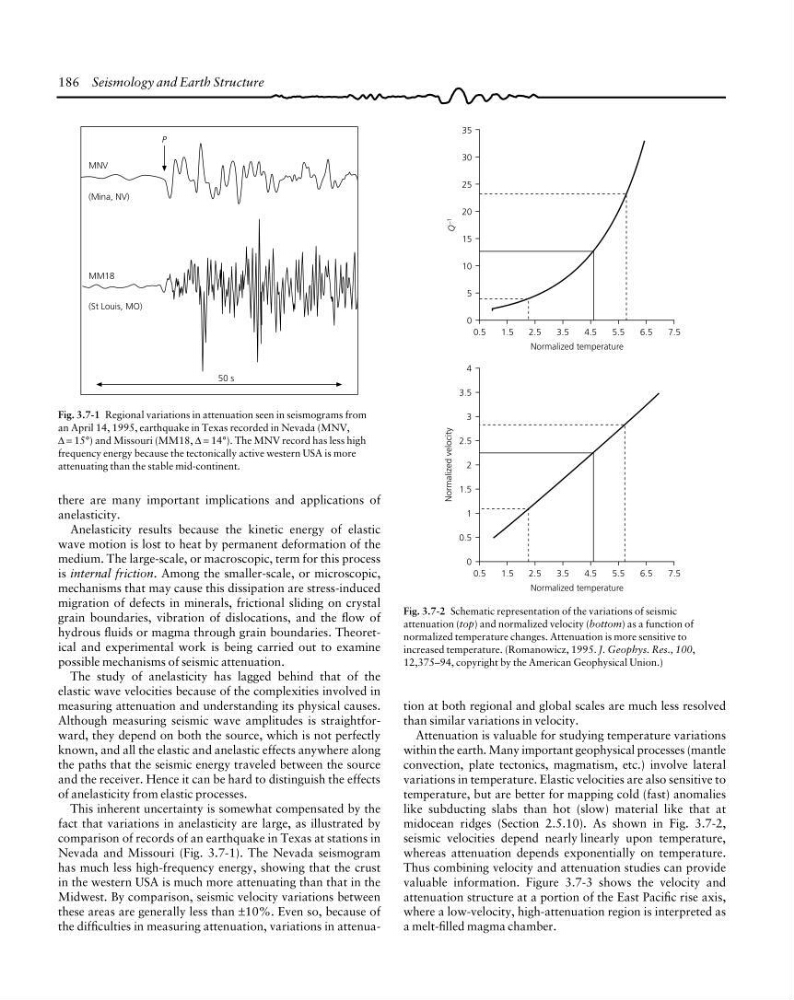
Fig. 3.7-1 Regional variations in attenuation seen in seismograms from
an April 14, 1995, earthquake in Texas recorded in Nevada (MNV,
∆ = 15°) and Missouri (MM18, ∆ = 14°). The MNV record has less high
frequency energy because the tectonically active western USA is more
attenuating than the stable mid-continent.
Fig. 3.7-2 Schematic representation of the variations of seismic
attenuation (top) and normalized velocity (bottom) as a function of
normalized temperature changes. Attenuation is more sensitive to
increased temperature. (Romanowicz, 1995. J. Geophys. Res., 100,
12,375–94, copyright by the American Geophysical Union.)
there are many important implications and applications of
anelasticity.
Anelasticity results because the kinetic energy of elastic
wave motion is lost to heat by permanent deformation of the
medium. The large-scale, or macroscopic, term for this process
is internal friction. Among the smaller-scale, or microscopic,
mechanisms that may cause this dissipation are stress-induced
migration of defects in minerals, frictional sliding on crystal
grain boundaries, vibration of dislocations, and the flow of
hydrous fluids or magma through grain boundaries. Theoretical and experimental work is being carried out to examine
possible mechanisms of seismic attenuation.
The study of anelasticity has lagged behind that of the
elastic wave velocities because of the complexities involved in
measuring attenuation and understanding its physical causes.
Although measuring seismic wave amplitudes is straightforward, they depend on both the source, which is not perfectly
known, and all the elastic and anelastic effects anywhere along
the paths that the seismic energy traveled between the source
and the receiver. Hence it can be hard to distinguish the effects
of anelasticity from elastic processes.
This inherent uncertainty is somewhat compensated by the
fact that variations in anelasticity are large, as illustrated by
comparison of records of an earthquake in Texas at stations in
Nevada and Missouri (Fig. 3.7-1). The Nevada seismogram
has much less high-frequency energy, showing that the crust
in the western USA is much more attenuating than that in the
Midwest. By comparison, seismic velocity variations between
these areas are generally less than ±10%. Even so, because of
the difficulties in measuring attenuation, variations in attenua0.5
35
30
25
20
15
10
5
0
Normalized temperature
Normalized velocity
Q
–1
4
3.5
3
2.5
2
1.5
1
0.5
0
1.5
2.5
3.5
4.5
5.5
6.5
7.5
0.5
Normalized temperature
1.5
2.5
3.5
4.5
5.5
6.5
7.5
tion at both regional and global scales are much less resolved
than similar variations in velocity.
Attenuation is valuable for studying temperature variations
within the earth. Many important geophysical processes (mantle
convection, plate tectonics, magmatism, etc.) involve lateral
variations in temperature. Elastic velocities are also sensitive to
temperature, but are better for mapping cold (fast) anomalies
like subducting slabs than hot (slow) material like that at
midocean ridges (Section 2.5.10). As shown in Fig. 3.7-2,
seismic velocities depend nearly linearly upon temperature,
whereas attenuation depends exponentially on temperature.
Thus combining velocity and attenuation studies can provide
valuable information. Figure 3.7-3 shows the velocity and
attenuation structure at a portion of the East Pacific rise axis,
where a low-velocity, high-attenuation region is interpreted as
a melt-filled magma chamber.
MNV
(Mina, NV)
MM18
(St Louis, MO)
50 s
P
Fig. 3.7-1 Regional variations in attenuation seen in seismograms from
an April 14, 1995, earthquake in Texas recorded in Nevada (MNV,
∆ = 15°) and Missouri (MM18, ∆ = 14°). The MNV record has less high
frequency energy because the tectonically active western USA is more
attenuating than the stable mid-continent.
Fig. 3.7-2 Schematic representation of the variations of seismic
attenuation (top) and normalized velocity (bottom) as a function of
normalized temperature changes. Attenuation is more sensitive to
increased temperature. (Romanowicz, 1995. J. Geophys. Res., 100,
12,375–94, copyright by the American Geophysical Union.)
there are many important implications and applications of
anelasticity.
Anelasticity results because the kinetic energy of elastic
wave motion is lost to heat by permanent deformation of the
medium. The large-scale, or macroscopic, term for this process
is internal friction. Among the smaller-scale, or microscopic,
mechanisms that may cause this dissipation are stress-induced
migration of defects in minerals, frictional sliding on crystal
grain boundaries, vibration of dislocations, and the flow of
hydrous fluids or magma through grain boundaries. Theoretical and experimental work is being carried out to examine
possible mechanisms of seismic attenuation.
The study of anelasticity has lagged behind that of the
elastic wave velocities because of the complexities involved in
measuring attenuation and understanding its physical causes.
Although measuring seismic wave amplitudes is straightforward, they depend on both the source, which is not perfectly
known, and all the elastic and anelastic effects anywhere along
the paths that the seismic energy traveled between the source
and the receiver. Hence it can be hard to distinguish the effects
of anelasticity from elastic processes.
This inherent uncertainty is somewhat compensated by the
fact that variations in anelasticity are large, as illustrated by
comparison of records of an earthquake in Texas at stations in
Nevada and Missouri (Fig. 3.7-1). The Nevada seismogram
has much less high-frequency energy, showing that the crust
in the western USA is much more attenuating than that in the
Midwest. By comparison, seismic velocity variations between
these areas are generally less than ±10%. Even so, because of
the difficulties in measuring attenuation, variations in attenua0.5
35
30
25
20
15
10
5
0
Normalized temperature
Normalized velocity
Q
–1
4
3.5
3
2.5
2
1.5
1
0.5
0
1.5
2.5
3.5
4.5
5.5
6.5
7.5
0.5
Normalized temperature
1.5
2.5
3.5
4.5
5.5
6.5
7.5
tion at both regional and global scales are much less resolved
than similar variations in velocity.
Attenuation is valuable for studying temperature variations
within the earth. Many important geophysical processes (mantle
convection, plate tectonics, magmatism, etc.) involve lateral
variations in temperature. Elastic velocities are also sensitive to
temperature, but are better for mapping cold (fast) anomalies
like subducting slabs than hot (slow) material like that at
midocean ridges (Section 2.5.10). As shown in Fig. 3.7-2,
seismic velocities depend nearly linearly upon temperature,
whereas attenuation depends exponentially on temperature.
Thus combining velocity and attenuation studies can provide
valuable information. Figure 3.7-3 shows the velocity and
attenuation structure at a portion of the East Pacific rise axis,
where a low-velocity, high-attenuation region is interpreted as
a melt-filled magma chamber.