

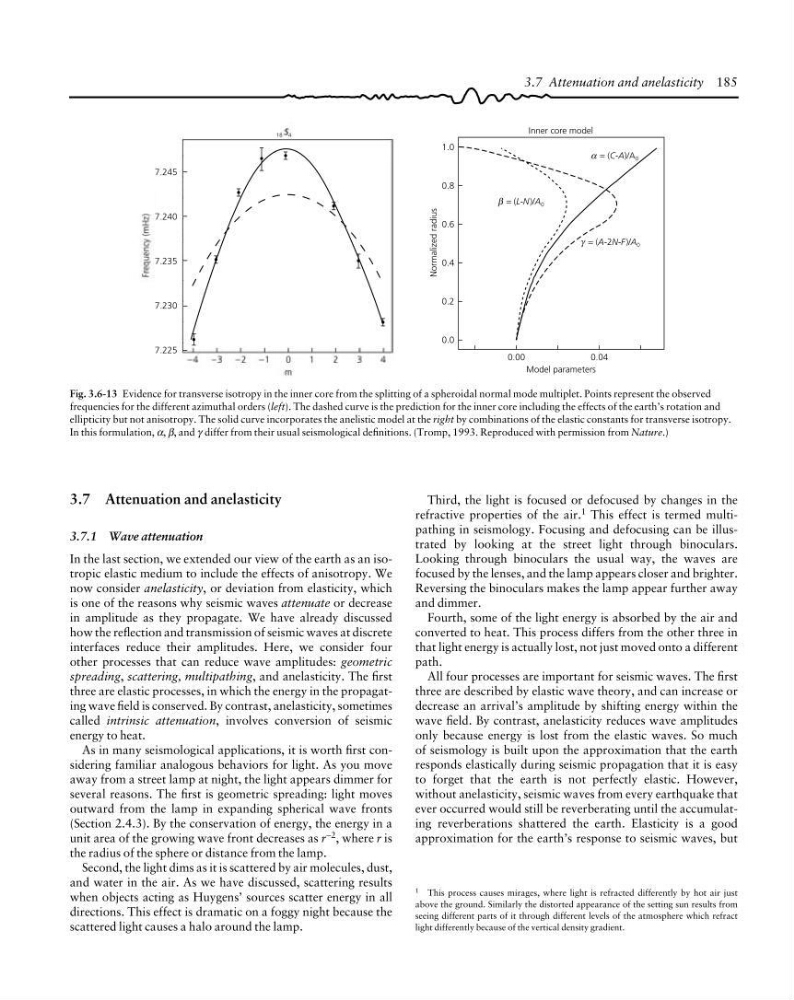
Fig. 3.6-13 Evidence for transverse isotropy in the inner core from the splitting of a spheroidal normal mode multiplet. Points represent the observed
frequencies for the different azimuthal orders (left). The dashed curve is the prediction for the inner core including the effects of the earth’s rotation and
ellipticity but not anisotropy. The solid curve incorporates the anelistic model at the right by combinations of the elastic constants for transverse isotropy.
In this formulation, α, β, and γ differ from their usual seismological definitions. (Tromp, 1993. Reproduced with permission from Nature.)
1 This process causes mirages, where light is refracted differently by hot air just
above the ground. Similarly the distorted appearance of the setting sun results from
seeing different parts of it through different levels of the atmosphere which refract
light differently because of the vertical density gradient.
3.7 Attenuation and anelasticity
3.7.1 Wave attenuation
In the last section, we extended our view of the earth as an isotropic elastic medium to include the effects of anisotropy. We
now consider anelasticity, or deviation from elasticity, which
is one of the reasons why seismic waves attenuate or decrease
in amplitude as they propagate. We have already discussed
how the reflection and transmission of seismic waves at discrete
interfaces reduce their amplitudes. Here, we consider four
other processes that can reduce wave amplitudes: geometric
spreading, scattering, multipathing, and anelasticity. The first
three are elastic processes, in which the energy in the propagating wave field is conserved. By contrast, anelasticity, sometimes
called intrinsic attenuation, involves conversion of seismic
energy to heat.
As in many seismological applications, it is worth first considering familiar analogous behaviors for light. As you move
away from a street lamp at night, the light appears dimmer for
several reasons. The first is geometric spreading: light moves
outward from the lamp in expanding spherical wave fronts
(Section 2.4.3). By the conservation of energy, the energy in a
unit area of the growing wave front decreases as r −2 , where r is
the radius of the sphere or distance from the lamp.
Second, the light dims as it is scattered by air molecules, dust,
and water in the air. As we have discussed, scattering results
when objects acting as Huygens’ sources scatter energy in all
directions. This effect is dramatic on a foggy night because the
scattered light causes a halo around the lamp.
Third, the light is focused or defocused by changes in the
refractive properties of the air. 1 This effect is termed multipathing in seismology. Focusing and defocusing can be illustrated by looking at the street light through binoculars.
Looking through binoculars the usual way, the waves are
focused by the lenses, and the lamp appears closer and brighter.
Reversing the binoculars makes the lamp appear further away
and dimmer.
Fourth, some of the light energy is absorbed by the air and
converted to heat. This process differs from the other three in
that light energy is actually lost, not just moved onto a different
path.
All four processes are important for seismic waves. The first
three are described by elastic wave theory, and can increase or
decrease an arrival’s amplitude by shifting energy within the
wave field. By contrast, anelasticity reduces wave amplitudes
only because energy is lost from the elastic waves. So much
of seismology is built upon the approximation that the earth
responds elastically during seismic propagation that it is easy
to forget that the earth is not perfectly elastic. However,
without anelasticity, seismic waves from every earthquake that
ever occurred would still be reverberating until the accumulating reverberations shattered the earth. Elasticity is a good
approximation for the earth’s response to seismic waves, but
3.7 Attenuation and anelasticity 185
Normalized radius
1.0
0.8
0.6
0.4
0.2
0.0
0.00
0.04
Model parameters
Inner core model
= (L-N)/A 0
β
= (A-2N-F )/A 0
γ
= (C-A)/A 0
α
7.245
7.240
7.235
7.230
7.225
4
18
frequencies for the different azimuthal orders (left). The dashed curve is the prediction for the inner core including the effects of the earth’s rotation and
ellipticity but not anisotropy. The solid curve incorporates the anelistic model at the right by combinations of the elastic constants for transverse isotropy.
In this formulation, α, β, and γ differ from their usual seismological definitions. (Tromp, 1993. Reproduced with permission from Nature.)
1 This process causes mirages, where light is refracted differently by hot air just
above the ground. Similarly the distorted appearance of the setting sun results from
seeing different parts of it through different levels of the atmosphere which refract
light differently because of the vertical density gradient.
3.7 Attenuation and anelasticity
3.7.1 Wave attenuation
In the last section, we extended our view of the earth as an isotropic elastic medium to include the effects of anisotropy. We
now consider anelasticity, or deviation from elasticity, which
is one of the reasons why seismic waves attenuate or decrease
in amplitude as they propagate. We have already discussed
how the reflection and transmission of seismic waves at discrete
interfaces reduce their amplitudes. Here, we consider four
other processes that can reduce wave amplitudes: geometric
spreading, scattering, multipathing, and anelasticity. The first
three are elastic processes, in which the energy in the propagating wave field is conserved. By contrast, anelasticity, sometimes
called intrinsic attenuation, involves conversion of seismic
energy to heat.
As in many seismological applications, it is worth first considering familiar analogous behaviors for light. As you move
away from a street lamp at night, the light appears dimmer for
several reasons. The first is geometric spreading: light moves
outward from the lamp in expanding spherical wave fronts
(Section 2.4.3). By the conservation of energy, the energy in a
unit area of the growing wave front decreases as r −2 , where r is
the radius of the sphere or distance from the lamp.
Second, the light dims as it is scattered by air molecules, dust,
and water in the air. As we have discussed, scattering results
when objects acting as Huygens’ sources scatter energy in all
directions. This effect is dramatic on a foggy night because the
scattered light causes a halo around the lamp.
Third, the light is focused or defocused by changes in the
refractive properties of the air. 1 This effect is termed multipathing in seismology. Focusing and defocusing can be illustrated by looking at the street light through binoculars.
Looking through binoculars the usual way, the waves are
focused by the lenses, and the lamp appears closer and brighter.
Reversing the binoculars makes the lamp appear further away
and dimmer.
Fourth, some of the light energy is absorbed by the air and
converted to heat. This process differs from the other three in
that light energy is actually lost, not just moved onto a different
path.
All four processes are important for seismic waves. The first
three are described by elastic wave theory, and can increase or
decrease an arrival’s amplitude by shifting energy within the
wave field. By contrast, anelasticity reduces wave amplitudes
only because energy is lost from the elastic waves. So much
of seismology is built upon the approximation that the earth
responds elastically during seismic propagation that it is easy
to forget that the earth is not perfectly elastic. However,
without anelasticity, seismic waves from every earthquake that
ever occurred would still be reverberating until the accumulating reverberations shattered the earth. Elasticity is a good
approximation for the earth’s response to seismic waves, but
3.7 Attenuation and anelasticity 185
Normalized radius
1.0
0.8
0.6
0.4
0.2
0.0
0.00
0.04
Model parameters
Inner core model
= (L-N)/A 0
β
= (A-2N-F )/A 0
γ
= (C-A)/A 0
α
7.245
7.240
7.235
7.230
7.225
4
18