

By contrast, for P and S waves propagating in the x 3 (axis of
symmetry) direction (Fig. 3.6-2, bottom), both S velocities
equal S 2 in Eqn 6. The P velocity reflects the fact that C corresponds to λ + 2µ for the x 3 direction, so
P 2 = (C/ρ) 1/2 .
(7)
For layered materials, typically P 1 > P 2 , so P waves propagate
faster in the x 1 direction than in the x 3 direction. This is because
the wave travels preferentially in the fast layers in the x 1 direction, whereas a P wave traveling in the x 3 direction must also
traverse the slow layers.
Transverse isotropy is often characterized by three
parameters:
ξ = N/L = (S 1 /S 2 ) 2 , φ = C/A = (P 2 /P 1 ) 2 , η = F/(A − 2L). (8)
If the material were isotropic, ξ = φ = η = 1. For layered structures, generally ξ > 1 and φ < 1.
A second common type of anisotropy is azimuthal
anisotropy, in which velocities vary as a function of horizontal
direction. One way to obtain this is to have transverse isotropy
with the x 3 axis turned to horizontal, which is analogous to
standing plywood vertically. In general, the P-wave velocity
varies with azimuth as
P(θ) = A 1 + A 2 cos 2θ + A 3 sin 2θ + A 4 cos 4θ + A 5 sin 4θ, (9)
where the constants A i depend on the 21 elastic constants.
3.6.3 Anisotropy of minerals and rocks
An important source of seismic anisotropy is minerals that are
anisotropic due to their crystal structure. At microscopic levels
the anisotropy can be enormous, with velocities along different
mineralogical axes varying by more than 100%. Generally,
however, the anisotropic mineral grains are randomly oriented,
so seismic waves have wavelengths long enough to average out
the anisotropic effects, leaving only weak anisotropy. However,
in some cases the mineral grains are aligned, causing significant
anisotropy.
Laboratory studies of the elastic moduli of minerals give
insight into such LPO anisotropy. Some studies involve static
methods like twisting or squeezing samples, but most use the
vibrational properties of mineral samples as small as 1 mm. At
very high pressures, a technique called Brillouin scattering,
which measures how laser light passing through the mineral is
distorted, yields elastic constants for samples smaller than
0.1 mm.
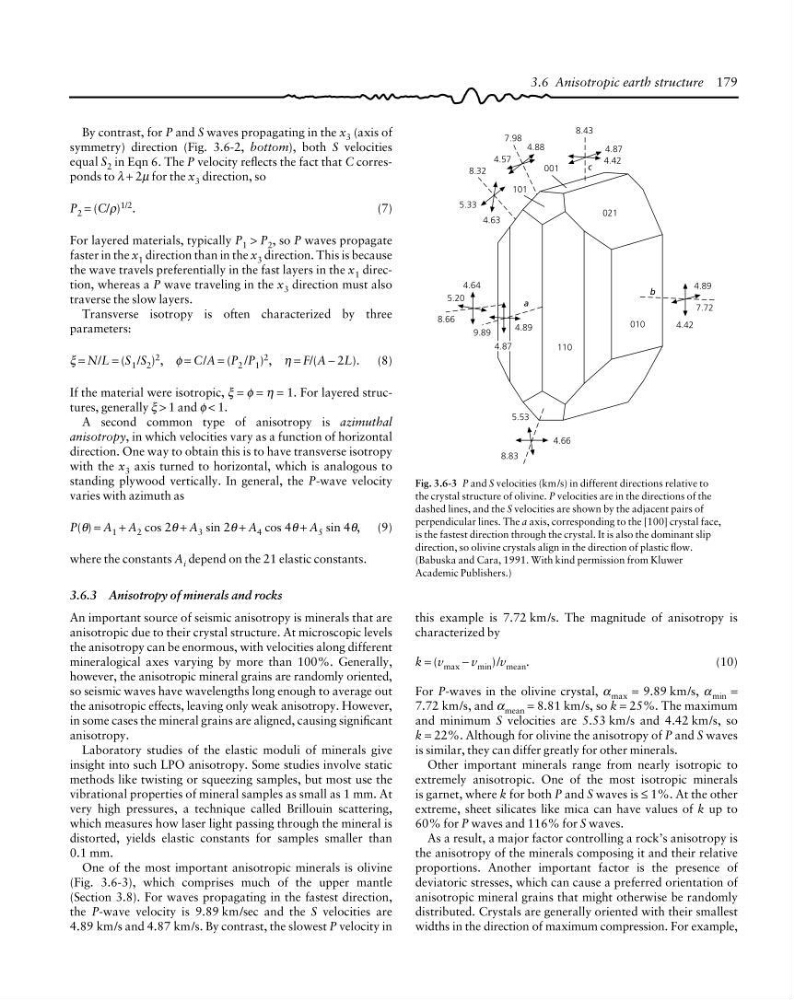
One of the most important anisotropic minerals is olivine
(Fig. 3.6-3), which comprises much of the upper mantle
(Section 3.8). For waves propagating in the fastest direction,
the P-wave velocity is 9.89 km/sec and the S velocities are
4.89 km/s and 4.87 km/s. By contrast, the slowest P velocity in
3.6 Anisotropic earth structure 179
7.98
8.43
4.88
4.87
4.42
021
010
110
001
4.57
101
8.32
5.33
4.63
4.64
4.89
9.89
8.66
4.42
5.20
7.72
5.53
4.66
8.83
4.89
b
a
c
4.87
Fig. 3.6-3 P and S velocities (km /s) in different directions relative to
the crystal structure of olivine. P velocities are in the directions of the
dashed lines, and the S velocities are shown by the adjacent pairs of
perpendicular lines. The a axis, corresponding to the [100] crystal face,
is the fastest direction through the crystal. It is also the dominant slip
direction, so olivine crystals align in the direction of plastic flow.
(Babuska and Cara, 1991. With kind permission from Kluwer
Academic Publishers.)
this example is 7.72 km/s. The magnitude of anisotropy is
characterized by
k = (v max − v min )/v mean .
(10)
For P-waves in the olivine crystal, α max = 9.89 km/s, α min =
7.72 km/s, and α mean = 8.81 km/s, so k = 25%. The maximum
and minimum S velocities are 5.53 km/s and 4.42 km/s, so
k = 22%. Although for olivine the anisotropy of P and S waves
is similar, they can differ greatly for other minerals.
Other important minerals range from nearly isotropic to
extremely anisotropic. One of the most isotropic minerals
is garnet, where k for both P and S waves is ≤ 1%. At the other
extreme, sheet silicates like mica can have values of k up to
60% for P waves and 116% for S waves.
As a result, a major factor controlling a rock’s anisotropy is
the anisotropy of the minerals composing it and their relative
proportions. Another important factor is the presence of
deviatoric stresses, which can cause a preferred orientation of
anisotropic mineral grains that might otherwise be randomly
distributed. Crystals are generally oriented with their smallest
widths in the direction of maximum compression. For example,
symmetry) direction (Fig. 3.6-2, bottom), both S velocities
equal S 2 in Eqn 6. The P velocity reflects the fact that C corresponds to λ + 2µ for the x 3 direction, so
P 2 = (C/ρ) 1/2 .
(7)
For layered materials, typically P 1 > P 2 , so P waves propagate
faster in the x 1 direction than in the x 3 direction. This is because
the wave travels preferentially in the fast layers in the x 1 direction, whereas a P wave traveling in the x 3 direction must also
traverse the slow layers.
Transverse isotropy is often characterized by three
parameters:
ξ = N/L = (S 1 /S 2 ) 2 , φ = C/A = (P 2 /P 1 ) 2 , η = F/(A − 2L). (8)
If the material were isotropic, ξ = φ = η = 1. For layered structures, generally ξ > 1 and φ < 1.
A second common type of anisotropy is azimuthal
anisotropy, in which velocities vary as a function of horizontal
direction. One way to obtain this is to have transverse isotropy
with the x 3 axis turned to horizontal, which is analogous to
standing plywood vertically. In general, the P-wave velocity
varies with azimuth as
P(θ) = A 1 + A 2 cos 2θ + A 3 sin 2θ + A 4 cos 4θ + A 5 sin 4θ, (9)
where the constants A i depend on the 21 elastic constants.
3.6.3 Anisotropy of minerals and rocks
An important source of seismic anisotropy is minerals that are
anisotropic due to their crystal structure. At microscopic levels
the anisotropy can be enormous, with velocities along different
mineralogical axes varying by more than 100%. Generally,
however, the anisotropic mineral grains are randomly oriented,
so seismic waves have wavelengths long enough to average out
the anisotropic effects, leaving only weak anisotropy. However,
in some cases the mineral grains are aligned, causing significant
anisotropy.
Laboratory studies of the elastic moduli of minerals give
insight into such LPO anisotropy. Some studies involve static
methods like twisting or squeezing samples, but most use the
vibrational properties of mineral samples as small as 1 mm. At
very high pressures, a technique called Brillouin scattering,
which measures how laser light passing through the mineral is
distorted, yields elastic constants for samples smaller than
0.1 mm.
One of the most important anisotropic minerals is olivine
(Fig. 3.6-3), which comprises much of the upper mantle
(Section 3.8). For waves propagating in the fastest direction,
the P-wave velocity is 9.89 km/sec and the S velocities are
4.89 km/s and 4.87 km/s. By contrast, the slowest P velocity in
3.6 Anisotropic earth structure 179
7.98
8.43
4.88
4.87
4.42
021
010
110
001
4.57
101
8.32
5.33
4.63
4.64
4.89
9.89
8.66
4.42
5.20
7.72
5.53
4.66
8.83
4.89
b
a
c
4.87
Fig. 3.6-3 P and S velocities (km /s) in different directions relative to
the crystal structure of olivine. P velocities are in the directions of the
dashed lines, and the S velocities are shown by the adjacent pairs of
perpendicular lines. The a axis, corresponding to the [100] crystal face,
is the fastest direction through the crystal. It is also the dominant slip
direction, so olivine crystals align in the direction of plastic flow.
(Babuska and Cara, 1991. With kind permission from Kluwer
Academic Publishers.)
this example is 7.72 km/s. The magnitude of anisotropy is
characterized by
k = (v max − v min )/v mean .
(10)
For P-waves in the olivine crystal, α max = 9.89 km/s, α min =
7.72 km/s, and α mean = 8.81 km/s, so k = 25%. The maximum
and minimum S velocities are 5.53 km/s and 4.42 km/s, so
k = 22%. Although for olivine the anisotropy of P and S waves
is similar, they can differ greatly for other minerals.
Other important minerals range from nearly isotropic to
extremely anisotropic. One of the most isotropic minerals
is garnet, where k for both P and S waves is ≤ 1%. At the other
extreme, sheet silicates like mica can have values of k up to
60% for P waves and 116% for S waves.
As a result, a major factor controlling a rock’s anisotropy is
the anisotropy of the minerals composing it and their relative
proportions. Another important factor is the presence of
deviatoric stresses, which can cause a preferred orientation of
anisotropic mineral grains that might otherwise be randomly
distributed. Crystals are generally oriented with their smallest
widths in the direction of maximum compression. For example,