

164 Seismology and Earth Structure
Time (min)
180
IASP91: 0 km source
IASP91: 600 km source
Delta (°)
Delta (°)
40
30
20
10
40
30
20
10
SKKP
PKKP
SS
SKiKP
SP
ScS
ScP
PcP
P
P diff
PP
PKP
PKiKP
S
SKP
SKS
SKKS
P
PcP
P diff
ScP
PKP
pP
sP
PcS
PP
ScS
S
pPKP
PKiKP
SKP
sS
S
d if f
S P
SKS
pSKS
SKKS
sSKS
SS
PKKP
PKKS
SKKP
P′P′
Time (min)
S
d if f
20 40 60 80 100 120 140 160
20 40 60 80 100 120 140 160 180
PKS
P′P′
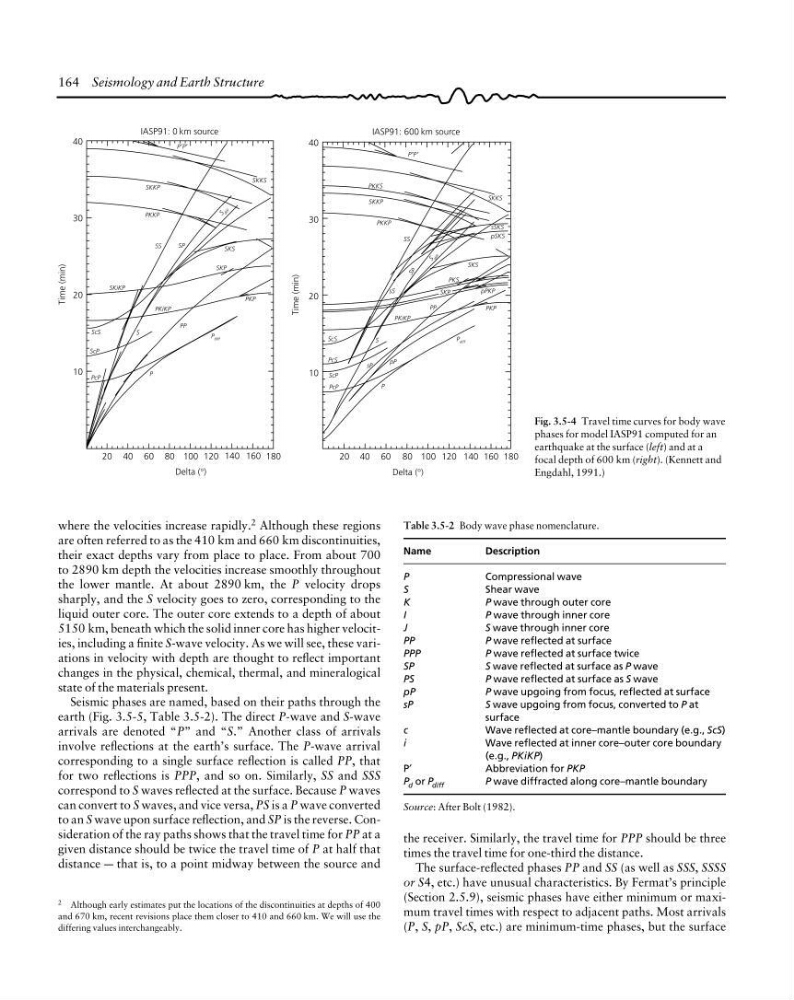
Fig. 3.5-4 Travel time curves for body wave
phases for model IASP91 computed for an
earthquake at the surface (left) and at a
focal depth of 600 km (right). (Kennett and
Engdahl, 1991.)
2 Although early estimates put the locations of the discontinuities at depths of 400
and 670 km, recent revisions place them closer to 410 and 660 km. We will use the
differing values interchangeably.
where the velocities increase rapidly.
2 Although these regions
are often referred to as the 410 km and 660 km discontinuities,
their exact depths vary from place to place. From about 700
to 2890 km depth the velocities increase smoothly throughout
the lower mantle. At about 2890 km, the P velocity drops
sharply, and the S velocity goes to zero, corresponding to the
liquid outer core. The outer core extends to a depth of about
5150 km, beneath which the solid inner core has higher velocities, including a finite S-wave velocity. As we will see, these variations in velocity with depth are thought to reflect important
changes in the physical, chemical, thermal, and mineralogical
state of the materials present.
Seismic phases are named, based on their paths through the
earth (Fig. 3.5-5, Table 3.5-2). The direct P-wave and S-wave
arrivals are denoted “P” and “S.” Another class of arrivals
involve reflections at the earth’s surface. The P-wave arrival
corresponding to a single surface reflection is called PP, that
for two reflections is PPP, and so on. Similarly, SS and SSS
correspond to S waves reflected at the surface. Because P waves
can convert to S waves, and vice versa, PS is a P wave converted
to an S wave upon surface reflection, and SP is the reverse. Consideration of the ray paths shows that the travel time for PP at a
given distance should be twice the travel time of P at half that
distance — that is, to a point midway between the source and
Table 3.5-2 Body wave phase nomenclature.
Name
Description
P
Compressional wave
S
Shear wave
K
P wave through outer core
I
P wave through inner core
J
S wave through inner core
PP
P wave reflected at surface
PPP
P wave reflected at surface twice
SP
S wave reflected at surface as P wave
PS
P wave reflected at surface as S wave
pP
P wave upgoing from focus, reflected at surface
sP
S wave upgoing from focus, converted to P at
surface
c
Wave reflected at core–mantle boundary (e.g., ScS)
i
Wave reflected at inner core–outer core boundary
(e.g., PKiKP)
P′
Abbreviation for PKP
P d or P diff
P wave diffracted along core–mantle boundary
Source: After Bolt (1982).
the receiver. Similarly, the travel time for PPP should be three
times the travel time for one-third the distance.
The surface-reflected phases PP and SS (as well as SSS, SSSS
or S4, etc.) have unusual characteristics. By Fermat’s principle
(Section 2.5.9), seismic phases have either minimum or maximum travel times with respect to adjacent paths. Most arrivals
(P, S, pP, ScS, etc.) are minimum-time phases, but the surface
Time (min)
180
IASP91: 0 km source
IASP91: 600 km source
Delta (°)
Delta (°)
40
30
20
10
40
30
20
10
SKKP
PKKP
SS
SKiKP
SP
ScS
ScP
PcP
P
P diff
PP
PKP
PKiKP
S
SKP
SKS
SKKS
P
PcP
P diff
ScP
PKP
pP
sP
PcS
PP
ScS
S
pPKP
PKiKP
SKP
sS
S
d if f
S P
SKS
pSKS
SKKS
sSKS
SS
PKKP
PKKS
SKKP
P′P′
Time (min)
S
d if f
20 40 60 80 100 120 140 160
20 40 60 80 100 120 140 160 180
PKS
P′P′
Fig. 3.5-4 Travel time curves for body wave
phases for model IASP91 computed for an
earthquake at the surface (left) and at a
focal depth of 600 km (right). (Kennett and
Engdahl, 1991.)
2 Although early estimates put the locations of the discontinuities at depths of 400
and 670 km, recent revisions place them closer to 410 and 660 km. We will use the
differing values interchangeably.
where the velocities increase rapidly.
2 Although these regions
are often referred to as the 410 km and 660 km discontinuities,
their exact depths vary from place to place. From about 700
to 2890 km depth the velocities increase smoothly throughout
the lower mantle. At about 2890 km, the P velocity drops
sharply, and the S velocity goes to zero, corresponding to the
liquid outer core. The outer core extends to a depth of about
5150 km, beneath which the solid inner core has higher velocities, including a finite S-wave velocity. As we will see, these variations in velocity with depth are thought to reflect important
changes in the physical, chemical, thermal, and mineralogical
state of the materials present.
Seismic phases are named, based on their paths through the
earth (Fig. 3.5-5, Table 3.5-2). The direct P-wave and S-wave
arrivals are denoted “P” and “S.” Another class of arrivals
involve reflections at the earth’s surface. The P-wave arrival
corresponding to a single surface reflection is called PP, that
for two reflections is PPP, and so on. Similarly, SS and SSS
correspond to S waves reflected at the surface. Because P waves
can convert to S waves, and vice versa, PS is a P wave converted
to an S wave upon surface reflection, and SP is the reverse. Consideration of the ray paths shows that the travel time for PP at a
given distance should be twice the travel time of P at half that
distance — that is, to a point midway between the source and
Table 3.5-2 Body wave phase nomenclature.
Name
Description
P
Compressional wave
S
Shear wave
K
P wave through outer core
I
P wave through inner core
J
S wave through inner core
PP
P wave reflected at surface
PPP
P wave reflected at surface twice
SP
S wave reflected at surface as P wave
PS
P wave reflected at surface as S wave
pP
P wave upgoing from focus, reflected at surface
sP
S wave upgoing from focus, converted to P at
surface
c
Wave reflected at core–mantle boundary (e.g., ScS)
i
Wave reflected at inner core–outer core boundary
(e.g., PKiKP)
P′
Abbreviation for PKP
P d or P diff
P wave diffracted along core–mantle boundary
Source: After Bolt (1982).
the receiver. Similarly, the travel time for PPP should be three
times the travel time for one-third the distance.
The surface-reflected phases PP and SS (as well as SSS, SSSS
or S4, etc.) have unusual characteristics. By Fermat’s principle
(Section 2.5.9), seismic phases have either minimum or maximum travel times with respect to adjacent paths. Most arrivals
(P, S, pP, ScS, etc.) are minimum-time phases, but the surface