

Solid
inner
core
SKKS
SS
Solid mantle
PKJKP
SKPPKP
SKKP
pPcPSKKP
S rays
P rays
SSS
PKIKP
PPP
PPS
SP
PP
pPcP
S
P
P
S
P
ScS
pP
sP
SKS
SKP
sPS
Fluid outer core
Elliptical earth:
— This path is same
length as PP
— All reflected
energy arrives
at same time
Spherical earth:
— This path is shorter than PP
— PP is a “maximum time” phase
Distance = ∆/2
ε
PP
Distance
= ∆
Station
Mantle
Core
Flat earth:
— This path is longer than PP
— PP is a “minimum time” phase
Earthquake
PP
Station
Earthquake
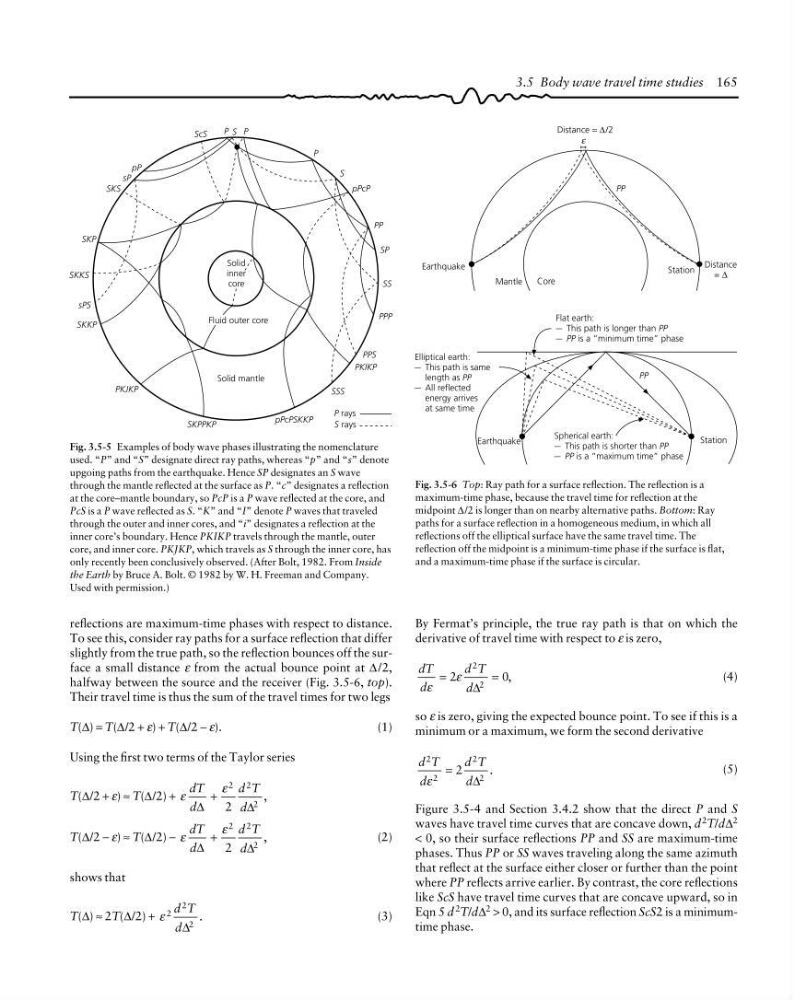
Fig. 3.5-6 Top: Ray path for a surface reflection. The reflection is a
maximum-time phase, because the travel time for reflection at the
midpoint ∆/2 is longer than on nearby alternative paths. Bottom: Ray
paths for a surface reflection in a homogeneous medium, in which all
reflections off the elliptical surface have the same travel time. The
reflection off the midpoint is a minimum-time phase if the surface is flat,
and a maximum-time phase if the surface is circular.
3.5 Body wave travel time studies 165
Fig. 3.5-5 Examples of body wave phases illustrating the nomenclature
used. “P” and “S” designate direct ray paths, whereas “p” and “s” denote
upgoing paths from the earthquake. Hence SP designates an S wave
through the mantle reflected at the surface as P. “c” designates a reflection
at the core–mantle boundary, so PcP is a P wave reflected at the core, and
PcS is a P wave reflected as S. “K” and “I” denote P waves that traveled
through the outer and inner cores, and “i” designates a reflection at the
inner core’s boundary. Hence PKIKP travels through the mantle, outer
core, and inner core. PKJKP, which travels as S through the inner core, has
only recently been conclusively observed. (After Bolt, 1982. From Inside
the Earth by Bruce A. Bolt. © 1982 by W. H. Freeman and Company.
Used with permission.)
By Fermat’s principle, the true ray path is that on which the
derivative of travel time with respect to ε is zero,
dT
d
d T
d
ε
ε
,
=
=
2
0
2
2
∆
(4)
so ε is zero, giving the expected bounce point. To see if this is a
minimum or a maximum, we form the second derivative
d T
d
d T
d
2
2
2
2
2
ε
.
=
∆
(5)
Figure 3.5-4 and Section 3.4.2 show that the direct P and S
waves have travel time curves that are concave down, d 2 T/d∆ 2
< 0, so their surface reflections PP and SS are maximum-time
phases. Thus PP or SS waves traveling along the same azimuth
that reflect at the surface either closer or further than the point
where PP reflects arrive earlier. By contrast, the core reflections
like ScS have travel time curves that are concave upward, so in
Eqn 5 d 2 T/d∆ 2 > 0, and its surface reflection ScS2 is a minimumtime phase.
reflections are maximum-time phases with respect to distance.
To see this, consider ray paths for a surface reflection that differ
slightly from the true path, so the reflection bounces off the surface a small distance ε from the actual bounce point at ∆ /2,
halfway between the source and the receiver (Fig. 3.5-6, top).
Their travel time is thus the sum of the travel times for two legs
T(∆) = T(∆/2 + ε) + T(∆/2 − ε).
(1)
Using the first two terms of the Taylor series
T(∆/2 + ε) ≈ T(∆/2) + ε
ε
dT
d
d T
d
∆
∆
,
+
2
2
2
2
T(∆/2 − ε) ≈ T(∆/2) − ε
ε
dT
d
d T
d
∆
∆
,
+
2
2
2
2
(2)
shows that
T(∆) ≈ 2T(∆/2) + ε 2
2
2
d T
d∆
.
(3)
inner
core
SKKS
SS
Solid mantle
PKJKP
SKPPKP
SKKP
pPcPSKKP
S rays
P rays
SSS
PKIKP
PPP
PPS
SP
PP
pPcP
S
P
P
S
P
ScS
pP
sP
SKS
SKP
sPS
Fluid outer core
Elliptical earth:
— This path is same
length as PP
— All reflected
energy arrives
at same time
Spherical earth:
— This path is shorter than PP
— PP is a “maximum time” phase
Distance = ∆/2
ε
PP
Distance
= ∆
Station
Mantle
Core
Flat earth:
— This path is longer than PP
— PP is a “minimum time” phase
Earthquake
PP
Station
Earthquake
Fig. 3.5-6 Top: Ray path for a surface reflection. The reflection is a
maximum-time phase, because the travel time for reflection at the
midpoint ∆/2 is longer than on nearby alternative paths. Bottom: Ray
paths for a surface reflection in a homogeneous medium, in which all
reflections off the elliptical surface have the same travel time. The
reflection off the midpoint is a minimum-time phase if the surface is flat,
and a maximum-time phase if the surface is circular.
3.5 Body wave travel time studies 165
Fig. 3.5-5 Examples of body wave phases illustrating the nomenclature
used. “P” and “S” designate direct ray paths, whereas “p” and “s” denote
upgoing paths from the earthquake. Hence SP designates an S wave
through the mantle reflected at the surface as P. “c” designates a reflection
at the core–mantle boundary, so PcP is a P wave reflected at the core, and
PcS is a P wave reflected as S. “K” and “I” denote P waves that traveled
through the outer and inner cores, and “i” designates a reflection at the
inner core’s boundary. Hence PKIKP travels through the mantle, outer
core, and inner core. PKJKP, which travels as S through the inner core, has
only recently been conclusively observed. (After Bolt, 1982. From Inside
the Earth by Bruce A. Bolt. © 1982 by W. H. Freeman and Company.
Used with permission.)
By Fermat’s principle, the true ray path is that on which the
derivative of travel time with respect to ε is zero,
dT
d
d T
d
ε
ε
,
=
=
2
0
2
2
∆
(4)
so ε is zero, giving the expected bounce point. To see if this is a
minimum or a maximum, we form the second derivative
d T
d
d T
d
2
2
2
2
2
ε
.
=
∆
(5)
Figure 3.5-4 and Section 3.4.2 show that the direct P and S
waves have travel time curves that are concave down, d 2 T/d∆ 2
< 0, so their surface reflections PP and SS are maximum-time
phases. Thus PP or SS waves traveling along the same azimuth
that reflect at the surface either closer or further than the point
where PP reflects arrive earlier. By contrast, the core reflections
like ScS have travel time curves that are concave upward, so in
Eqn 5 d 2 T/d∆ 2 > 0, and its surface reflection ScS2 is a minimumtime phase.
reflections are maximum-time phases with respect to distance.
To see this, consider ray paths for a surface reflection that differ
slightly from the true path, so the reflection bounces off the surface a small distance ε from the actual bounce point at ∆ /2,
halfway between the source and the receiver (Fig. 3.5-6, top).
Their travel time is thus the sum of the travel times for two legs
T(∆) = T(∆/2 + ε) + T(∆/2 − ε).
(1)
Using the first two terms of the Taylor series
T(∆/2 + ε) ≈ T(∆/2) + ε
ε
dT
d
d T
d
∆
∆
,
+
2
2
2
2
T(∆/2 − ε) ≈ T(∆/2) − ε
ε
dT
d
d T
d
∆
∆
,
+
2
2
2
2
(2)
shows that
T(∆) ≈ 2T(∆/2) + ε 2
2
2
d T
d∆
.
(3)