

160 Seismology and Earth Structure
Velocity
Depth
Distance (∆)
Time
Ray parameter (p)
Distance (∆)
Distance (∆)
Ray parameter (p)
Intercept time ( )
τ
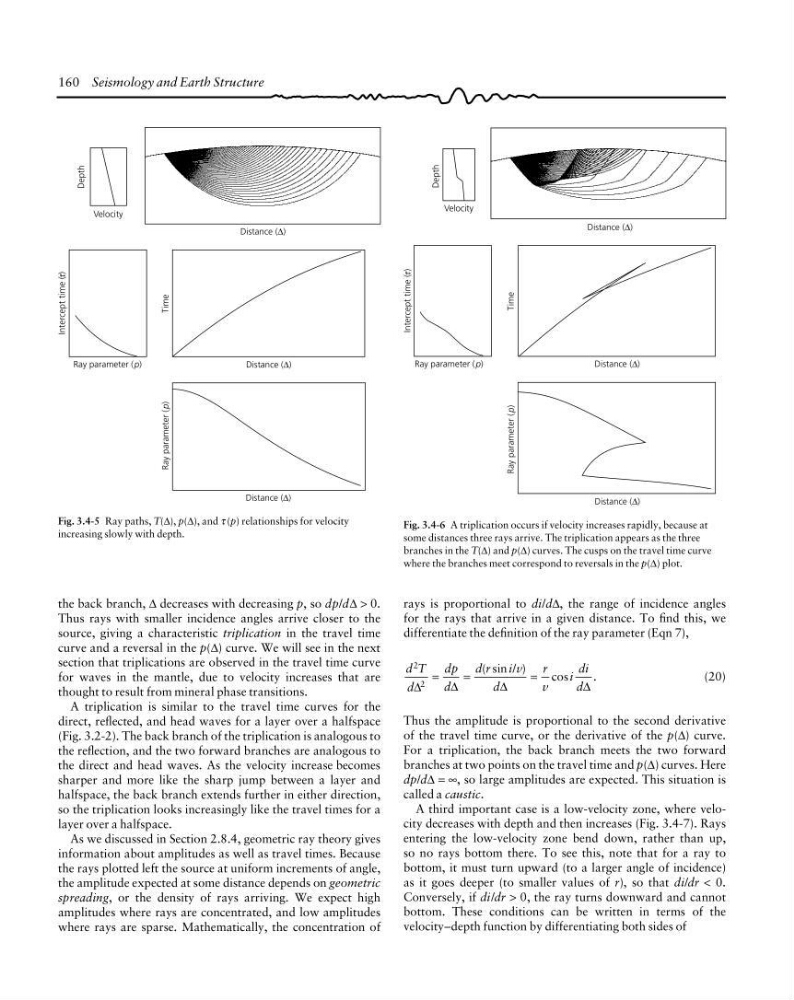
Fig. 3.4-5 Ray paths, T(∆), p(∆), and τ (p) relationships for velocity
increasing slowly with depth.
Intercept time ( )
τ
Distance (∆)
Velocity
Depth
Ray parameter ( p)
Distance (∆)
Time
Distance (∆)
Ray parameter ( p)
Fig. 3.4-6 A triplication occurs if velocity increases rapidly, because at
some distances three rays arrive. The triplication appears as the three
branches in the T(∆) and p(∆) curves. The cusps on the travel time curve
where the branches meet correspond to reversals in the p(∆) plot.
the back branch, ∆ decreases with decreasing p, so dp/d∆ > 0.
Thus rays with smaller incidence angles arrive closer to the
source, giving a characteristic triplication in the travel time
curve and a reversal in the p(∆) curve. We will see in the next
section that triplications are observed in the travel time curve
for waves in the mantle, due to velocity increases that are
thought to result from mineral phase transitions.
A triplication is similar to the travel time curves for the
direct, reflected, and head waves for a layer over a halfspace
(Fig. 3.2-2). The back branch of the triplication is analogous to
the reflection, and the two forward branches are analogous to
the direct and head waves. As the velocity increase becomes
sharper and more like the sharp jump between a layer and
halfspace, the back branch extends further in either direction,
so the triplication looks increasingly like the travel times for a
layer over a halfspace.
As we discussed in Section 2.8.4, geometric ray theory gives
information about amplitudes as well as travel times. Because
the rays plotted left the source at uniform increments of angle,
the amplitude expected at some distance depends on geometric
spreading, or the density of rays arriving. We expect high
amplitudes where rays are concentrated, and low amplitudes
where rays are sparse. Mathematically, the concentration of
rays is proportional to di/d∆, the range of incidence angles
for the rays that arrive in a given distance. To find this, we
differentiate the definition of the ray parameter (Eqn 7),
d T
d
dp
d
d r
i v
d
r
v
i
di
d
2
2
∆
∆
∆
∆
( sin / )
cos
.
=
=
=
(20)
Thus the amplitude is proportional to the second derivative
of the travel time curve, or the derivative of the p(∆) curve.
For a triplication, the back branch meets the two forward
branches at two points on the travel time and p(∆) curves. Here
dp/d∆ = ∞, so large amplitudes are expected. This situation is
called a caustic.
A third important case is a low-velocity zone, where velocity decreases with depth and then increases (Fig. 3.4-7). Rays
entering the low-velocity zone bend down, rather than up,
so no rays bottom there. To see this, note that for a ray to
bottom, it must turn upward (to a larger angle of incidence)
as it goes deeper (to smaller values of r), so that di/dr < 0.
Conversely, if di/dr > 0, the ray turns downward and cannot
bottom. These conditions can be written in terms of the
velocity–depth function by differentiating both sides of
Velocity
Depth
Distance (∆)
Time
Ray parameter (p)
Distance (∆)
Distance (∆)
Ray parameter (p)
Intercept time ( )
τ
Fig. 3.4-5 Ray paths, T(∆), p(∆), and τ (p) relationships for velocity
increasing slowly with depth.
Intercept time ( )
τ
Distance (∆)
Velocity
Depth
Ray parameter ( p)
Distance (∆)
Time
Distance (∆)
Ray parameter ( p)
Fig. 3.4-6 A triplication occurs if velocity increases rapidly, because at
some distances three rays arrive. The triplication appears as the three
branches in the T(∆) and p(∆) curves. The cusps on the travel time curve
where the branches meet correspond to reversals in the p(∆) plot.
the back branch, ∆ decreases with decreasing p, so dp/d∆ > 0.
Thus rays with smaller incidence angles arrive closer to the
source, giving a characteristic triplication in the travel time
curve and a reversal in the p(∆) curve. We will see in the next
section that triplications are observed in the travel time curve
for waves in the mantle, due to velocity increases that are
thought to result from mineral phase transitions.
A triplication is similar to the travel time curves for the
direct, reflected, and head waves for a layer over a halfspace
(Fig. 3.2-2). The back branch of the triplication is analogous to
the reflection, and the two forward branches are analogous to
the direct and head waves. As the velocity increase becomes
sharper and more like the sharp jump between a layer and
halfspace, the back branch extends further in either direction,
so the triplication looks increasingly like the travel times for a
layer over a halfspace.
As we discussed in Section 2.8.4, geometric ray theory gives
information about amplitudes as well as travel times. Because
the rays plotted left the source at uniform increments of angle,
the amplitude expected at some distance depends on geometric
spreading, or the density of rays arriving. We expect high
amplitudes where rays are concentrated, and low amplitudes
where rays are sparse. Mathematically, the concentration of
rays is proportional to di/d∆, the range of incidence angles
for the rays that arrive in a given distance. To find this, we
differentiate the definition of the ray parameter (Eqn 7),
d T
d
dp
d
d r
i v
d
r
v
i
di
d
2
2
∆
∆
∆
∆
( sin / )
cos
.
=
=
=
(20)
Thus the amplitude is proportional to the second derivative
of the travel time curve, or the derivative of the p(∆) curve.
For a triplication, the back branch meets the two forward
branches at two points on the travel time and p(∆) curves. Here
dp/d∆ = ∞, so large amplitudes are expected. This situation is
called a caustic.
A third important case is a low-velocity zone, where velocity decreases with depth and then increases (Fig. 3.4-7). Rays
entering the low-velocity zone bend down, rather than up,
so no rays bottom there. To see this, note that for a ray to
bottom, it must turn upward (to a larger angle of incidence)
as it goes deeper (to smaller values of r), so that di/dr < 0.
Conversely, if di/dr > 0, the ray turns downward and cannot
bottom. These conditions can be written in terms of the
velocity–depth function by differentiating both sides of