

152 Seismology and Earth Structure
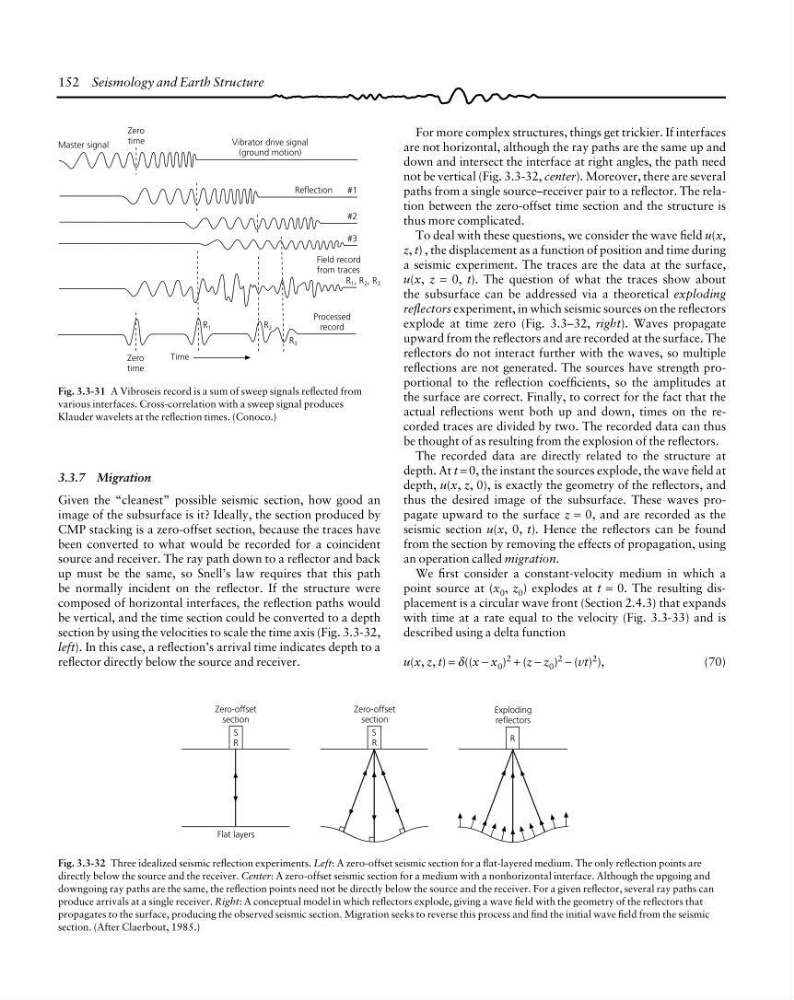
For more complex structures, things get trickier. If interfaces
are not horizontal, although the ray paths are the same up and
down and intersect the interface at right angles, the path need
not be vertical (Fig. 3.3-32, center). Moreover, there are several
paths from a single source–receiver pair to a reflector. The relation between the zero-offset time section and the structure is
thus more complicated.
To deal with these questions, we consider the wave field u(x,
z, t) , the displacement as a function of position and time during
a seismic experiment. The traces are the data at the surface,
u(x, z = 0, t). The question of what the traces show about
the subsurface can be addressed via a theoretical exploding
reflectors experiment, in which seismic sources on the reflectors
explode at time zero (Fig. 3.3–32, right). Waves propagate
upward from the reflectors and are recorded at the surface. The
reflectors do not interact further with the waves, so multiple
reflections are not generated. The sources have strength proportional to the reflection coefficients, so the amplitudes at
the surface are correct. Finally, to correct for the fact that the
actual reflections went both up and down, times on the recorded traces are divided by two. The recorded data can thus
be thought of as resulting from the explosion of the reflectors.
The recorded data are directly related to the structure at
depth. At t = 0, the instant the sources explode, the wave field at
depth, u(x, z, 0), is exactly the geometry of the reflectors, and
thus the desired image of the subsurface. These waves propagate upward to the surface z = 0, and are recorded as the
seismic section u(x, 0, t). Hence the reflectors can be found
from the section by removing the effects of propagation, using
an operation called migration.
We first consider a constant-velocity medium in which a
point source at (x 0 , z 0 ) explodes at t = 0. The resulting displacement is a circular wave front (Section 2.4.3) that expands
with time at a rate equal to the velocity (Fig. 3.3-33) and is
described using a delta function
u(x, z, t) = δ((x − x 0 )
2
+ (z − z 0 )
2
− (vt)
2
),
(70)
Fig. 3.3-32 Three idealized seismic reflection experiments. Left: A zero-offset seismic section for a flat-layered medium. The only reflection points are
directly below the source and the receiver. Center: A zero-offset seismic section for a medium with a nonhorizontal interface. Although the upgoing and
downgoing ray paths are the same, the reflection points need not be directly below the source and the receiver. For a given reflector, several ray paths can
produce arrivals at a single receiver. Right: A conceptual model in which reflectors explode, giving a wave field with the geometry of the reflectors that
propagates to the surface, producing the observed seismic section. Migration seeks to reverse this process and find the initial wave field from the seismic
section. (After Claerbout, 1985.)
Zero-offset
section
S
R
Zero-offset
section
Exploding
reflectors
S
R
R
Flat layers
3.3.7 Migration
Given the “cleanest” possible seismic section, how good an
image of the subsurface is it? Ideally, the section produced by
CMP stacking is a zero-offset section, because the traces have
been converted to what would be recorded for a coincident
source and receiver. The ray path down to a reflector and back
up must be the same, so Snell’s law requires that this path
be normally incident on the reflector. If the structure were
composed of horizontal interfaces, the reflection paths would
be vertical, and the time section could be converted to a depth
section by using the velocities to scale the time axis (Fig. 3.3-32,
left). In this case, a reflection’s arrival time indicates depth to a
reflector directly below the source and receiver.
Fig. 3.3-31 A Vibroseis record is a sum of sweep signals reflected from
various interfaces. Cross-correlation with a sweep signal produces
Klauder wavelets at the reflection times. (Conoco.)
Master signal
Zero
time
Vibrator drive signal
(ground motion)
Reflection
#2
#1
#3
Field record
from traces
R 1 , R 2 , R 3
Processed
record
R 3
R 2
R 1
Time
Zero
time
For more complex structures, things get trickier. If interfaces
are not horizontal, although the ray paths are the same up and
down and intersect the interface at right angles, the path need
not be vertical (Fig. 3.3-32, center). Moreover, there are several
paths from a single source–receiver pair to a reflector. The relation between the zero-offset time section and the structure is
thus more complicated.
To deal with these questions, we consider the wave field u(x,
z, t) , the displacement as a function of position and time during
a seismic experiment. The traces are the data at the surface,
u(x, z = 0, t). The question of what the traces show about
the subsurface can be addressed via a theoretical exploding
reflectors experiment, in which seismic sources on the reflectors
explode at time zero (Fig. 3.3–32, right). Waves propagate
upward from the reflectors and are recorded at the surface. The
reflectors do not interact further with the waves, so multiple
reflections are not generated. The sources have strength proportional to the reflection coefficients, so the amplitudes at
the surface are correct. Finally, to correct for the fact that the
actual reflections went both up and down, times on the recorded traces are divided by two. The recorded data can thus
be thought of as resulting from the explosion of the reflectors.
The recorded data are directly related to the structure at
depth. At t = 0, the instant the sources explode, the wave field at
depth, u(x, z, 0), is exactly the geometry of the reflectors, and
thus the desired image of the subsurface. These waves propagate upward to the surface z = 0, and are recorded as the
seismic section u(x, 0, t). Hence the reflectors can be found
from the section by removing the effects of propagation, using
an operation called migration.
We first consider a constant-velocity medium in which a
point source at (x 0 , z 0 ) explodes at t = 0. The resulting displacement is a circular wave front (Section 2.4.3) that expands
with time at a rate equal to the velocity (Fig. 3.3-33) and is
described using a delta function
u(x, z, t) = δ((x − x 0 )
2
+ (z − z 0 )
2
− (vt)
2
),
(70)
Fig. 3.3-32 Three idealized seismic reflection experiments. Left: A zero-offset seismic section for a flat-layered medium. The only reflection points are
directly below the source and the receiver. Center: A zero-offset seismic section for a medium with a nonhorizontal interface. Although the upgoing and
downgoing ray paths are the same, the reflection points need not be directly below the source and the receiver. For a given reflector, several ray paths can
produce arrivals at a single receiver. Right: A conceptual model in which reflectors explode, giving a wave field with the geometry of the reflectors that
propagates to the surface, producing the observed seismic section. Migration seeks to reverse this process and find the initial wave field from the seismic
section. (After Claerbout, 1985.)
Zero-offset
section
S
R
Zero-offset
section
Exploding
reflectors
S
R
R
Flat layers
3.3.7 Migration
Given the “cleanest” possible seismic section, how good an
image of the subsurface is it? Ideally, the section produced by
CMP stacking is a zero-offset section, because the traces have
been converted to what would be recorded for a coincident
source and receiver. The ray path down to a reflector and back
up must be the same, so Snell’s law requires that this path
be normally incident on the reflector. If the structure were
composed of horizontal interfaces, the reflection paths would
be vertical, and the time section could be converted to a depth
section by using the velocities to scale the time axis (Fig. 3.3-32,
left). In this case, a reflection’s arrival time indicates depth to a
reflector directly below the source and receiver.
Fig. 3.3-31 A Vibroseis record is a sum of sweep signals reflected from
various interfaces. Cross-correlation with a sweep signal produces
Klauder wavelets at the reflection times. (Conoco.)
Master signal
Zero
time
Vibrator drive signal
(ground motion)
Reflection
#2
#1
#3
Field record
from traces
R 1 , R 2 , R 3
Processed
record
R 3
R 2
R 1
Time
Zero
time