

3.3 Reflection seismology 145
Reflections
Refraction data
T – X/6
2 s
P m P
P n
X
T
Reflection data
The continental Moho:
model and seismic signatures
1 s
Wavelet
0 −5 km
Moho
~8.0 km /s
Upper mantle
P m P
P
n
Crust
~6.7 km /s
Geophones
Source
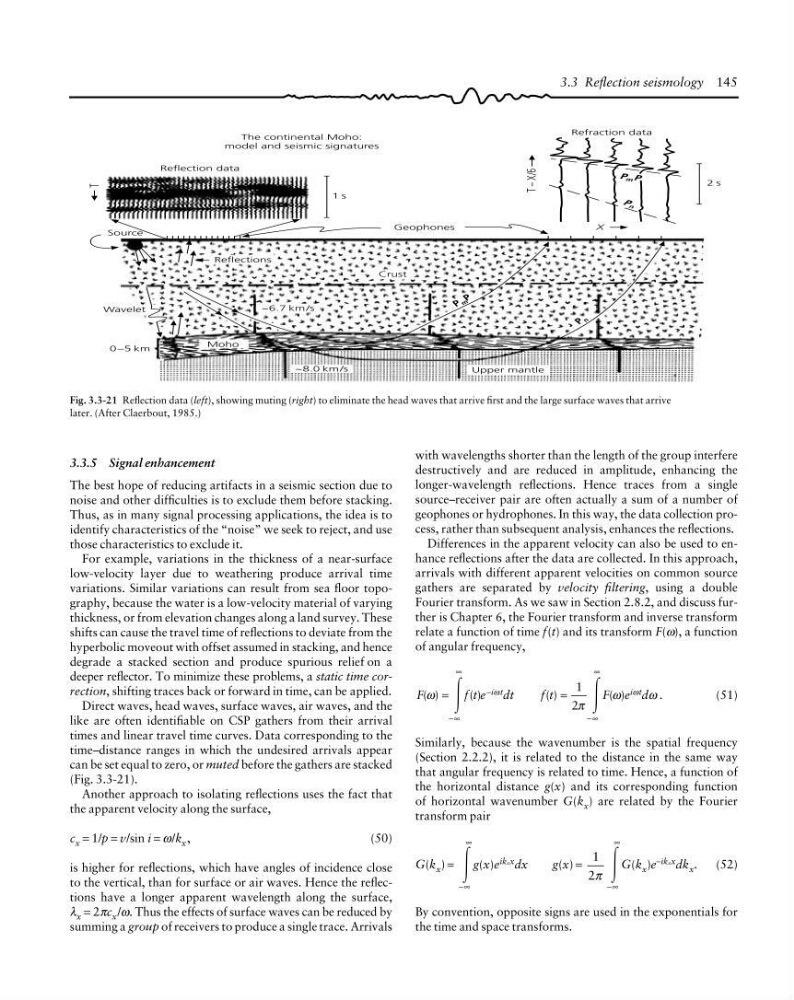
Fig. 3.3-21 Reflection data (left), showing muting (right) to eliminate the head waves that arrive first and the large surface waves that arrive
later. (After Claerbout, 1985.)
3.3.5 Signal enhancement
The best hope of reducing artifacts in a seismic section due to
noise and other difficulties is to exclude them before stacking.
Thus, as in many signal processing applications, the idea is to
identify characteristics of the “noise” we seek to reject, and use
those characteristics to exclude it.
For example, variations in the thickness of a near-surface
low-velocity layer due to weathering produce arrival time
variations. Similar variations can result from sea floor topography, because the water is a low-velocity material of varying
thickness, or from elevation changes along a land survey. These
shifts can cause the travel time of reflections to deviate from the
hyperbolic moveout with offset assumed in stacking, and hence
degrade a stacked section and produce spurious relief on a
deeper reflector. To minimize these problems, a static time correction, shifting traces back or forward in time, can be applied.
Direct waves, head waves, surface waves, air waves, and the
like are often identifiable on CSP gathers from their arrival
times and linear travel time curves. Data corresponding to the
time–distance ranges in which the undesired arrivals appear
can be set equal to zero, or muted before the gathers are stacked
(Fig. 3.3-21).
Another approach to isolating reflections uses the fact that
the apparent velocity along the surface,
c x = 1/p = v/sin i = ω/k x ,
(50)
is higher for reflections, which have angles of incidence close
to the vertical, than for surface or air waves. Hence the reflections have a longer apparent wavelength along the surface,
λ x = 2πc x /ω. Thus the effects of surface waves can be reduced by
summing a group of receivers to produce a single trace. Arrivals
with wavelengths shorter than the length of the group interfere
destructively and are reduced in amplitude, enhancing the
longer-wavelength reflections. Hence traces from a single
source–receiver pair are often actually a sum of a number of
geophones or hydrophones. In this way, the data collection process, rather than subsequent analysis, enhances the reflections.
Differences in the apparent velocity can also be used to enhance reflections after the data are collected. In this approach,
arrivals with different apparent velocities on common source
gathers are separated by velocity filtering, using a double
Fourier transform. As we saw in Section 2.8.2, and discuss further is Chapter 6, the Fourier transform and inverse transform
relate a function of time f(t) and its transform F(ω), a function
of angular frequency,
F
fte d t
i t
( )
( )
ω
ω
=
−∞
∞
−
Ύ
f t
F e d
i t
( )
( )
=
−∞
∞
1
2π
ω
ω
ω
Ύ
.
(51)
Similarly, because the wavenumber is the spatial frequency
(Section 2.2.2), it is related to the distance in the same way
that angular frequency is related to time. Hence, a function of
the horizontal distance g(x) and its corresponding function
of horizontal wavenumber G(k x ) are related by the Fourier
transform pair
G(k x ) =
Ύ
−∞
∞
g(x)e ikxx dx
g(x) =
1
2π Ύ
−∞
∞
G(k x )e −ikxx dk x .
(52)
By convention, opposite signs are used in the exponentials for
the time and space transforms.
Reflections
Refraction data
T – X/6
2 s
P m P
P n
X
T
Reflection data
The continental Moho:
model and seismic signatures
1 s
Wavelet
0 −5 km
Moho
~8.0 km /s
Upper mantle
P m P
P
n
Crust
~6.7 km /s
Geophones
Source
Fig. 3.3-21 Reflection data (left), showing muting (right) to eliminate the head waves that arrive first and the large surface waves that arrive
later. (After Claerbout, 1985.)
3.3.5 Signal enhancement
The best hope of reducing artifacts in a seismic section due to
noise and other difficulties is to exclude them before stacking.
Thus, as in many signal processing applications, the idea is to
identify characteristics of the “noise” we seek to reject, and use
those characteristics to exclude it.
For example, variations in the thickness of a near-surface
low-velocity layer due to weathering produce arrival time
variations. Similar variations can result from sea floor topography, because the water is a low-velocity material of varying
thickness, or from elevation changes along a land survey. These
shifts can cause the travel time of reflections to deviate from the
hyperbolic moveout with offset assumed in stacking, and hence
degrade a stacked section and produce spurious relief on a
deeper reflector. To minimize these problems, a static time correction, shifting traces back or forward in time, can be applied.
Direct waves, head waves, surface waves, air waves, and the
like are often identifiable on CSP gathers from their arrival
times and linear travel time curves. Data corresponding to the
time–distance ranges in which the undesired arrivals appear
can be set equal to zero, or muted before the gathers are stacked
(Fig. 3.3-21).
Another approach to isolating reflections uses the fact that
the apparent velocity along the surface,
c x = 1/p = v/sin i = ω/k x ,
(50)
is higher for reflections, which have angles of incidence close
to the vertical, than for surface or air waves. Hence the reflections have a longer apparent wavelength along the surface,
λ x = 2πc x /ω. Thus the effects of surface waves can be reduced by
summing a group of receivers to produce a single trace. Arrivals
with wavelengths shorter than the length of the group interfere
destructively and are reduced in amplitude, enhancing the
longer-wavelength reflections. Hence traces from a single
source–receiver pair are often actually a sum of a number of
geophones or hydrophones. In this way, the data collection process, rather than subsequent analysis, enhances the reflections.
Differences in the apparent velocity can also be used to enhance reflections after the data are collected. In this approach,
arrivals with different apparent velocities on common source
gathers are separated by velocity filtering, using a double
Fourier transform. As we saw in Section 2.8.2, and discuss further is Chapter 6, the Fourier transform and inverse transform
relate a function of time f(t) and its transform F(ω), a function
of angular frequency,
F
fte d t
i t
( )
( )
ω
ω
=
−∞
∞
−
Ύ
f t
F e d
i t
( )
( )
=
−∞
∞
1
2π
ω
ω
ω
Ύ
.
(51)
Similarly, because the wavenumber is the spatial frequency
(Section 2.2.2), it is related to the distance in the same way
that angular frequency is related to time. Hence, a function of
the horizontal distance g(x) and its corresponding function
of horizontal wavenumber G(k x ) are related by the Fourier
transform pair
G(k x ) =
Ύ
−∞
∞
g(x)e ikxx dx
g(x) =
1
2π Ύ
−∞
∞
G(k x )e −ikxx dk x .
(52)
By convention, opposite signs are used in the exponentials for
the time and space transforms.