

i = 90°
i
ds
dz
z p
i 0
3.3 Reflection seismology 137
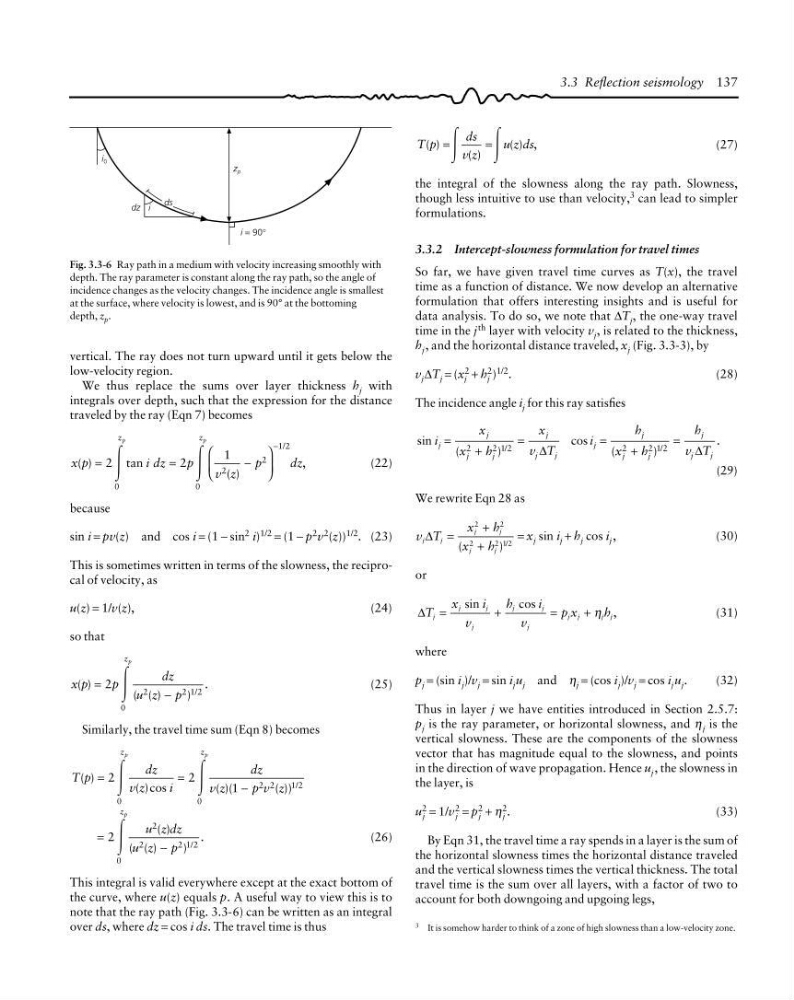
Fig. 3.3-6 Ray path in a medium with velocity increasing smoothly with
depth. The ray parameter is constant along the ray path, so the angle of
incidence changes as the velocity changes. The incidence angle is smallest
at the surface, where velocity is lowest, and is 90° at the bottoming
depth, z p .
3 It is somehow harder to think of a zone of high slowness than a low-velocity zone.
vertical. The ray does not turn upward until it gets below the
low-velocity region.
We thus replace the sums over layer thickness h j with
integrals over depth, such that the expression for the distance
traveled by the ray (Eqn 7) becomes
x p
i dz
p
v z
p
dz
z
z
p
p
( )
tan
( )
,
/
=
=
−
⎛
⎝
⎜
⎞
⎠
⎟
−
2
2
1
0
0
2
2
1 2
Ύ
Ύ
(22)
because
sin i = pv(z) and cos i = (1 − sin
2 i) 1/2 = (1 − p 2 v 2 (z)) 1/2 . (23)
This is sometimes written in terms of the slowness, the reciprocal of velocity, as
u(z) = 1/v(z),
(24)
so that
x p
p
dz
u z p
z p
( )
( ( )
)
.
/
=
−
2
0
2
212
Ύ
(25)
Similarly, the travel time sum (Eqn 8) becomes
T p
dz
v z
i
dz
v z
p v z
z
z
p
p
( )
( ) cos
( )(
( )) /
=
=
−
2
2
1
0
0
2 2
1 2
Ύ
Ύ
=
−
( )
( ( )
)
.
/
2
0
2
2
212
Ύ
z p
u z dz
u z p
(26)
This integral is valid everywhere except at the exact bottom of
the curve, where u(z) equals p. A useful way to view this is to
note that the ray path (Fig. 3.3-6) can be written as an integral
over ds, where dz = cos i ds. The travel time is thus
T p
ds
v z
u z ds
( )
( )
( ) ,
=
=
Ύ Ύ
(27)
the integral of the slowness along the ray path. Slowness,
though less intuitive to use than velocity,
3 can lead to simpler
formulations.
3.3.2 Intercept-slowness formulation for travel times
So far, we have given travel time curves as T(x), the travel
time as a function of distance. We now develop an alternative
formulation that offers interesting insights and is useful for
data analysis. To do so, we note that ∆T j , the one-way travel
time in the j th layer with velocity v j , is related to the thickness,
h j , and the horizontal distance traveled, x j (Fig. 3.3-3), by
v j ∆T j = (x 2
j + h 2
j ) 1/2 .
(28)
The incidence angle i j for this ray satisfies
sin
(
)
cos
(
)
.
/
/
i
x
x
h
x
v T
i
h
x
h
h
v T
j
j
j
j
j
j
j
j
j
j
j
j
j
j
=
+
=
=
+
=
2
212
2
212
∆
∆
(29)
We rewrite Eqn 28 as
v T
x
h
x
h
j
j
j
j
j
j
∆ =
+
+
(
)
/
2
2
2
21 2
= x j sin i j + h j cos i j ,
(30)
or
∆T
x
i
v
h
i
v
p x
h
j
j
j
j
j
j
j
j j
j j
=
+
=
+
sin
cos
,
η
(31)
where
p j = (sin i j )/v j = sin i j u j and η j = (cos i j )/v j = cos i j u j .
(32)
Thus in layer j we have entities introduced in Section 2.5.7:
p j is the ray parameter, or horizontal slowness, and η j is the
vertical slowness. These are the components of the slowness
vector that has magnitude equal to the slowness, and points
in the direction of wave propagation. Hence u j , the slowness in
the layer, is
u j
2 = 1/v j
2 = p j
2 + η j
2 .
(33)
By Eqn 31, the travel time a ray spends in a layer is the sum of
the horizontal slowness times the horizontal distance traveled
and the vertical slowness times the vertical thickness. The total
travel time is the sum over all layers, with a factor of two to
account for both downgoing and upgoing legs,
i
ds
dz
z p
i 0
3.3 Reflection seismology 137
Fig. 3.3-6 Ray path in a medium with velocity increasing smoothly with
depth. The ray parameter is constant along the ray path, so the angle of
incidence changes as the velocity changes. The incidence angle is smallest
at the surface, where velocity is lowest, and is 90° at the bottoming
depth, z p .
3 It is somehow harder to think of a zone of high slowness than a low-velocity zone.
vertical. The ray does not turn upward until it gets below the
low-velocity region.
We thus replace the sums over layer thickness h j with
integrals over depth, such that the expression for the distance
traveled by the ray (Eqn 7) becomes
x p
i dz
p
v z
p
dz
z
z
p
p
( )
tan
( )
,
/
=
=
−
⎛
⎝
⎜
⎞
⎠
⎟
−
2
2
1
0
0
2
2
1 2
Ύ
Ύ
(22)
because
sin i = pv(z) and cos i = (1 − sin
2 i) 1/2 = (1 − p 2 v 2 (z)) 1/2 . (23)
This is sometimes written in terms of the slowness, the reciprocal of velocity, as
u(z) = 1/v(z),
(24)
so that
x p
p
dz
u z p
z p
( )
( ( )
)
.
/
=
−
2
0
2
212
Ύ
(25)
Similarly, the travel time sum (Eqn 8) becomes
T p
dz
v z
i
dz
v z
p v z
z
z
p
p
( )
( ) cos
( )(
( )) /
=
=
−
2
2
1
0
0
2 2
1 2
Ύ
Ύ
=
−
( )
( ( )
)
.
/
2
0
2
2
212
Ύ
z p
u z dz
u z p
(26)
This integral is valid everywhere except at the exact bottom of
the curve, where u(z) equals p. A useful way to view this is to
note that the ray path (Fig. 3.3-6) can be written as an integral
over ds, where dz = cos i ds. The travel time is thus
T p
ds
v z
u z ds
( )
( )
( ) ,
=
=
Ύ Ύ
(27)
the integral of the slowness along the ray path. Slowness,
though less intuitive to use than velocity,
3 can lead to simpler
formulations.
3.3.2 Intercept-slowness formulation for travel times
So far, we have given travel time curves as T(x), the travel
time as a function of distance. We now develop an alternative
formulation that offers interesting insights and is useful for
data analysis. To do so, we note that ∆T j , the one-way travel
time in the j th layer with velocity v j , is related to the thickness,
h j , and the horizontal distance traveled, x j (Fig. 3.3-3), by
v j ∆T j = (x 2
j + h 2
j ) 1/2 .
(28)
The incidence angle i j for this ray satisfies
sin
(
)
cos
(
)
.
/
/
i
x
x
h
x
v T
i
h
x
h
h
v T
j
j
j
j
j
j
j
j
j
j
j
j
j
j
=
+
=
=
+
=
2
212
2
212
∆
∆
(29)
We rewrite Eqn 28 as
v T
x
h
x
h
j
j
j
j
j
j
∆ =
+
+
(
)
/
2
2
2
21 2
= x j sin i j + h j cos i j ,
(30)
or
∆T
x
i
v
h
i
v
p x
h
j
j
j
j
j
j
j
j j
j j
=
+
=
+
sin
cos
,
η
(31)
where
p j = (sin i j )/v j = sin i j u j and η j = (cos i j )/v j = cos i j u j .
(32)
Thus in layer j we have entities introduced in Section 2.5.7:
p j is the ray parameter, or horizontal slowness, and η j is the
vertical slowness. These are the components of the slowness
vector that has magnitude equal to the slowness, and points
in the direction of wave propagation. Hence u j , the slowness in
the layer, is
u j
2 = 1/v j
2 = p j
2 + η j
2 .
(33)
By Eqn 31, the travel time a ray spends in a layer is the sum of
the horizontal slowness times the horizontal distance traveled
and the vertical slowness times the vertical thickness. The total
travel time is the sum over all layers, with a factor of two to
account for both downgoing and upgoing legs,