

3.3 Reflection seismology 135
allow us to compute the corresponding travel time curve T(x),
consider a single layer, where x 0 (= x/2) is the horizontal distance along each of the downgoing and upgoing legs. In this
case, Eqn 8 becomes
T(x) = 2[(x/2)
2
+ h
2
0 ]
1/2
/v 0 ,
(9)
because
cos i 0 = h 0 (x 2
0 + h 2
0 ) −1/2 .
(10)
Hence Eqn 8 yields Eqn 9, which is equivalent to the relation
we derived earlier showing that the travel time curve for the
reflection is a hyperbola (Eqn 1).
For multiple layers, we approximate the travel time curve
for the reflection R n+1 off the top of the (n + 1) th layer as a
hyperbola,
T(x) 2
n+1 = x 2 /E 2
n + t 2
n ,
(11)
and find the two parameters, E n and t n . t n is the total two-way
(up and down) vertical travel time at zero offset, which is twice
the sum of the one-way vertical travel times ∆t j for each layer
t
t
h v
n
j
j j
j
n
j
n
=
=
=
=
∑
∑
( / ).
2
2
0
0
∆
(12)
The velocity term, E n , is a little trickier. From the geometry, the
distance traveled by the downgoing ray in layer j is
x j = v j ∆T j sin i j = (v j
2 /v 0 )∆T j sin (i 0 ),
(13)
where the last step used Snell’s law (Eqn 6). Hence, by Eqn 7,
the total distance, x, can be written
x
x
i
v
v T
j
j
j
j
n
j
n
sin
.
=
=
=
=
∑
∑
2
2
0
0
2
0
0
∆
(14)
Because the ray parameter is constant along a ray, the slope of
the travel time curve is, by Eqn 4,
dT
dx
i
v
x
v T
j
j
j
n
sin
/(
).
=
=
=
∑
0
0
2
0
2
∆
(15)
For the hyperbolic approximation (Eqn 11), the slope of the
travel time curve is
dT
dx
x
T
n
,
=
E 2
(16)
so we define
E n
j
j
j
n
v T T
2
2
0
2
=
=
∑
(
) / .
∆
(17)
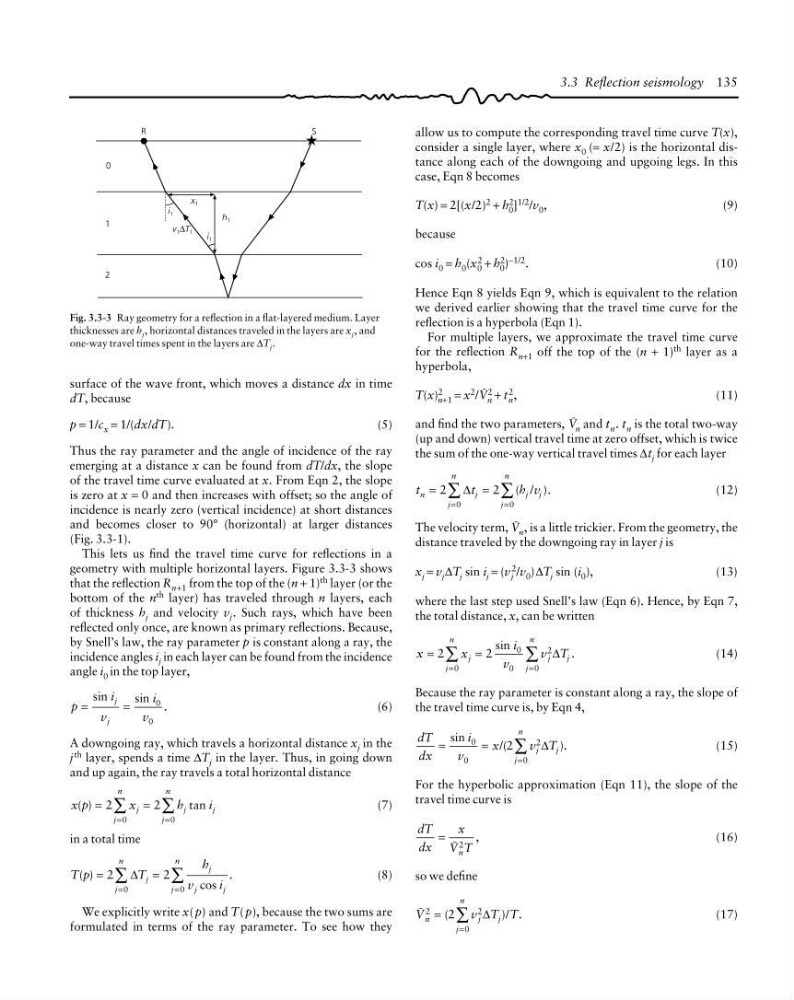
Fig. 3.3-3 Ray geometry for a reflection in a flat-layered medium. Layer
thicknesses are h j , horizontal distances traveled in the layers are x j , and
one-way travel times spent in the layers are ∆T j .
R
0
1
2
x 1
h 1
i 1
i 1
v 1 ∆T 1
S
surface of the wave front, which moves a distance dx in time
dT, because
p = 1/c x = 1/(dx/dT).
(5)
Thus the ray parameter and the angle of incidence of the ray
emerging at a distance x can be found from dT/dx, the slope
of the travel time curve evaluated at x. From Eqn 2, the slope
is zero at x = 0 and then increases with offset; so the angle of
incidence is nearly zero (vertical incidence) at short distances
and becomes closer to 90° (horizontal) at larger distances
(Fig. 3.3-1).
This lets us find the travel time curve for reflections in a
geometry with multiple horizontal layers. Figure 3.3-3 shows
that the reflection R n+1 from the top of the (n + 1) th layer (or the
bottom of the n th layer) has traveled through n layers, each
of thickness h j and velocity v j . Such rays, which have been
reflected only once, are known as primary reflections. Because,
by Snell’s law, the ray parameter p is constant along a ray, the
incidence angles i j in each layer can be found from the incidence
angle i 0 in the top layer,
p
i
v
i
v
j
j
sin
sin .
=
=
0
0
(6)
A downgoing ray, which travels a horizontal distance x j in the
j th layer, spends a time ∆T j in the layer. Thus, in going down
and up again, the ray travels a total horizontal distance
x p
x
h
i
j
j
j
j
n
j
n
( )
tan
=
=
=
=
∑
∑
2
2
0
0
(7)
in a total time
T p
T
h
v
i
j
j
j
j
j
n
j
n
( )
cos
.
=
=
=
=
∑
∑
2
2
0
0
∆
(8)
We explicitly write x( p) and T( p), because the two sums are
formulated in terms of the ray parameter. To see how they
allow us to compute the corresponding travel time curve T(x),
consider a single layer, where x 0 (= x/2) is the horizontal distance along each of the downgoing and upgoing legs. In this
case, Eqn 8 becomes
T(x) = 2[(x/2)
2
+ h
2
0 ]
1/2
/v 0 ,
(9)
because
cos i 0 = h 0 (x 2
0 + h 2
0 ) −1/2 .
(10)
Hence Eqn 8 yields Eqn 9, which is equivalent to the relation
we derived earlier showing that the travel time curve for the
reflection is a hyperbola (Eqn 1).
For multiple layers, we approximate the travel time curve
for the reflection R n+1 off the top of the (n + 1) th layer as a
hyperbola,
T(x) 2
n+1 = x 2 /E 2
n + t 2
n ,
(11)
and find the two parameters, E n and t n . t n is the total two-way
(up and down) vertical travel time at zero offset, which is twice
the sum of the one-way vertical travel times ∆t j for each layer
t
t
h v
n
j
j j
j
n
j
n
=
=
=
=
∑
∑
( / ).
2
2
0
0
∆
(12)
The velocity term, E n , is a little trickier. From the geometry, the
distance traveled by the downgoing ray in layer j is
x j = v j ∆T j sin i j = (v j
2 /v 0 )∆T j sin (i 0 ),
(13)
where the last step used Snell’s law (Eqn 6). Hence, by Eqn 7,
the total distance, x, can be written
x
x
i
v
v T
j
j
j
j
n
j
n
sin
.
=
=
=
=
∑
∑
2
2
0
0
2
0
0
∆
(14)
Because the ray parameter is constant along a ray, the slope of
the travel time curve is, by Eqn 4,
dT
dx
i
v
x
v T
j
j
j
n
sin
/(
).
=
=
=
∑
0
0
2
0
2
∆
(15)
For the hyperbolic approximation (Eqn 11), the slope of the
travel time curve is
dT
dx
x
T
n
,
=
E 2
(16)
so we define
E n
j
j
j
n
v T T
2
2
0
2
=
=
∑
(
) / .
∆
(17)
Fig. 3.3-3 Ray geometry for a reflection in a flat-layered medium. Layer
thicknesses are h j , horizontal distances traveled in the layers are x j , and
one-way travel times spent in the layers are ∆T j .
R
0
1
2
x 1
h 1
i 1
i 1
v 1 ∆T 1
S
surface of the wave front, which moves a distance dx in time
dT, because
p = 1/c x = 1/(dx/dT).
(5)
Thus the ray parameter and the angle of incidence of the ray
emerging at a distance x can be found from dT/dx, the slope
of the travel time curve evaluated at x. From Eqn 2, the slope
is zero at x = 0 and then increases with offset; so the angle of
incidence is nearly zero (vertical incidence) at short distances
and becomes closer to 90° (horizontal) at larger distances
(Fig. 3.3-1).
This lets us find the travel time curve for reflections in a
geometry with multiple horizontal layers. Figure 3.3-3 shows
that the reflection R n+1 from the top of the (n + 1) th layer (or the
bottom of the n th layer) has traveled through n layers, each
of thickness h j and velocity v j . Such rays, which have been
reflected only once, are known as primary reflections. Because,
by Snell’s law, the ray parameter p is constant along a ray, the
incidence angles i j in each layer can be found from the incidence
angle i 0 in the top layer,
p
i
v
i
v
j
j
sin
sin .
=
=
0
0
(6)
A downgoing ray, which travels a horizontal distance x j in the
j th layer, spends a time ∆T j in the layer. Thus, in going down
and up again, the ray travels a total horizontal distance
x p
x
h
i
j
j
j
j
n
j
n
( )
tan
=
=
=
=
∑
∑
2
2
0
0
(7)
in a total time
T p
T
h
v
i
j
j
j
j
j
n
j
n
( )
cos
.
=
=
=
=
∑
∑
2
2
0
0
∆
(8)
We explicitly write x( p) and T( p), because the two sums are
formulated in terms of the ray parameter. To see how they