

Reflections
Refraction data
T – X/6
2 s
P m P
P n
X
T
Reflection data
The continental Moho:
model and seismic signatures
1 s
Wavelet
0−5 km
Moho
~8.0 km/s
Upper mantle
P m
P
P
n
Crust
~6.7 km/s
Geophones
Source
3.2 Refraction seismology 133
Extrusive rocks:
Intrusive rocks:
Percent of mineral by volume
100
90
80
70
60
50
40
30
20
10
0
Rhyolite
Granite
Dacite
Granodiorite
Andesite
Diorite
Basalt
Gabbro
Komatiite
Peridotite
Potassium
feldspar
Quartz
(Sodium-rich)
Plagioclase
feldspar
(Calcium-rich)
Pyroxene
Olivine
Amphibole
M u sc o v it e
B io ti te
70
60
50
40
Silica content (volume percent)
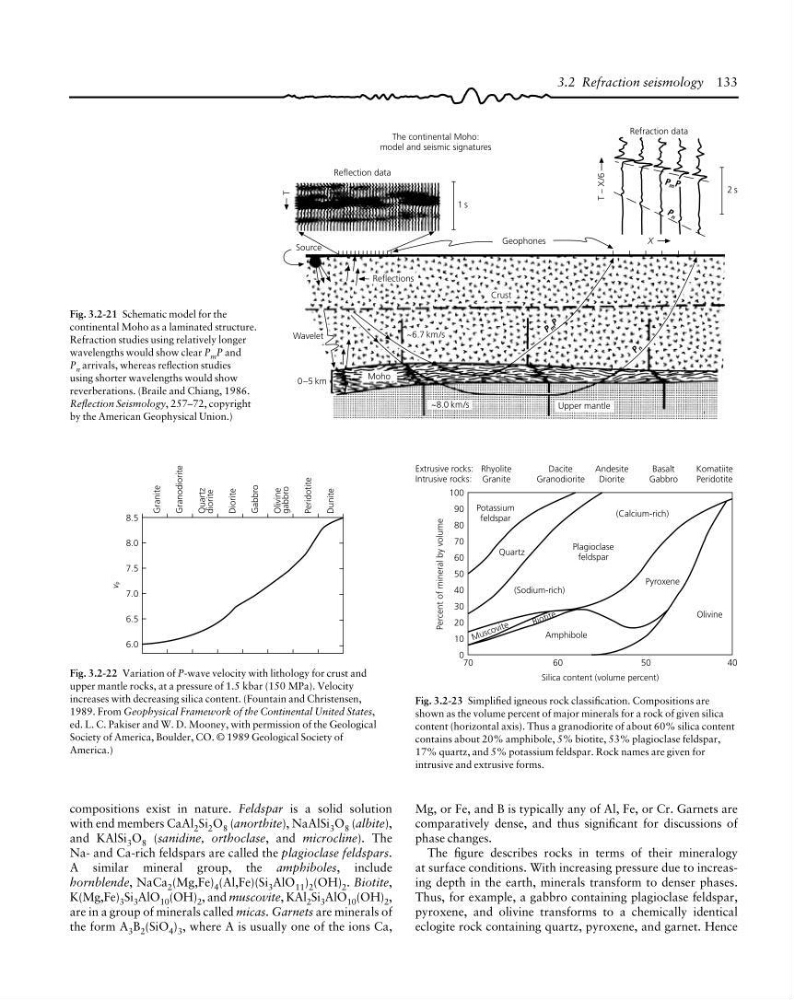
Fig. 3.2-23 Simplified igneous rock classification. Compositions are
shown as the volume percent of major minerals for a rock of given silica
content (horizontal axis). Thus a granodiorite of about 60% silica content
contains about 20% amphibole, 5% biotite, 53% plagioclase feldspar,
17% quartz, and 5% potassium feldspar. Rock names are given for
intrusive and extrusive forms.
Fig. 3.2-21 Schematic model for the
continental Moho as a laminated structure.
Refraction studies using relatively longer
wavelengths would show clear P m P and
P n arrivals, whereas reflection studies
using shorter wavelengths would show
reverberations. (Braile and Chiang, 1986.
Reflection Seismology, 257–72, copyright
by the American Geophysical Union.)
v
P
8.5
8.0
7.5
7.0
6.5
6.0
Granite
Granodiorite
Quartz
diorite
Diorite
Gabbro
Olivine
gabbro
Peridotite
Dunite
Fig. 3.2-22 Variation of P-wave velocity with lithology for crust and
upper mantle rocks, at a pressure of 1.5 kbar (150 MPa). Velocity
increases with decreasing silica content. (Fountain and Christensen,
1989. From Geophysical Framework of the Continental United States,
ed. L. C. Pakiser and W. D. Mooney, with permission of the Geological
Society of America, Boulder, CO. © 1989 Geological Society of
America.)
Mg, or Fe, and B is typically any of Al, Fe, or Cr. Garnets are
comparatively dense, and thus significant for discussions of
phase changes.
The figure describes rocks in terms of their mineralogy
at surface conditions. With increasing pressure due to increasing depth in the earth, minerals transform to denser phases.
Thus, for example, a gabbro containing plagioclase feldspar,
pyroxene, and olivine transforms to a chemically identical
eclogite rock containing quartz, pyroxene, and garnet. Hence
compositions exist in nature. Feldspar is a solid solution
with end members CaAl 2 Si 2 O 8 (anorthite), NaAlSi 3 O 8 (albite),
and KAlSi 3 O 8 (sanidine, orthoclase, and microcline). The
Na- and Ca-rich feldspars are called the plagioclase feldspars.
A similar mineral group, the amphiboles, include
hornblende, NaCa 2 (Mg,Fe) 4 (Al,Fe)(Si 3 AlO 11 ) 2 (OH) 2 . Biotite,
K(Mg,Fe) 3 Si 3 AlO 10 (OH) 2 , and muscovite, KAl 2 Si 3 AlO 10 (OH) 2 ,
are in a group of minerals called micas. Garnets are minerals of
the form A 3 B 2 (SiO 4 ) 3 , where A is usually one of the ions Ca,
Refraction data
T – X/6
2 s
P m P
P n
X
T
Reflection data
The continental Moho:
model and seismic signatures
1 s
Wavelet
0−5 km
Moho
~8.0 km/s
Upper mantle
P m
P
P
n
Crust
~6.7 km/s
Geophones
Source
3.2 Refraction seismology 133
Extrusive rocks:
Intrusive rocks:
Percent of mineral by volume
100
90
80
70
60
50
40
30
20
10
0
Rhyolite
Granite
Dacite
Granodiorite
Andesite
Diorite
Basalt
Gabbro
Komatiite
Peridotite
Potassium
feldspar
Quartz
(Sodium-rich)
Plagioclase
feldspar
(Calcium-rich)
Pyroxene
Olivine
Amphibole
M u sc o v it e
B io ti te
70
60
50
40
Silica content (volume percent)
Fig. 3.2-23 Simplified igneous rock classification. Compositions are
shown as the volume percent of major minerals for a rock of given silica
content (horizontal axis). Thus a granodiorite of about 60% silica content
contains about 20% amphibole, 5% biotite, 53% plagioclase feldspar,
17% quartz, and 5% potassium feldspar. Rock names are given for
intrusive and extrusive forms.
Fig. 3.2-21 Schematic model for the
continental Moho as a laminated structure.
Refraction studies using relatively longer
wavelengths would show clear P m P and
P n arrivals, whereas reflection studies
using shorter wavelengths would show
reverberations. (Braile and Chiang, 1986.
Reflection Seismology, 257–72, copyright
by the American Geophysical Union.)
v
P
8.5
8.0
7.5
7.0
6.5
6.0
Granite
Granodiorite
Quartz
diorite
Diorite
Gabbro
Olivine
gabbro
Peridotite
Dunite
Fig. 3.2-22 Variation of P-wave velocity with lithology for crust and
upper mantle rocks, at a pressure of 1.5 kbar (150 MPa). Velocity
increases with decreasing silica content. (Fountain and Christensen,
1989. From Geophysical Framework of the Continental United States,
ed. L. C. Pakiser and W. D. Mooney, with permission of the Geological
Society of America, Boulder, CO. © 1989 Geological Society of
America.)
Mg, or Fe, and B is typically any of Al, Fe, or Cr. Garnets are
comparatively dense, and thus significant for discussions of
phase changes.
The figure describes rocks in terms of their mineralogy
at surface conditions. With increasing pressure due to increasing depth in the earth, minerals transform to denser phases.
Thus, for example, a gabbro containing plagioclase feldspar,
pyroxene, and olivine transforms to a chemically identical
eclogite rock containing quartz, pyroxene, and garnet. Hence
compositions exist in nature. Feldspar is a solid solution
with end members CaAl 2 Si 2 O 8 (anorthite), NaAlSi 3 O 8 (albite),
and KAlSi 3 O 8 (sanidine, orthoclase, and microcline). The
Na- and Ca-rich feldspars are called the plagioclase feldspars.
A similar mineral group, the amphiboles, include
hornblende, NaCa 2 (Mg,Fe) 4 (Al,Fe)(Si 3 AlO 11 ) 2 (OH) 2 . Biotite,
K(Mg,Fe) 3 Si 3 AlO 10 (OH) 2 , and muscovite, KAl 2 Si 3 AlO 10 (OH) 2 ,
are in a group of minerals called micas. Garnets are minerals of
the form A 3 B 2 (SiO 4 ) 3 , where A is usually one of the ions Ca,