

3.2 Refraction seismology 131
5 0 °
4 0 °
3 0 °
1 2 0 °
4 0
4 5
3 5
5 0
5 0
4 5
4 0
4 5
4 0
40
3 5
4 0
4 5
35
30
80°
Crustal thickness
(Hc, km)
+
70 °
0
1000 km
35
90°
3 0
40
100°
50
4 0
3 5
30
2
5
30
11 0°
5 0 °
4 0 °
3 0 °
1 2 0 °
Upper mantle seismic
velocity (P n , km/s)
70 °
0
1000 km
80 °
90°
100°
110°
8 .0
8 . 0
7 . 8
7.9
7 .7
8 . 0
7 . 8
8.2
7
.9
8 . 1
8 . 0
8 .1
8 .2
8. 1
8.2
8. 1
8 .0
8 .1
2 5
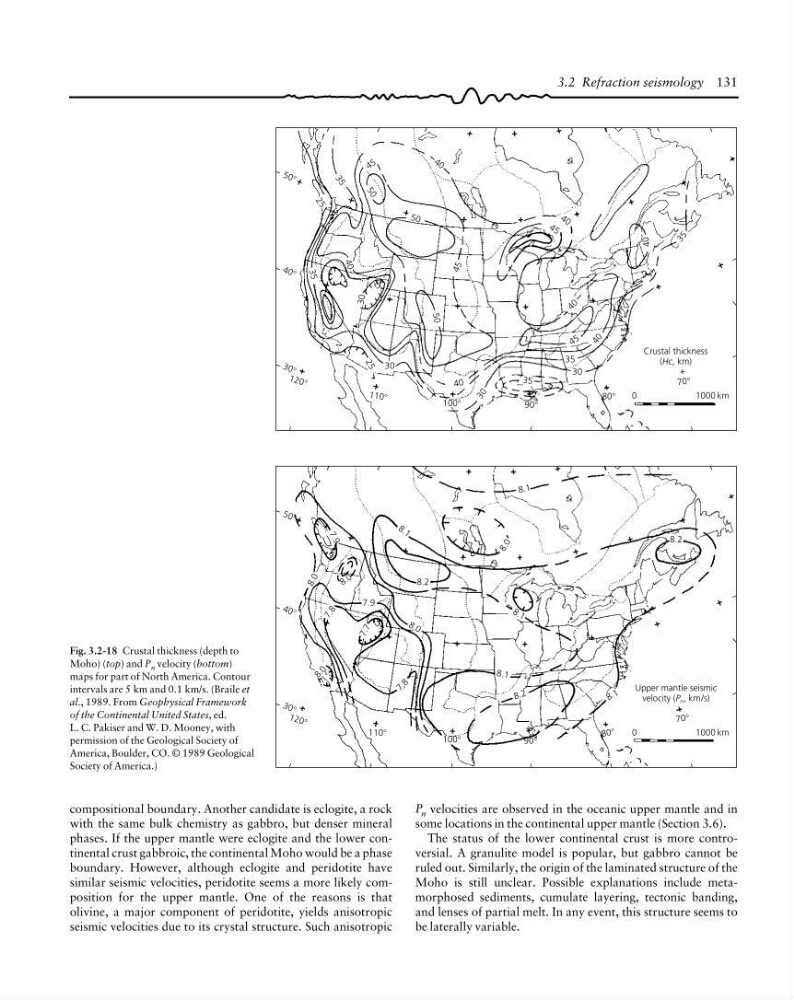
Fig. 3.2-18 Crustal thickness (depth to
Moho) (top) and P n velocity (bottom)
maps for part of North America. Contour
intervals are 5 km and 0.1 km/s. (Braile et
al., 1989. From Geophysical Framework
of the Continental United States, ed.
L. C. Pakiser and W. D. Mooney, with
permission of the Geological Society of
America, Boulder, CO. © 1989 Geological
Society of America.)
compositional boundary. Another candidate is eclogite, a rock
with the same bulk chemistry as gabbro, but denser mineral
phases. If the upper mantle were eclogite and the lower continental crust gabbroic, the continental Moho would be a phase
boundary. However, although eclogite and peridotite have
similar seismic velocities, peridotite seems a more likely composition for the upper mantle. One of the reasons is that
olivine, a major component of peridotite, yields anisotropic
seismic velocities due to its crystal structure. Such anisotropic
P n velocities are observed in the oceanic upper mantle and in
some locations in the continental upper mantle (Section 3.6).
The status of the lower continental crust is more controversial. A granulite model is popular, but gabbro cannot be
ruled out. Similarly, the origin of the laminated structure of the
Moho is still unclear. Possible explanations include metamorphosed sediments, cumulate layering, tectonic banding,
and lenses of partial melt. In any event, this structure seems to
be laterally variable.
5 0 °
4 0 °
3 0 °
1 2 0 °
4 0
4 5
3 5
5 0
5 0
4 5
4 0
4 5
4 0
40
3 5
4 0
4 5
35
30
80°
Crustal thickness
(Hc, km)
+
70 °
0
1000 km
35
90°
3 0
40
100°
50
4 0
3 5
30
2
5
30
11 0°
5 0 °
4 0 °
3 0 °
1 2 0 °
Upper mantle seismic
velocity (P n , km/s)
70 °
0
1000 km
80 °
90°
100°
110°
8 .0
8 . 0
7 . 8
7.9
7 .7
8 . 0
7 . 8
8.2
7
.9
8 . 1
8 . 0
8 .1
8 .2
8. 1
8.2
8. 1
8 .0
8 .1
2 5
Fig. 3.2-18 Crustal thickness (depth to
Moho) (top) and P n velocity (bottom)
maps for part of North America. Contour
intervals are 5 km and 0.1 km/s. (Braile et
al., 1989. From Geophysical Framework
of the Continental United States, ed.
L. C. Pakiser and W. D. Mooney, with
permission of the Geological Society of
America, Boulder, CO. © 1989 Geological
Society of America.)
compositional boundary. Another candidate is eclogite, a rock
with the same bulk chemistry as gabbro, but denser mineral
phases. If the upper mantle were eclogite and the lower continental crust gabbroic, the continental Moho would be a phase
boundary. However, although eclogite and peridotite have
similar seismic velocities, peridotite seems a more likely composition for the upper mantle. One of the reasons is that
olivine, a major component of peridotite, yields anisotropic
seismic velocities due to its crystal structure. Such anisotropic
P n velocities are observed in the oceanic upper mantle and in
some locations in the continental upper mantle (Section 3.6).
The status of the lower continental crust is more controversial. A granulite model is popular, but gabbro cannot be
ruled out. Similarly, the origin of the laminated structure of the
Moho is still unclear. Possible explanations include metamorphosed sediments, cumulate layering, tectonic banding,
and lenses of partial melt. In any event, this structure seems to
be laterally variable.