

124 Seismology and Earth Structure
Distance (km)
0
2
T
− X /6 (s)
−4
−2
0
2
P g
P i P
P i
P m P
Wyoming
Montana
CA
SP43
South
North
−110
−120
−130
−140
−150
−160
−170
−180
10
5
0
−5
−10
−15
−20
T
− X /6 (s)
P n
P n 2
0
−100
−200
−300
−400
−500
−600
−700
−240
−250
−260
−270
−280
−290
−300
−310
−320
−330
T
− X /6 (s)
the down-dip ray path (Fig. 3.2-10) from a source, below
which the perpendicular distance to the interface is h d , to a
receiver at a distance x, below which the perpendicular distance to the interface is (h d + x sin θ). The travel time for the
head wave in the down-dip direction is the sum of the distance
along the interface divided by v 1 plus that for the upgoing and
downgoing legs divided by v 0
T x
x
h
x
i
v
h
x
v
i
d
d
c
d
c
( )
cos
(
sin ) tan
(
sin )
cos
.
=
−
+
+
+
θ
θ
θ
2
2
1
0
(15)
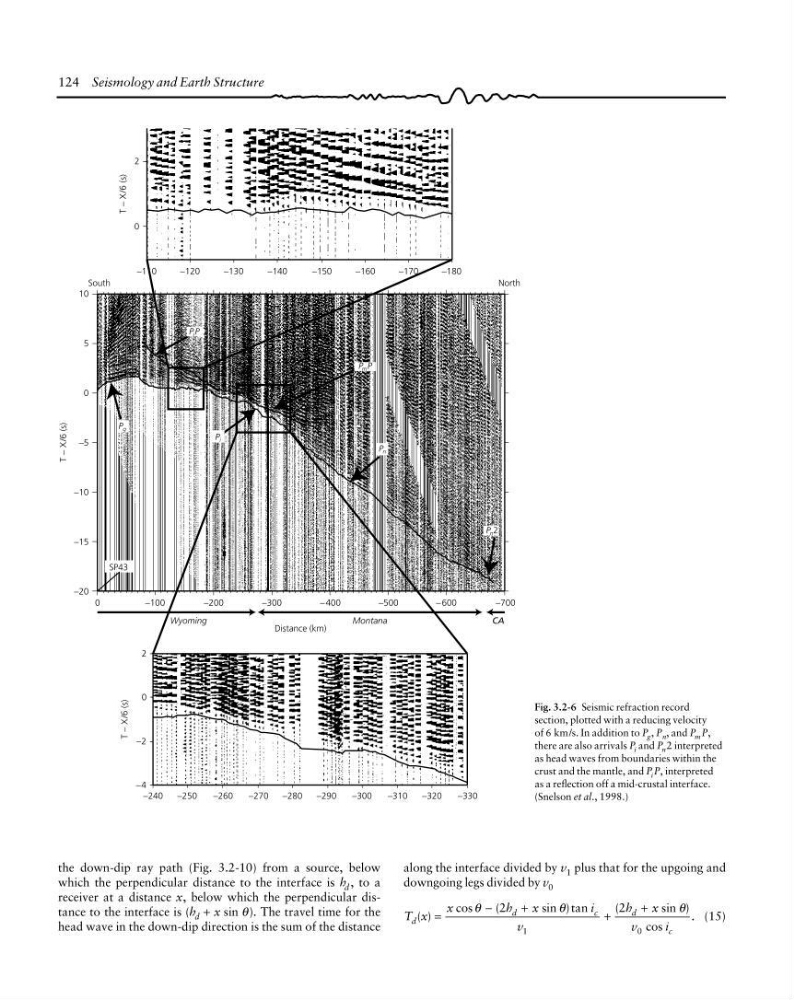
Fig. 3.2-6 Seismic refraction record
section, plotted with a reducing velocity
of 6 km/s. In addition to P g , P n , and P m P,
there are also arrivals P i and P n 2 interpreted
as head waves from boundaries within the
crust and the mantle, and P i P, interpreted
as a reflection off a mid-crustal interface.
(Snelson et al., 1998.)
Distance (km)
0
2
T
− X /6 (s)
−4
−2
0
2
P g
P i P
P i
P m P
Wyoming
Montana
CA
SP43
South
North
−110
−120
−130
−140
−150
−160
−170
−180
10
5
0
−5
−10
−15
−20
T
− X /6 (s)
P n
P n 2
0
−100
−200
−300
−400
−500
−600
−700
−240
−250
−260
−270
−280
−290
−300
−310
−320
−330
T
− X /6 (s)
the down-dip ray path (Fig. 3.2-10) from a source, below
which the perpendicular distance to the interface is h d , to a
receiver at a distance x, below which the perpendicular distance to the interface is (h d + x sin θ). The travel time for the
head wave in the down-dip direction is the sum of the distance
along the interface divided by v 1 plus that for the upgoing and
downgoing legs divided by v 0
T x
x
h
x
i
v
h
x
v
i
d
d
c
d
c
( )
cos
(
sin ) tan
(
sin )
cos
.
=
−
+
+
+
θ
θ
θ
2
2
1
0
(15)
Fig. 3.2-6 Seismic refraction record
section, plotted with a reducing velocity
of 6 km/s. In addition to P g , P n , and P m P,
there are also arrivals P i and P n 2 interpreted
as head waves from boundaries within the
crust and the mantle, and P i P, interpreted
as a reflection off a mid-crustal interface.
(Snelson et al., 1998.)