

114 Basic Seismological Theory
exploited the fact that individual singlets within the multiplet
have different surface eigenfunctions, so spectra at different
stations can be weighted and combined to enhance the desired
singlet and suppress others.
The causes of mode splitting can be visualized by considering
a mode multiplet to be a superposition of singlets corresponding to waves traveling along different paths around the earth. If
the earth is spherical, nonrotating, and spherically symmetric,
all these paths are of the same length and have the same travel
times. However, if some paths take longer than others, the relation between the wave velocity and eigenfrequency (Eqn 21)
shows that the corresponding eigenfrequencies will differ.
Thus splitting occurs when waves traveling on different paths
encounter different velocities. Put another way, splitting occurs
when the actual positions on earth of the source and the
receiver, not just their relative positions, matter.
Mode splitting due to the rotation of the earth reflects two
effects. The direct effect is that the Coriolis force due to the
rotation causes splitting, because waves traveling in the direction of the rotation travel faster than those going the other way.
The splitting is proportional to the ratio of the mode’s period to
that of the earth’s rotation (24 hours), so this effect is largest
for 0 S 2 and decreases for shorter-period modes. An indirect
effect is that the rotating earth takes an elliptical shape (Section A.7), so waves traveling across the poles travel a distance
67 km shorter than waves traveling around the equator, causing the multiplets to be split. Figure 2.9-16 shows rotational
and elliptical splitting for the 0 S 2 multiplet. The amplitudes of
the split singlets are predicted to be greatest for m = ±1, smaller
for ±2, and zero for 0. Interference between the singlets with
slightly different frequencies causes the time series for the
multiplet to show beating (Section 2.8.1).
Mode splitting can be caused by any other process that
causes some wave paths to be faster than others. Splitting
results from lateral variations in velocity, or inhomogeneity,
within the earth. Seismic velocities vary laterally at any given
depth by a few percent at most, but these variations are vital for
understanding tectonic effects, including mantle convection
(Section 5.1). Thus, just as the average frequencies of mode
multiplets are significant for determining the radial velocity
structure of the earth, so the frequencies of singlets help resolve
the three-dimensional structure. Splitting also results from
seismic anisotropy (Section 3.6), which occurs when waves
traveling in different directions through a region travel at
different velocities. For example, Fig. 3.6-13 shows splitting
resulting from anisotropy in the inner core.
A related effect is called mode coupling. Recall that in the
homogeneous string the modes were purely orthogonal and did
not interact with each other. Similarly, in the ideal SNREI
earth, energy is not transferred from the oscillations of one
mode to another. However, real-earth effects like rotation,
ellipticity, lateral inhomogeneity, and anisotropy affect not only
the eigenfrequencies, but also the eigenfunctions. As a result,
the eigenfunction of a given mode contains both the eigenfunction it would have for a SNREI earth and perturbations due to
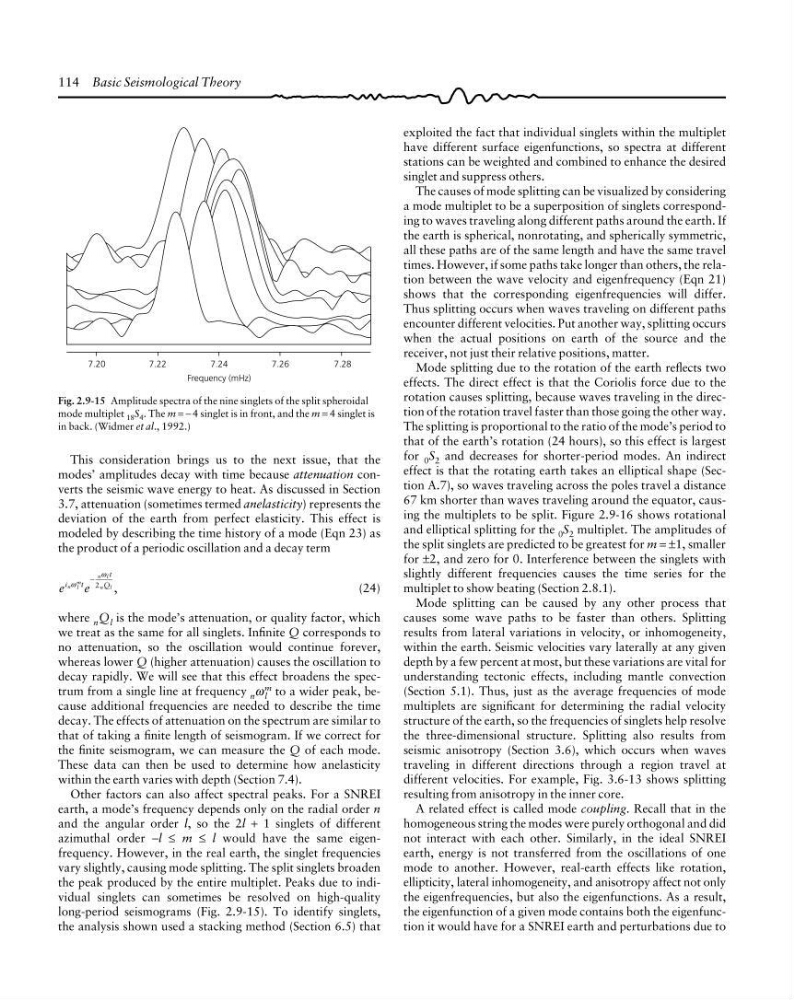
Fig. 2.9-15 Amplitude spectra of the nine singlets of the split spheroidal
mode multiplet 18 S 4 . The m = − 4 singlet is in front, and the m = 4 singlet is
in back. (Widmer et al., 1992.)
7.20
7.22
7.24
7.26
7.28
Frequency (mHz)
This consideration brings us to the next issue, that the
modes’ amplitudes decay with time because attenuation converts the seismic wave energy to heat. As discussed in Section
3.7, attenuation (sometimes termed anelasticity) represents the
deviation of the earth from perfect elasticity. This effect is
modeled by describing the time history of a mode (Eqn 23) as
the product of a periodic oscillation and a decay term
e
e
i
t
t
Q
n l
m
n l
n l
ω
ω
−
2
,
(24)
where n Q l is the mode’s attenuation, or quality factor, which
we treat as the same for all singlets. Infinite Q corresponds to
no attenuation, so the oscillation would continue forever,
whereas lower Q (higher attenuation) causes the oscillation to
decay rapidly. We will see that this effect broadens the spectrum from a single line at frequency n ω l
m to a wider peak, because additional frequencies are needed to describe the time
decay. The effects of attenuation on the spectrum are similar to
that of taking a finite length of seismogram. If we correct for
the finite seismogram, we can measure the Q of each mode.
These data can then be used to determine how anelasticity
within the earth varies with depth (Section 7.4).
Other factors can also affect spectral peaks. For a SNREI
earth, a mode’s frequency depends only on the radial order n
and the angular order l, so the 2l + 1 singlets of different
azimuthal order −l ≤ m ≤ l would have the same eigenfrequency. However, in the real earth, the singlet frequencies
vary slightly, causing mode splitting. The split singlets broaden
the peak produced by the entire multiplet. Peaks due to individual singlets can sometimes be resolved on high-quality
long-period seismograms (Fig. 2.9-15). To identify singlets,
the analysis shown used a stacking method (Section 6.5) that
exploited the fact that individual singlets within the multiplet
have different surface eigenfunctions, so spectra at different
stations can be weighted and combined to enhance the desired
singlet and suppress others.
The causes of mode splitting can be visualized by considering
a mode multiplet to be a superposition of singlets corresponding to waves traveling along different paths around the earth. If
the earth is spherical, nonrotating, and spherically symmetric,
all these paths are of the same length and have the same travel
times. However, if some paths take longer than others, the relation between the wave velocity and eigenfrequency (Eqn 21)
shows that the corresponding eigenfrequencies will differ.
Thus splitting occurs when waves traveling on different paths
encounter different velocities. Put another way, splitting occurs
when the actual positions on earth of the source and the
receiver, not just their relative positions, matter.
Mode splitting due to the rotation of the earth reflects two
effects. The direct effect is that the Coriolis force due to the
rotation causes splitting, because waves traveling in the direction of the rotation travel faster than those going the other way.
The splitting is proportional to the ratio of the mode’s period to
that of the earth’s rotation (24 hours), so this effect is largest
for 0 S 2 and decreases for shorter-period modes. An indirect
effect is that the rotating earth takes an elliptical shape (Section A.7), so waves traveling across the poles travel a distance
67 km shorter than waves traveling around the equator, causing the multiplets to be split. Figure 2.9-16 shows rotational
and elliptical splitting for the 0 S 2 multiplet. The amplitudes of
the split singlets are predicted to be greatest for m = ±1, smaller
for ±2, and zero for 0. Interference between the singlets with
slightly different frequencies causes the time series for the
multiplet to show beating (Section 2.8.1).
Mode splitting can be caused by any other process that
causes some wave paths to be faster than others. Splitting
results from lateral variations in velocity, or inhomogeneity,
within the earth. Seismic velocities vary laterally at any given
depth by a few percent at most, but these variations are vital for
understanding tectonic effects, including mantle convection
(Section 5.1). Thus, just as the average frequencies of mode
multiplets are significant for determining the radial velocity
structure of the earth, so the frequencies of singlets help resolve
the three-dimensional structure. Splitting also results from
seismic anisotropy (Section 3.6), which occurs when waves
traveling in different directions through a region travel at
different velocities. For example, Fig. 3.6-13 shows splitting
resulting from anisotropy in the inner core.
A related effect is called mode coupling. Recall that in the
homogeneous string the modes were purely orthogonal and did
not interact with each other. Similarly, in the ideal SNREI
earth, energy is not transferred from the oscillations of one
mode to another. However, real-earth effects like rotation,
ellipticity, lateral inhomogeneity, and anisotropy affect not only
the eigenfrequencies, but also the eigenfunctions. As a result,
the eigenfunction of a given mode contains both the eigenfunction it would have for a SNREI earth and perturbations due to
Fig. 2.9-15 Amplitude spectra of the nine singlets of the split spheroidal
mode multiplet 18 S 4 . The m = − 4 singlet is in front, and the m = 4 singlet is
in back. (Widmer et al., 1992.)
7.20
7.22
7.24
7.26
7.28
Frequency (mHz)
This consideration brings us to the next issue, that the
modes’ amplitudes decay with time because attenuation converts the seismic wave energy to heat. As discussed in Section
3.7, attenuation (sometimes termed anelasticity) represents the
deviation of the earth from perfect elasticity. This effect is
modeled by describing the time history of a mode (Eqn 23) as
the product of a periodic oscillation and a decay term
e
e
i
t
t
Q
n l
m
n l
n l
ω
ω
−
2
,
(24)
where n Q l is the mode’s attenuation, or quality factor, which
we treat as the same for all singlets. Infinite Q corresponds to
no attenuation, so the oscillation would continue forever,
whereas lower Q (higher attenuation) causes the oscillation to
decay rapidly. We will see that this effect broadens the spectrum from a single line at frequency n ω l
m to a wider peak, because additional frequencies are needed to describe the time
decay. The effects of attenuation on the spectrum are similar to
that of taking a finite length of seismogram. If we correct for
the finite seismogram, we can measure the Q of each mode.
These data can then be used to determine how anelasticity
within the earth varies with depth (Section 7.4).
Other factors can also affect spectral peaks. For a SNREI
earth, a mode’s frequency depends only on the radial order n
and the angular order l, so the 2l + 1 singlets of different
azimuthal order −l ≤ m ≤ l would have the same eigenfrequency. However, in the real earth, the singlet frequencies
vary slightly, causing mode splitting. The split singlets broaden
the peak produced by the entire multiplet. Peaks due to individual singlets can sometimes be resolved on high-quality
long-period seismograms (Fig. 2.9-15). To identify singlets,
the analysis shown used a stacking method (Section 6.5) that