

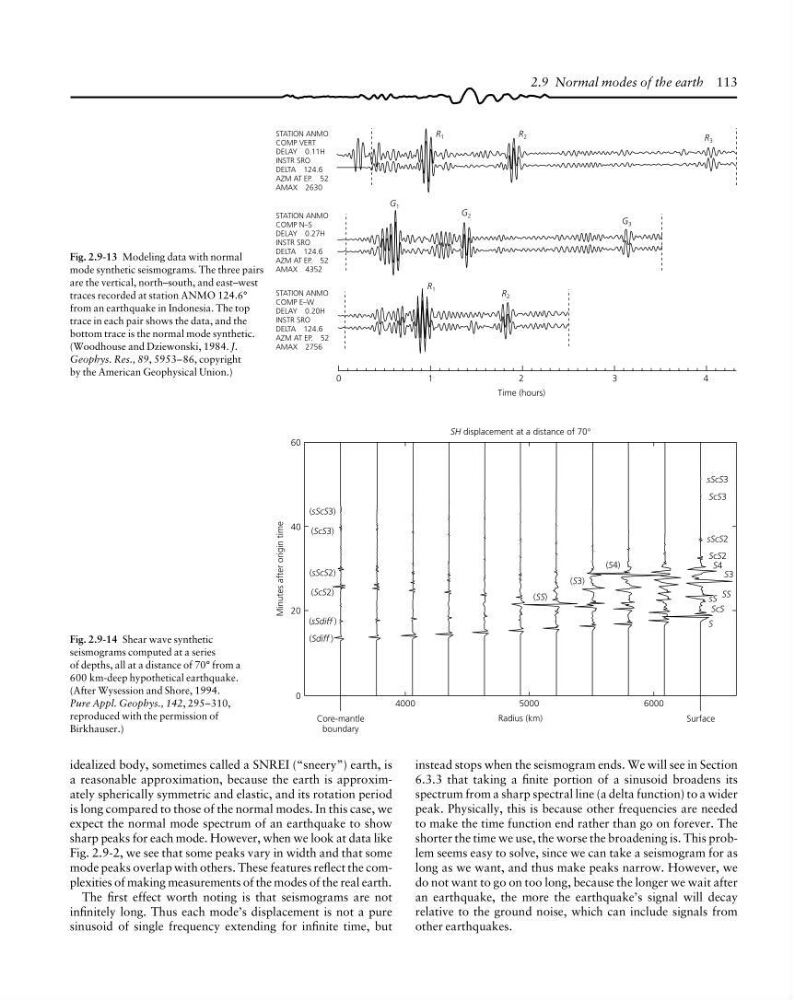
Fig. 2.9-14 Shear wave synthetic
seismograms computed at a series
of depths, all at a distance of 70° from a
600 km-deep hypothetical earthquake.
(After Wysession and Shore, 1994.
Pure Appl. Geophys., 142, 295–310,
reproduced with the permission of
Birkhauser.)
Minutes after origin time
60
sScS3
ScS3
sScS2
ScS2
S4
S3
SS
sS
ScS
S
40
20
0
(sScS3)
(ScS3)
(sScS2)
(ScS2)
(sSdiff )
(Sdiff )
4000
5000
6000
SH displacement at a distance of 70°
Core-mantle
boundary
Radius (km)
Surface
(SS)
(S3)
(S4)
2.9 Normal modes of the earth 113
STATION ANMO
COMP VERT
DELAY 0.11H
INSTR SRO
DELTA 124.6
AZM AT EP. 52
AMAX 2630
STATION ANMO
COMP N–S
DELAY 0.27H
INSTR SRO
DELTA 124.6
AZM AT EP. 52
AMAX 4352
STATION ANMO
COMP E–W
DELAY 0.20H
INSTR SRO
DELTA 124.6
AZM AT EP. 52
AMAX 2756
0
1
2
Time (hours)
3
4
R 1
R 2
G 2
G 1
G 3
R 1
R 2
R 3
Fig. 2.9-13 Modeling data with normal
mode synthetic seismograms. The three pairs
are the vertical, north–south, and east–west
traces recorded at station ANMO 124.6°
from an earthquake in Indonesia. The top
trace in each pair shows the data, and the
bottom trace is the normal mode synthetic.
(Woodhouse and Dziewonski, 1984. J.
Geophys. Res., 89, 5953–86, copyright
by the American Geophysical Union.)
idealized body, sometimes called a SNREI (“sneery”) earth, is
a reasonable approximation, because the earth is approximately spherically symmetric and elastic, and its rotation period
is long compared to those of the normal modes. In this case, we
expect the normal mode spectrum of an earthquake to show
sharp peaks for each mode. However, when we look at data like
Fig. 2.9-2, we see that some peaks vary in width and that some
mode peaks overlap with others. These features reflect the complexities of making measurements of the modes of the real earth.
The first effect worth noting is that seismograms are not
infinitely long. Thus each mode’s displacement is not a pure
sinusoid of single frequency extending for infinite time, but
instead stops when the seismogram ends. We will see in Section
6.3.3 that taking a finite portion of a sinusoid broadens its
spectrum from a sharp spectral line (a delta function) to a wider
peak. Physically, this is because other frequencies are needed
to make the time function end rather than go on forever. The
shorter the time we use, the worse the broadening is. This problem seems easy to solve, since we can take a seismogram for as
long as we want, and thus make peaks narrow. However, we
do not want to go on too long, because the longer we wait after
an earthquake, the more the earthquake’s signal will decay
relative to the ground noise, which can include signals from
other earthquakes.
seismograms computed at a series
of depths, all at a distance of 70° from a
600 km-deep hypothetical earthquake.
(After Wysession and Shore, 1994.
Pure Appl. Geophys., 142, 295–310,
reproduced with the permission of
Birkhauser.)
Minutes after origin time
60
sScS3
ScS3
sScS2
ScS2
S4
S3
SS
sS
ScS
S
40
20
0
(sScS3)
(ScS3)
(sScS2)
(ScS2)
(sSdiff )
(Sdiff )
4000
5000
6000
SH displacement at a distance of 70°
Core-mantle
boundary
Radius (km)
Surface
(SS)
(S3)
(S4)
2.9 Normal modes of the earth 113
STATION ANMO
COMP VERT
DELAY 0.11H
INSTR SRO
DELTA 124.6
AZM AT EP. 52
AMAX 2630
STATION ANMO
COMP N–S
DELAY 0.27H
INSTR SRO
DELTA 124.6
AZM AT EP. 52
AMAX 4352
STATION ANMO
COMP E–W
DELAY 0.20H
INSTR SRO
DELTA 124.6
AZM AT EP. 52
AMAX 2756
0
1
2
Time (hours)
3
4
R 1
R 2
G 2
G 1
G 3
R 1
R 2
R 3
Fig. 2.9-13 Modeling data with normal
mode synthetic seismograms. The three pairs
are the vertical, north–south, and east–west
traces recorded at station ANMO 124.6°
from an earthquake in Indonesia. The top
trace in each pair shows the data, and the
bottom trace is the normal mode synthetic.
(Woodhouse and Dziewonski, 1984. J.
Geophys. Res., 89, 5953–86, copyright
by the American Geophysical Union.)
idealized body, sometimes called a SNREI (“sneery”) earth, is
a reasonable approximation, because the earth is approximately spherically symmetric and elastic, and its rotation period
is long compared to those of the normal modes. In this case, we
expect the normal mode spectrum of an earthquake to show
sharp peaks for each mode. However, when we look at data like
Fig. 2.9-2, we see that some peaks vary in width and that some
mode peaks overlap with others. These features reflect the complexities of making measurements of the modes of the real earth.
The first effect worth noting is that seismograms are not
infinitely long. Thus each mode’s displacement is not a pure
sinusoid of single frequency extending for infinite time, but
instead stops when the seismogram ends. We will see in Section
6.3.3 that taking a finite portion of a sinusoid broadens its
spectrum from a sharp spectral line (a delta function) to a wider
peak. Physically, this is because other frequencies are needed
to make the time function end rather than go on forever. The
shorter the time we use, the worse the broadening is. This problem seems easy to solve, since we can take a seismogram for as
long as we want, and thus make peaks narrow. However, we
do not want to go on too long, because the longer we wait after
an earthquake, the more the earthquake’s signal will decay
relative to the ground noise, which can include signals from
other earthquakes.