

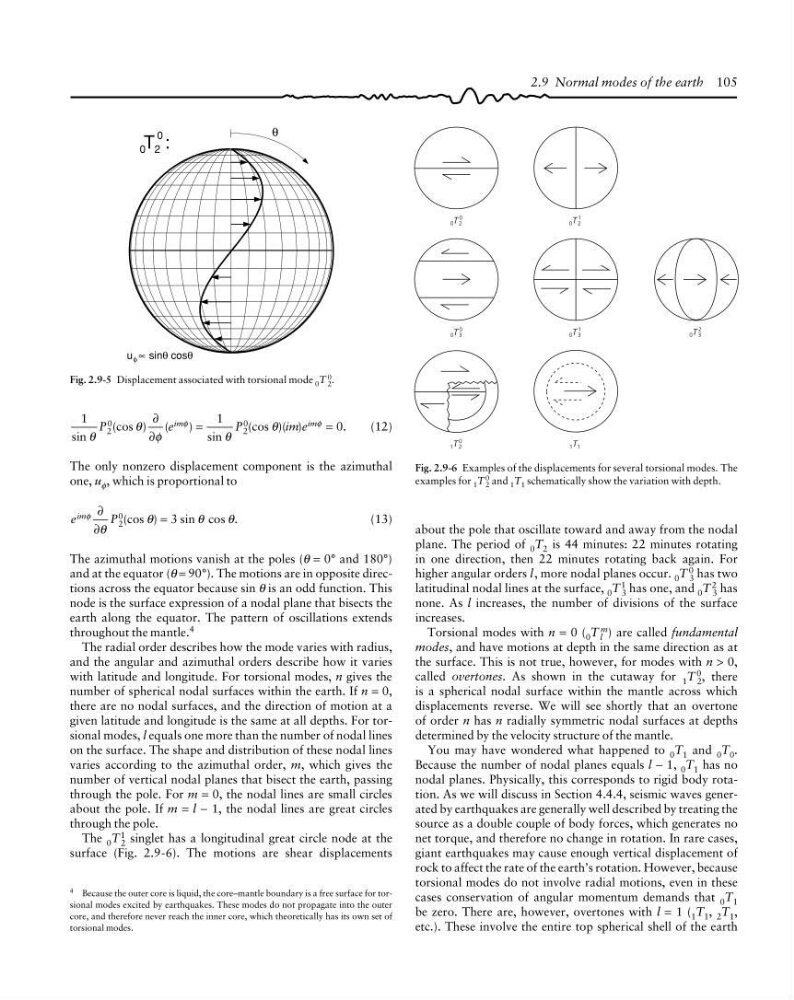
Fig. 2.9-5 Displacement associated with torsional mode 0 T 0
2 .
4 Because the outer core is liquid, the core–mantle boundary is a free surface for torsional modes excited by earthquakes. These modes do not propagate into the outer
core, and therefore never reach the inner core, which theoretically has its own set of
torsional modes.
2.9 Normal modes of the earth 105
0 T 2
0
0 T 2
1
0 T 3
2
1 T 1
1 T 2
0
0 T 3
0
0 T 3
1
Fig. 2.9-6 Examples of the displacements for several torsional modes. The
examples for 1 T
0
2 and 1 T 1 schematically show the variation with depth.
1
1
0
2
0
2
0
sin
(cos ) (
)
sin
(cos )( )
.
θ
θ φ
θ
θ
φ
φ
P
e
P
i me
im
im
∂
∂
=
=
(12)
The only nonzero displacement component is the azimuthal
one, u φ , which is proportional to
e
P
imφ
θ
θ
θ
θ
∂
∂
2
0
3
(cos )
sin cos .
=
(13)
The azimuthal motions vanish at the poles (θ = 0° and 180°)
and at the equator (θ = 90°). The motions are in opposite directions across the equator because sin θ is an odd function. This
node is the surface expression of a nodal plane that bisects the
earth along the equator. The pattern of oscillations extends
throughout the mantle. 4
The radial order describes how the mode varies with radius,
and the angular and azimuthal orders describe how it varies
with latitude and longitude. For torsional modes, n gives the
number of spherical nodal surfaces within the earth. If n = 0,
there are no nodal surfaces, and the direction of motion at a
given latitude and longitude is the same at all depths. For torsional modes, l equals one more than the number of nodal lines
on the surface. The shape and distribution of these nodal lines
varies according to the azimuthal order, m, which gives the
number of vertical nodal planes that bisect the earth, passing
through the pole. For m = 0, the nodal lines are small circles
about the pole. If m = l − 1, the nodal lines are great circles
through the pole.
The 0 T 1
2 singlet has a longitudinal great circle node at the
surface (Fig. 2.9-6). The motions are shear displacements
about the pole that oscillate toward and away from the nodal
plane. The period of 0 T 2 is 44 minutes: 22 minutes rotating
in one direction, then 22 minutes rotating back again. For
higher angular orders l, more nodal planes occur. 0 T
0
3 has two
latitudinal nodal lines at the surface, 0 T 1
3 has one, and 0 T 2
3 has
none. As l increases, the number of divisions of the surface
increases.
Torsional modes with n = 0 ( 0 T l
m ) are called fundamental
modes, and have motions at depth in the same direction as at
the surface. This is not true, however, for modes with n > 0,
called overtones. As shown in the cutaway for 1 T 0
2 , there
is a spherical nodal surface within the mantle across which
displacements reverse. We will see shortly that an overtone
of order n has n radially symmetric nodal surfaces at depths
determined by the velocity structure of the mantle.
You may have wondered what happened to 0 T 1 and 0 T 0 .
Because the number of nodal planes equals l − 1, 0 T 1 has no
nodal planes. Physically, this corresponds to rigid body rotation. As we will discuss in Section 4.4.4, seismic waves generated by earthquakes are generally well described by treating the
source as a double couple of body forces, which generates no
net torque, and therefore no change in rotation. In rare cases,
giant earthquakes may cause enough vertical displacement of
rock to affect the rate of the earth’s rotation. However, because
torsional modes do not involve radial motions, even in these
cases conservation of angular momentum demands that 0 T 1
be zero. There are, however, overtones with l = 1 ( 1 T 1 , 2 T 1 ,
etc.). These involve the entire top spherical shell of the earth
θ
u ∝ sinθ cosθ
φ
T :
0 2
0
2 .
4 Because the outer core is liquid, the core–mantle boundary is a free surface for torsional modes excited by earthquakes. These modes do not propagate into the outer
core, and therefore never reach the inner core, which theoretically has its own set of
torsional modes.
2.9 Normal modes of the earth 105
0 T 2
0
0 T 2
1
0 T 3
2
1 T 1
1 T 2
0
0 T 3
0
0 T 3
1
Fig. 2.9-6 Examples of the displacements for several torsional modes. The
examples for 1 T
0
2 and 1 T 1 schematically show the variation with depth.
1
1
0
2
0
2
0
sin
(cos ) (
)
sin
(cos )( )
.
θ
θ φ
θ
θ
φ
φ
P
e
P
i me
im
im
∂
∂
=
=
(12)
The only nonzero displacement component is the azimuthal
one, u φ , which is proportional to
e
P
imφ
θ
θ
θ
θ
∂
∂
2
0
3
(cos )
sin cos .
=
(13)
The azimuthal motions vanish at the poles (θ = 0° and 180°)
and at the equator (θ = 90°). The motions are in opposite directions across the equator because sin θ is an odd function. This
node is the surface expression of a nodal plane that bisects the
earth along the equator. The pattern of oscillations extends
throughout the mantle. 4
The radial order describes how the mode varies with radius,
and the angular and azimuthal orders describe how it varies
with latitude and longitude. For torsional modes, n gives the
number of spherical nodal surfaces within the earth. If n = 0,
there are no nodal surfaces, and the direction of motion at a
given latitude and longitude is the same at all depths. For torsional modes, l equals one more than the number of nodal lines
on the surface. The shape and distribution of these nodal lines
varies according to the azimuthal order, m, which gives the
number of vertical nodal planes that bisect the earth, passing
through the pole. For m = 0, the nodal lines are small circles
about the pole. If m = l − 1, the nodal lines are great circles
through the pole.
The 0 T 1
2 singlet has a longitudinal great circle node at the
surface (Fig. 2.9-6). The motions are shear displacements
about the pole that oscillate toward and away from the nodal
plane. The period of 0 T 2 is 44 minutes: 22 minutes rotating
in one direction, then 22 minutes rotating back again. For
higher angular orders l, more nodal planes occur. 0 T
0
3 has two
latitudinal nodal lines at the surface, 0 T 1
3 has one, and 0 T 2
3 has
none. As l increases, the number of divisions of the surface
increases.
Torsional modes with n = 0 ( 0 T l
m ) are called fundamental
modes, and have motions at depth in the same direction as at
the surface. This is not true, however, for modes with n > 0,
called overtones. As shown in the cutaway for 1 T 0
2 , there
is a spherical nodal surface within the mantle across which
displacements reverse. We will see shortly that an overtone
of order n has n radially symmetric nodal surfaces at depths
determined by the velocity structure of the mantle.
You may have wondered what happened to 0 T 1 and 0 T 0 .
Because the number of nodal planes equals l − 1, 0 T 1 has no
nodal planes. Physically, this corresponds to rigid body rotation. As we will discuss in Section 4.4.4, seismic waves generated by earthquakes are generally well described by treating the
source as a double couple of body forces, which generates no
net torque, and therefore no change in rotation. In rare cases,
giant earthquakes may cause enough vertical displacement of
rock to affect the rate of the earth’s rotation. However, because
torsional modes do not involve radial motions, even in these
cases conservation of angular momentum demands that 0 T 1
be zero. There are, however, overtones with l = 1 ( 1 T 1 , 2 T 1 ,
etc.). These involve the entire top spherical shell of the earth
θ
u ∝ sinθ cosθ
φ
T :
0 2
0