

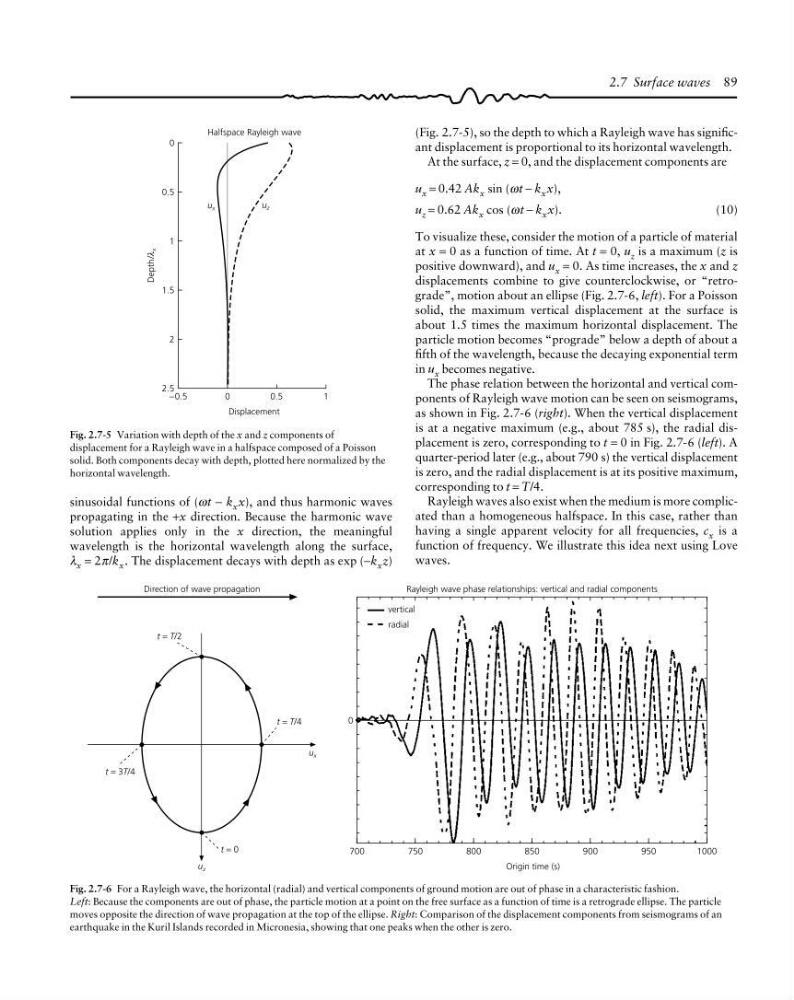
(Fig. 2.7-5), so the depth to which a Rayleigh wave has significant displacement is proportional to its horizontal wavelength.
At the surface, z = 0, and the displacement components are
u x = 0.42 Ak x sin (ωt − k x x),
u z = 0.62 Ak x cos (ωt − k x x).
(10)
To visualize these, consider the motion of a particle of material
at x = 0 as a function of time. At t = 0, u z is a maximum (z is
positive downward), and u x = 0. As time increases, the x and z
displacements combine to give counterclockwise, or “retrograde”, motion about an ellipse (Fig. 2.7-6, left). For a Poisson
solid, the maximum vertical displacement at the surface is
about 1.5 times the maximum horizontal displacement. The
particle motion becomes “prograde” below a depth of about a
fifth of the wavelength, because the decaying exponential term
in u x becomes negative.
The phase relation between the horizontal and vertical components of Rayleigh wave motion can be seen on seismograms,
as shown in Fig. 2.7-6 (right). When the vertical displacement
is at a negative maximum (e.g., about 785 s), the radial displacement is zero, corresponding to t = 0 in Fig. 2.7-6 (left). A
quarter-period later (e.g., about 790 s) the vertical displacement
is zero, and the radial displacement is at its positive maximum,
corresponding to t = T/4.
Rayleigh waves also exist when the medium is more complicated than a homogeneous halfspace. In this case, rather than
having a single apparent velocity for all frequencies, c x is a
function of frequency. We illustrate this idea next using Love
waves.
Fig. 2.7-5 Variation with depth of the x and z components of
displacement for a Rayleigh wave in a halfspace composed of a Poisson
solid. Both components decay with depth, plotted here normalized by the
horizontal wavelength.
Fig. 2.7-6 For a Rayleigh wave, the horizontal (radial) and vertical components of ground motion are out of phase in a characteristic fashion.
Left: Because the components are out of phase, the particle motion at a point on the free surface as a function of time is a retrograde ellipse. The particle
moves opposite the direction of wave propagation at the top of the ellipse. Right: Comparison of the displacement components from seismograms of an
earthquake in the Kuril Islands recorded in Micronesia, showing that one peaks when the other is zero.
0
700
Origin time (s)
1000
u x
u z
t = 3T/4
t = T/4
t = 0
t = T/2
Direction of wave propagation
750
800
850
900
950
Rayleigh wave phase relationships: vertical and radial components
vertical
radial
2.7 Surface waves 89
Depth/
x
0
0.5
1
1.5
2
2.5
−0.5
Displacement
0
0.5
1
u x
λ
u z
Halfspace Rayleigh wave
sinusoidal functions of (ωt − k x x), and thus harmonic waves
propagating in the +x direction. Because the harmonic wave
solution applies only in the x direction, the meaningful
wavelength is the horizontal wavelength along the surface,
λ x = 2π/k x . The displacement decays with depth as exp (−k x z)
At the surface, z = 0, and the displacement components are
u x = 0.42 Ak x sin (ωt − k x x),
u z = 0.62 Ak x cos (ωt − k x x).
(10)
To visualize these, consider the motion of a particle of material
at x = 0 as a function of time. At t = 0, u z is a maximum (z is
positive downward), and u x = 0. As time increases, the x and z
displacements combine to give counterclockwise, or “retrograde”, motion about an ellipse (Fig. 2.7-6, left). For a Poisson
solid, the maximum vertical displacement at the surface is
about 1.5 times the maximum horizontal displacement. The
particle motion becomes “prograde” below a depth of about a
fifth of the wavelength, because the decaying exponential term
in u x becomes negative.
The phase relation between the horizontal and vertical components of Rayleigh wave motion can be seen on seismograms,
as shown in Fig. 2.7-6 (right). When the vertical displacement
is at a negative maximum (e.g., about 785 s), the radial displacement is zero, corresponding to t = 0 in Fig. 2.7-6 (left). A
quarter-period later (e.g., about 790 s) the vertical displacement
is zero, and the radial displacement is at its positive maximum,
corresponding to t = T/4.
Rayleigh waves also exist when the medium is more complicated than a homogeneous halfspace. In this case, rather than
having a single apparent velocity for all frequencies, c x is a
function of frequency. We illustrate this idea next using Love
waves.
Fig. 2.7-5 Variation with depth of the x and z components of
displacement for a Rayleigh wave in a halfspace composed of a Poisson
solid. Both components decay with depth, plotted here normalized by the
horizontal wavelength.
Fig. 2.7-6 For a Rayleigh wave, the horizontal (radial) and vertical components of ground motion are out of phase in a characteristic fashion.
Left: Because the components are out of phase, the particle motion at a point on the free surface as a function of time is a retrograde ellipse. The particle
moves opposite the direction of wave propagation at the top of the ellipse. Right: Comparison of the displacement components from seismograms of an
earthquake in the Kuril Islands recorded in Micronesia, showing that one peaks when the other is zero.
0
700
Origin time (s)
1000
u x
u z
t = 3T/4
t = T/4
t = 0
t = T/2
Direction of wave propagation
750
800
850
900
950
Rayleigh wave phase relationships: vertical and radial components
vertical
radial
2.7 Surface waves 89
Depth/
x
0
0.5
1
1.5
2
2.5
−0.5
Displacement
0
0.5
1
u x
λ
u z
Halfspace Rayleigh wave
sinusoidal functions of (ωt − k x x), and thus harmonic waves
propagating in the +x direction. Because the harmonic wave
solution applies only in the x direction, the meaningful
wavelength is the horizontal wavelength along the surface,
λ x = 2π/k x . The displacement decays with depth as exp (−k x z)