

88 Basic Seismological Theory
Time (hours)
3
2
1
0 0
60
120
180
Range (°)
R 1
R 2
R 4
R 3
0
60
120
180
Range (°)
3
Time (hours)
6
5
4
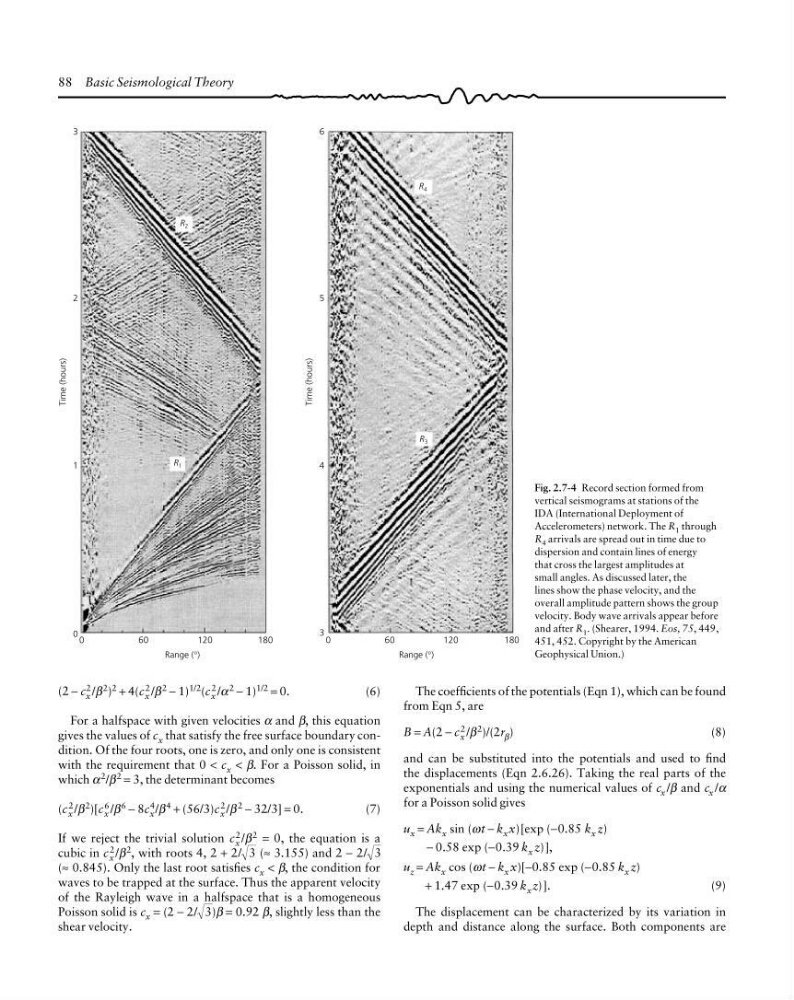
Fig. 2.7-4 Record section formed from
vertical seismograms at stations of the
IDA (International Deployment of
Accelerometers) network. The R 1 through
R 4 arrivals are spread out in time due to
dispersion and contain lines of energy
that cross the largest amplitudes at
small angles. As discussed later, the
lines show the phase velocity, and the
overall amplitude pattern shows the group
velocity. Body wave arrivals appear before
and after R 1 . (Shearer, 1994. Eos, 75, 449,
451, 452. Copyright by the American
Geophysical Union.)
The coefficients of the potentials (Eqn 1), which can be found
from Eqn 5, are
B = A(2 − c 2
x /β 2 )/(2r β )
(8)
and can be substituted into the potentials and used to find
the displacements (Eqn 2.6.26). Taking the real parts of the
exponentials and using the numerical values of c x /β and c x /α
for a Poisson solid gives
u x = Ak x sin (ωt − k x x)[exp (−0.85 k x z)
− 0.58 exp (−0.39 k x z)],
u z = Ak x cos (ωt − k x x)[−0.85 exp (−0.85 k x z)
+ 1.47 exp (−0.39 k x z)].
(9)
The displacement can be characterized by its variation in
depth and distance along the surface. Both components are
(2 − c 2
x /β 2 ) 2 + 4(c 2
x /β 2 − 1) 1/2 (c 2
x /α 2 − 1) 1/2 = 0.
(6)
For a halfspace with given velocities α and β, this equation
gives the values of c x that satisfy the free surface boundary condition. Of the four roots, one is zero, and only one is consistent
with the requirement that 0 < c x < β. For a Poisson solid, in
which α 2 /β 2 = 3, the determinant becomes
(c
2
x /β
2 )[c
6
x /β
6
− 8c
4
x /β
4
+ (56/3)c
2
x /β
2
− 32/3] = 0.
(7)
If we reject the trivial solution c 2
x /β 2 = 0, the equation is a
cubic in c
2
x /β
2
, with roots 4, 2 + 2/ 3 (≈ 3.155) and 2 − 2/ 3
(≈ 0.845). Only the last root satisfies c x < β, the condition for
waves to be trapped at the surface. Thus the apparent velocity
of the Rayleigh wave in a halfspace that is a homogeneous
Poisson solid is c x = (2 − 2/ 3 )β = 0.92 β, slightly less than the
shear velocity.
Time (hours)
3
2
1
0 0
60
120
180
Range (°)
R 1
R 2
R 4
R 3
0
60
120
180
Range (°)
3
Time (hours)
6
5
4
Fig. 2.7-4 Record section formed from
vertical seismograms at stations of the
IDA (International Deployment of
Accelerometers) network. The R 1 through
R 4 arrivals are spread out in time due to
dispersion and contain lines of energy
that cross the largest amplitudes at
small angles. As discussed later, the
lines show the phase velocity, and the
overall amplitude pattern shows the group
velocity. Body wave arrivals appear before
and after R 1 . (Shearer, 1994. Eos, 75, 449,
451, 452. Copyright by the American
Geophysical Union.)
The coefficients of the potentials (Eqn 1), which can be found
from Eqn 5, are
B = A(2 − c 2
x /β 2 )/(2r β )
(8)
and can be substituted into the potentials and used to find
the displacements (Eqn 2.6.26). Taking the real parts of the
exponentials and using the numerical values of c x /β and c x /α
for a Poisson solid gives
u x = Ak x sin (ωt − k x x)[exp (−0.85 k x z)
− 0.58 exp (−0.39 k x z)],
u z = Ak x cos (ωt − k x x)[−0.85 exp (−0.85 k x z)
+ 1.47 exp (−0.39 k x z)].
(9)
The displacement can be characterized by its variation in
depth and distance along the surface. Both components are
(2 − c 2
x /β 2 ) 2 + 4(c 2
x /β 2 − 1) 1/2 (c 2
x /α 2 − 1) 1/2 = 0.
(6)
For a halfspace with given velocities α and β, this equation
gives the values of c x that satisfy the free surface boundary condition. Of the four roots, one is zero, and only one is consistent
with the requirement that 0 < c x < β. For a Poisson solid, in
which α 2 /β 2 = 3, the determinant becomes
(c
2
x /β
2 )[c
6
x /β
6
− 8c
4
x /β
4
+ (56/3)c
2
x /β
2
− 32/3] = 0.
(7)
If we reject the trivial solution c 2
x /β 2 = 0, the equation is a
cubic in c
2
x /β
2
, with roots 4, 2 + 2/ 3 (≈ 3.155) and 2 − 2/ 3
(≈ 0.845). Only the last root satisfies c x < β, the condition for
waves to be trapped at the surface. Thus the apparent velocity
of the Rayleigh wave in a halfspace that is a homogeneous
Poisson solid is c x = (2 − 2/ 3 )β = 0.92 β, slightly less than the
shear velocity.