

2.7.2 Rayleigh waves in a homogeneous halfspace
Rayleigh waves are a combination of P and SV waves that can
exist at the top of a homogeneous halfspace. To describe them,
we define the free surface as z = 0, measure z downward, and
use potentials for waves propagating in the x–z plane. We
consider only P and SV waves, because they can satisfy the free
surface boundary conditions and do not interact with SH
waves. The P and SV potentials are
φ = A exp (i(ωt − k x x − k x r α z)),
ψ = B exp (i(ωt − k x x − k x r β z)).
(1)
For a combination of these potentials to describe energy
trapped near the free surface, two conditions must apply. The
solution must both ensure that the energy does not propagate
away from the surface and satisfy the free surface boundary
conditions.
For the energy to be trapped near the surface, the exponentials exp (−ik x r α z) and exp (−ik x r β z) must have negative real
exponents, so that the displacement will decay as z → ∞. Because
r α = (c 2
x /α 2 − 1) 1/2 , r β = (c 2
x /β 2 − 1) 1/2 ,
(2)
this radiation condition requires that c x < β < α, so that both
square roots become imaginary, with a choice of sign such that
r α = −i(1 − c 2
x /α 2 ) 1/2 , r β = −i(1 − c 2
x /β 2 ) 1/2 .
(3)
Thus c x , the apparent velocity along the surface, must be less
than the shear velocity.
The other condition, the vanishing of traction at the free
surface, arose for the P–SV reflection at a free surface (Section
2.6.5). The difference here is that the boundary conditions are
satisfied with no incident wave. Using Eqn 2.6.28 without an
incident wave shows that when the stress components are expressed in terms of the potentials, the amplitudes A and B must
satisfy the continuity equations
σ xz (x, 0, t) = 0 = 2r α A + (1 − r 2
β )B,
σ zz (x, 0, t) = 0 = [λ(1 + r 2
α ) + 2µr 2
α ]A + 2µr β B.
(4)
Eliminating the Lamé constants from the second equation
using (1 + r 2
α ) = c 2
x /α 2 and the definitions of the velocities α and
β gives a system of two homogeneous linear equations for
A and B,
2(c 2
x /α 2 − 1) 1/2 A + (2 − c 2
x /β 2 )B = 0,
(c 2
x /β 2 − 2)A + 2(c 2
x /β 2 − 1) 1/2 B = 0.
(5)
This system has nontrivial solutions if the determinant of the
system is zero (Section A.4.4), such that
Fig. 2.7-2 Geometry for surface waves propagating in a vertical plane
containing the source and receiver. Rayleigh (P–SV ) waves appear on the
vertical and radial components. Love (SH) waves appear on the transverse
component.
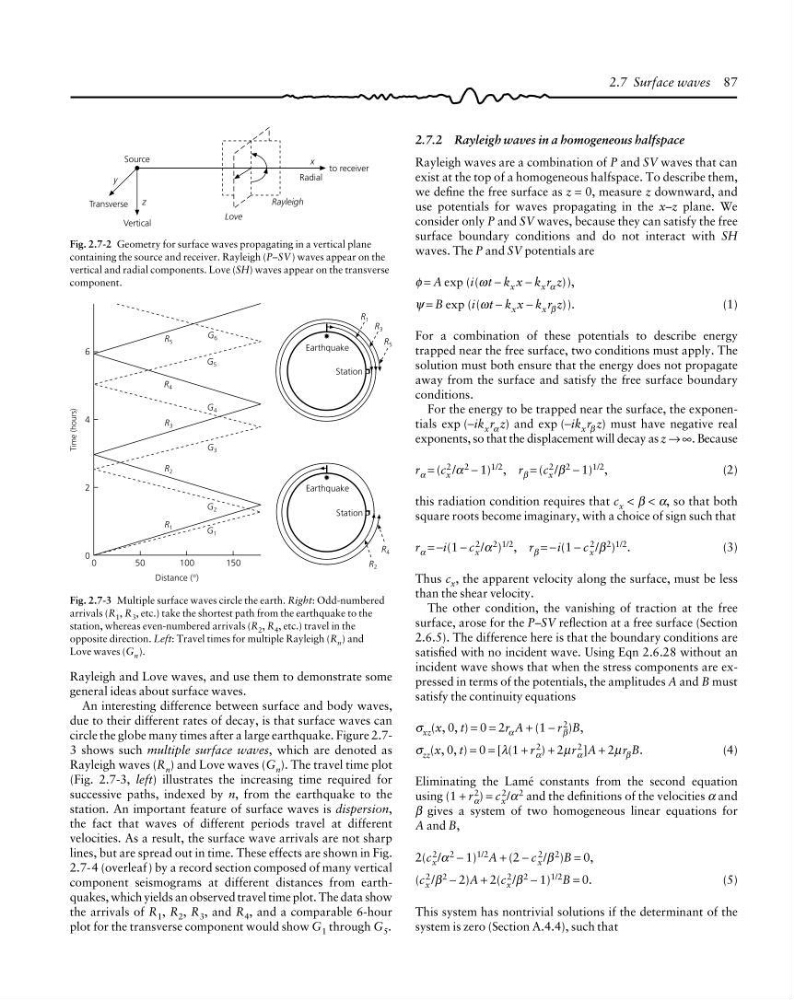
Fig. 2.7-3 Multiple surface waves circle the earth. Right: Odd-numbered
arrivals (R 1 , R 3 , etc.) take the shortest path from the earthquake to the
station, whereas even-numbered arrivals (R 2 , R 4 , etc.) travel in the
opposite direction. Left: Travel times for multiple Rayleigh (R n ) and
Love waves (G n ).
2.7 Surface waves 87
y
Transverse
z
Vertical
Source
to receiver
Radial
x
Love
Rayleigh
Rayleigh and Love waves, and use them to demonstrate some
general ideas about surface waves.
An interesting difference between surface and body waves,
due to their different rates of decay, is that surface waves can
circle the globe many times after a large earthquake. Figure 2.73 shows such multiple surface waves, which are denoted as
Rayleigh waves (R n ) and Love waves (G n ). The travel time plot
(Fig. 2.7-3, left) illustrates the increasing time required for
successive paths, indexed by n, from the earthquake to the
station. An important feature of surface waves is dispersion,
the fact that waves of different periods travel at different
velocities. As a result, the surface wave arrivals are not sharp
lines, but are spread out in time. These effects are shown in Fig.
2.7-4 (overleaf ) by a record section composed of many vertical
component seismograms at different distances from earthquakes, which yields an observed travel time plot. The data show
the arrivals of R 1 , R 2 , R 3 , and R 4 , and a comparable 6-hour
plot for the transverse component would show G 1 through G 5 .
R 5
R 3
R 1
R 4
R 5
G 6
G 5
R 4
G 4
R 3
G 3
R 2
G 2
R 1
G 1
Time (hours)
6
4
2
0
0
Distance (°)
50
100
150
Earthquake
Station
Earthquake
Station
R 2
Rayleigh waves are a combination of P and SV waves that can
exist at the top of a homogeneous halfspace. To describe them,
we define the free surface as z = 0, measure z downward, and
use potentials for waves propagating in the x–z plane. We
consider only P and SV waves, because they can satisfy the free
surface boundary conditions and do not interact with SH
waves. The P and SV potentials are
φ = A exp (i(ωt − k x x − k x r α z)),
ψ = B exp (i(ωt − k x x − k x r β z)).
(1)
For a combination of these potentials to describe energy
trapped near the free surface, two conditions must apply. The
solution must both ensure that the energy does not propagate
away from the surface and satisfy the free surface boundary
conditions.
For the energy to be trapped near the surface, the exponentials exp (−ik x r α z) and exp (−ik x r β z) must have negative real
exponents, so that the displacement will decay as z → ∞. Because
r α = (c 2
x /α 2 − 1) 1/2 , r β = (c 2
x /β 2 − 1) 1/2 ,
(2)
this radiation condition requires that c x < β < α, so that both
square roots become imaginary, with a choice of sign such that
r α = −i(1 − c 2
x /α 2 ) 1/2 , r β = −i(1 − c 2
x /β 2 ) 1/2 .
(3)
Thus c x , the apparent velocity along the surface, must be less
than the shear velocity.
The other condition, the vanishing of traction at the free
surface, arose for the P–SV reflection at a free surface (Section
2.6.5). The difference here is that the boundary conditions are
satisfied with no incident wave. Using Eqn 2.6.28 without an
incident wave shows that when the stress components are expressed in terms of the potentials, the amplitudes A and B must
satisfy the continuity equations
σ xz (x, 0, t) = 0 = 2r α A + (1 − r 2
β )B,
σ zz (x, 0, t) = 0 = [λ(1 + r 2
α ) + 2µr 2
α ]A + 2µr β B.
(4)
Eliminating the Lamé constants from the second equation
using (1 + r 2
α ) = c 2
x /α 2 and the definitions of the velocities α and
β gives a system of two homogeneous linear equations for
A and B,
2(c 2
x /α 2 − 1) 1/2 A + (2 − c 2
x /β 2 )B = 0,
(c 2
x /β 2 − 2)A + 2(c 2
x /β 2 − 1) 1/2 B = 0.
(5)
This system has nontrivial solutions if the determinant of the
system is zero (Section A.4.4), such that
Fig. 2.7-2 Geometry for surface waves propagating in a vertical plane
containing the source and receiver. Rayleigh (P–SV ) waves appear on the
vertical and radial components. Love (SH) waves appear on the transverse
component.
Fig. 2.7-3 Multiple surface waves circle the earth. Right: Odd-numbered
arrivals (R 1 , R 3 , etc.) take the shortest path from the earthquake to the
station, whereas even-numbered arrivals (R 2 , R 4 , etc.) travel in the
opposite direction. Left: Travel times for multiple Rayleigh (R n ) and
Love waves (G n ).
2.7 Surface waves 87
y
Transverse
z
Vertical
Source
to receiver
Radial
x
Love
Rayleigh
Rayleigh and Love waves, and use them to demonstrate some
general ideas about surface waves.
An interesting difference between surface and body waves,
due to their different rates of decay, is that surface waves can
circle the globe many times after a large earthquake. Figure 2.73 shows such multiple surface waves, which are denoted as
Rayleigh waves (R n ) and Love waves (G n ). The travel time plot
(Fig. 2.7-3, left) illustrates the increasing time required for
successive paths, indexed by n, from the earthquake to the
station. An important feature of surface waves is dispersion,
the fact that waves of different periods travel at different
velocities. As a result, the surface wave arrivals are not sharp
lines, but are spread out in time. These effects are shown in Fig.
2.7-4 (overleaf ) by a record section composed of many vertical
component seismograms at different distances from earthquakes, which yields an observed travel time plot. The data show
the arrivals of R 1 , R 2 , R 3 , and R 4 , and a comparable 6-hour
plot for the transverse component would show G 1 through G 5 .
R 5
R 3
R 1
R 4
R 5
G 6
G 5
R 4
G 4
R 3
G 3
R 2
G 2
R 1
G 1
Time (hours)
6
4
2
0
0
Distance (°)
50
100
150
Earthquake
Station
Earthquake
Station
R 2