

86 Basic Seismological Theory
× 10+4
−5
Vertical
15
20
25
30
35
40
45
Rayleigh
× 10+4
× 10+4
× 10+2
0
5
5
0
−5
−10
10
5
0
−5
−10
PKKP
SP
PP
P diff
Transverse
S diff
Love
Radial
SKKS
SKS
SS
SSS
S4
Rayleigh
10
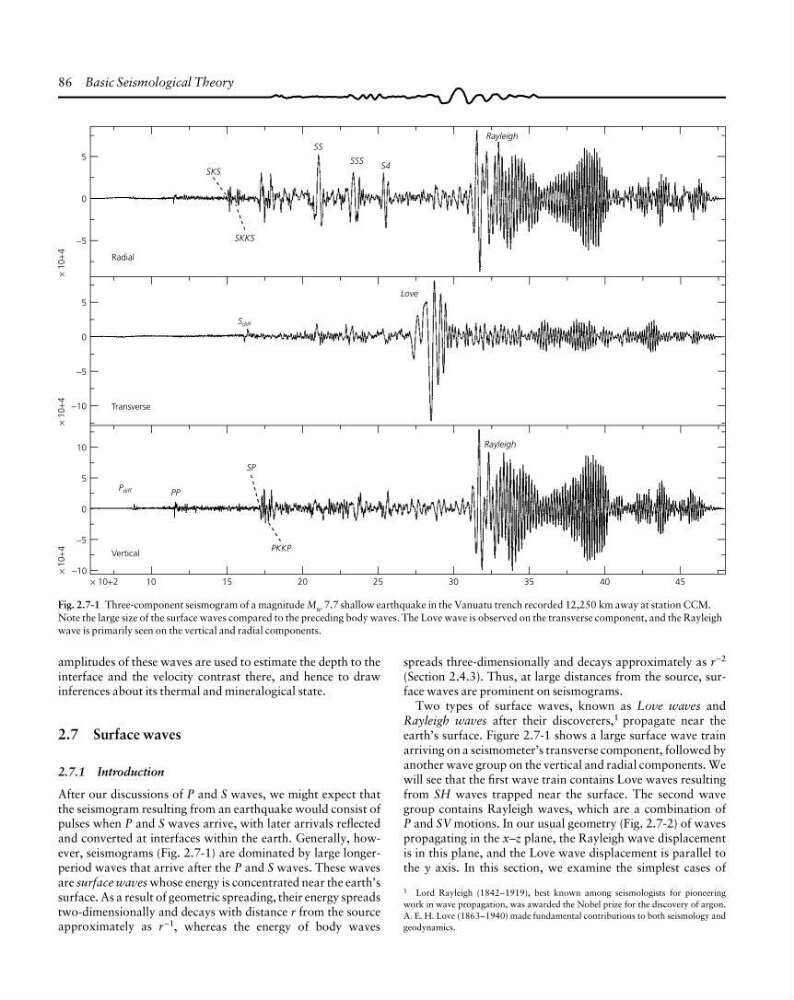
Fig. 2.7-1 Three-component seismogram of a magnitude M w 7.7 shallow earthquake in the Vanuatu trench recorded 12,250 km away at station CCM.
Note the large size of the surface waves compared to the preceding body waves. The Love wave is observed on the transverse component, and the Rayleigh
wave is primarily seen on the vertical and radial components.
1 Lord Rayleigh (1842–1919), best known among seismologists for pioneering
work in wave propagation, was awarded the Nobel prize for the discovery of argon.
A. E. H. Love (1863–1940) made fundamental contributions to both seismology and
geodynamics.
amplitudes of these waves are used to estimate the depth to the
interface and the velocity contrast there, and hence to draw
inferences about its thermal and mineralogical state.
2.7 Surface waves
2.7.1 Introduction
After our discussions of P and S waves, we might expect that
the seismogram resulting from an earthquake would consist of
pulses when P and S waves arrive, with later arrivals reflected
and converted at interfaces within the earth. Generally, however, seismograms (Fig. 2.7-1) are dominated by large longerperiod waves that arrive after the P and S waves. These waves
are surface waves whose energy is concentrated near the earth’s
surface. As a result of geometric spreading, their energy spreads
two-dimensionally and decays with distance r from the source
approximately as r −1 , whereas the energy of body waves
spreads three-dimensionally and decays approximately as r
−2
(Section 2.4.3). Thus, at large distances from the source, surface waves are prominent on seismograms.
Two types of surface waves, known as Love waves and
Rayleigh waves after their discoverers, 1 propagate near the
earth’s surface. Figure 2.7-1 shows a large surface wave train
arriving on a seismometer’s transverse component, followed by
another wave group on the vertical and radial components. We
will see that the first wave train contains Love waves resulting
from SH waves trapped near the surface. The second wave
group contains Rayleigh waves, which are a combination of
P and SV motions. In our usual geometry (Fig. 2.7-2) of waves
propagating in the x–z plane, the Rayleigh wave displacement
is in this plane, and the Love wave displacement is parallel to
the y axis. In this section, we examine the simplest cases of
× 10+4
−5
Vertical
15
20
25
30
35
40
45
Rayleigh
× 10+4
× 10+4
× 10+2
0
5
5
0
−5
−10
10
5
0
−5
−10
PKKP
SP
PP
P diff
Transverse
S diff
Love
Radial
SKKS
SKS
SS
SSS
S4
Rayleigh
10
Fig. 2.7-1 Three-component seismogram of a magnitude M w 7.7 shallow earthquake in the Vanuatu trench recorded 12,250 km away at station CCM.
Note the large size of the surface waves compared to the preceding body waves. The Love wave is observed on the transverse component, and the Rayleigh
wave is primarily seen on the vertical and radial components.
1 Lord Rayleigh (1842–1919), best known among seismologists for pioneering
work in wave propagation, was awarded the Nobel prize for the discovery of argon.
A. E. H. Love (1863–1940) made fundamental contributions to both seismology and
geodynamics.
amplitudes of these waves are used to estimate the depth to the
interface and the velocity contrast there, and hence to draw
inferences about its thermal and mineralogical state.
2.7 Surface waves
2.7.1 Introduction
After our discussions of P and S waves, we might expect that
the seismogram resulting from an earthquake would consist of
pulses when P and S waves arrive, with later arrivals reflected
and converted at interfaces within the earth. Generally, however, seismograms (Fig. 2.7-1) are dominated by large longerperiod waves that arrive after the P and S waves. These waves
are surface waves whose energy is concentrated near the earth’s
surface. As a result of geometric spreading, their energy spreads
two-dimensionally and decays with distance r from the source
approximately as r −1 , whereas the energy of body waves
spreads three-dimensionally and decays approximately as r
−2
(Section 2.4.3). Thus, at large distances from the source, surface waves are prominent on seismograms.
Two types of surface waves, known as Love waves and
Rayleigh waves after their discoverers, 1 propagate near the
earth’s surface. Figure 2.7-1 shows a large surface wave train
arriving on a seismometer’s transverse component, followed by
another wave group on the vertical and radial components. We
will see that the first wave train contains Love waves resulting
from SH waves trapped near the surface. The second wave
group contains Rayleigh waves, which are a combination of
P and SV motions. In our usual geometry (Fig. 2.7-2) of waves
propagating in the x–z plane, the Rayleigh wave displacement
is in this plane, and the Love wave displacement is parallel to
the y axis. In this section, we examine the simplest cases of