

82
M. D. Alba-Rodríguez et al.
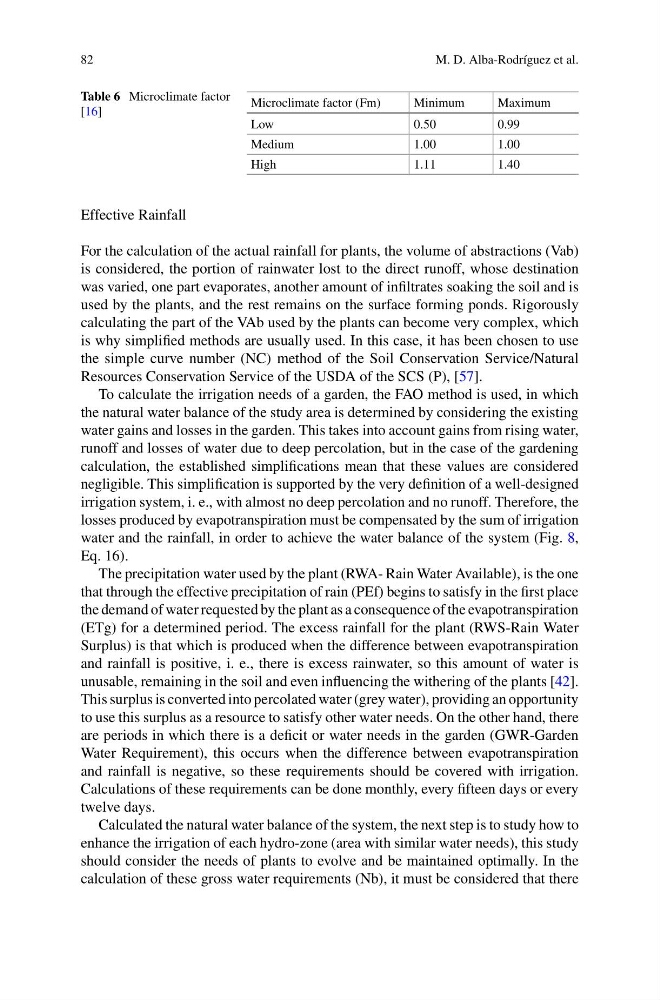
Table 6 Microclimate factor
[16]
Microclimate factor (Fm)
Minimum
Maximum
Low
0.50
0.99
Medium
1.00
1.00
High
1.11
1.40
Effective Rainfall
For the calculation of the actual rainfall for plants, the volume of abstractions (Vab)
is considered, the portion of rainwater lost to the direct runoff, whose destination
was varied, one part evaporates, another amount of infiltrates soaking the soil and is
used by the plants, and the rest remains on the surface forming ponds. Rigorously
calculating the part of the VAb used by the plants can become very complex, which
is why simplified methods are usually used. In this case, it has been chosen to use
the simple curve number (NC) method of the Soil Conservation Service/Natural
Resources Conservation Service of the USDA of the SCS (P), [57].
To calculate the irrigation needs of a garden, the FAO method is used, in which
the natural water balance of the study area is determined by considering the existing
water gains and losses in the garden. This takes into account gains from rising water,
runoff and losses of water due to deep percolation, but in the case of the gardening
calculation, the established simplifications mean that these values are considered
negligible. This simplification is supported by the very definition of a well-designed
irrigation system, i. e., with almost no deep percolation and no runoff. Therefore, the
losses produced by evapotranspiration must be compensated by the sum of irrigation
water and the rainfall, in order to achieve the water balance of the system (Fig. 8,
Eq. 16).
The precipitation water used by the plant (RWA- Rain Water Available), is the one
that through the effective precipitation of rain (PEf) begins to satisfy in the first place
the demand of water requested by the plant as a consequence of the evapotranspiration
(ETg) for a determined period. The excess rainfall for the plant (RWS-Rain Water
Surplus) is that which is produced when the difference between evapotranspiration
and rainfall is positive, i. e., there is excess rainwater, so this amount of water is
unusable, remaining in the soil and even influencing the withering of the plants [42].
This surplus is converted into percolated water (grey water), providing an opportunity
to use this surplus as a resource to satisfy other water needs. On the other hand, there
are periods in which there is a deficit or water needs in the garden (GWR-Garden
Water Requirement), this occurs when the difference between evapotranspiration
and rainfall is negative, so these requirements should be covered with irrigation.
Calculations of these requirements can be done monthly, every fifteen days or every
twelve days.
Calculated the natural water balance of the system, the next step is to study how to
enhance the irrigation of each hydro-zone (area with similar water needs), this study
should consider the needs of plants to evolve and be maintained optimally. In the
calculation of these gross water requirements (Nb), it must be considered that there
M. D. Alba-Rodríguez et al.
Table 6 Microclimate factor
[16]
Microclimate factor (Fm)
Minimum
Maximum
Low
0.50
0.99
Medium
1.00
1.00
High
1.11
1.40
Effective Rainfall
For the calculation of the actual rainfall for plants, the volume of abstractions (Vab)
is considered, the portion of rainwater lost to the direct runoff, whose destination
was varied, one part evaporates, another amount of infiltrates soaking the soil and is
used by the plants, and the rest remains on the surface forming ponds. Rigorously
calculating the part of the VAb used by the plants can become very complex, which
is why simplified methods are usually used. In this case, it has been chosen to use
the simple curve number (NC) method of the Soil Conservation Service/Natural
Resources Conservation Service of the USDA of the SCS (P), [57].
To calculate the irrigation needs of a garden, the FAO method is used, in which
the natural water balance of the study area is determined by considering the existing
water gains and losses in the garden. This takes into account gains from rising water,
runoff and losses of water due to deep percolation, but in the case of the gardening
calculation, the established simplifications mean that these values are considered
negligible. This simplification is supported by the very definition of a well-designed
irrigation system, i. e., with almost no deep percolation and no runoff. Therefore, the
losses produced by evapotranspiration must be compensated by the sum of irrigation
water and the rainfall, in order to achieve the water balance of the system (Fig. 8,
Eq. 16).
The precipitation water used by the plant (RWA- Rain Water Available), is the one
that through the effective precipitation of rain (PEf) begins to satisfy in the first place
the demand of water requested by the plant as a consequence of the evapotranspiration
(ETg) for a determined period. The excess rainfall for the plant (RWS-Rain Water
Surplus) is that which is produced when the difference between evapotranspiration
and rainfall is positive, i. e., there is excess rainwater, so this amount of water is
unusable, remaining in the soil and even influencing the withering of the plants [42].
This surplus is converted into percolated water (grey water), providing an opportunity
to use this surplus as a resource to satisfy other water needs. On the other hand, there
are periods in which there is a deficit or water needs in the garden (GWR-Garden
Water Requirement), this occurs when the difference between evapotranspiration
and rainfall is negative, so these requirements should be covered with irrigation.
Calculations of these requirements can be done monthly, every fifteen days or every
twelve days.
Calculated the natural water balance of the system, the next step is to study how to
enhance the irrigation of each hydro-zone (area with similar water needs), this study
should consider the needs of plants to evolve and be maintained optimally. In the
calculation of these gross water requirements (Nb), it must be considered that there