

Industrial Water Footprint: Case Study on Textile Industries
49
12.1 Blue and Green Water Footprint in Cotton Cultivation
Water footprint in the agricultural processing of cotton crops can be ascribed mainly
to water used for the growth of cotton crops, which mainly depends upon the water
obtained from rainfall and irrigation water supplied. The evaporation of infiltrated
rainwater attributes to the green water footprint, whereas the surface or groundwater
extracted for irrigation constitutes the blue water footprint. The ratio of green to blue
water footprint in agricultural activities may vary significantly based on the climatic
and growth conditions of a particular region. Tropical places may receive higher
annual rainfall which may increase the green water consumption comparatively.
Places with limited rainfall periods annually may depend more upon the irrigation
water for the growth of crops.
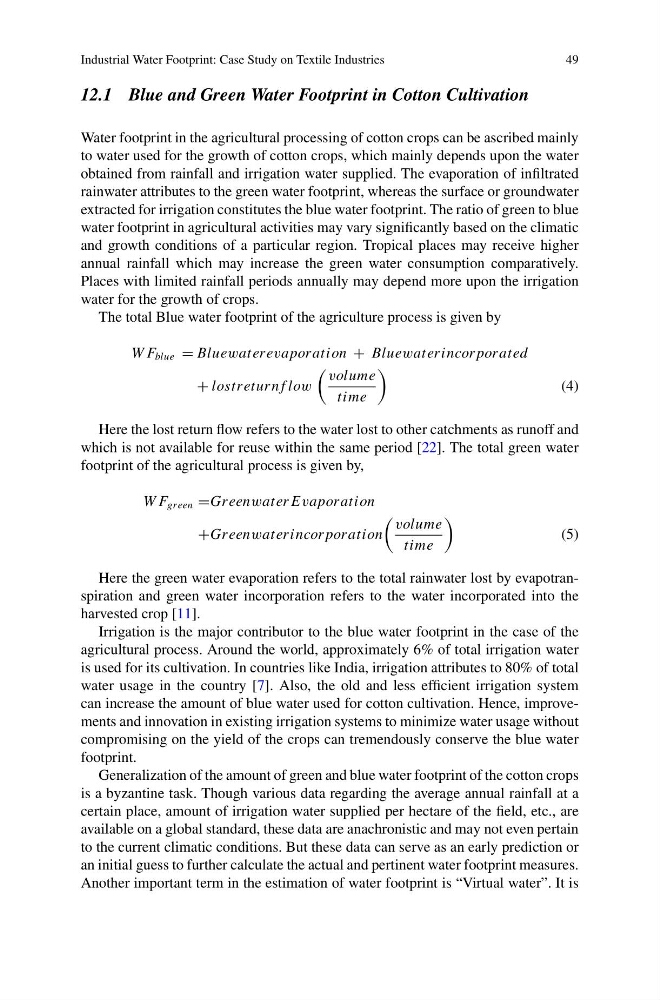
The total Blue water footprint of the agriculture process is given by
W F blue = Bluewaterevaporation + Bluewaterincor porated
+ lostreturn f low
volume
time
(4)
Here the lost return flow refers to the water lost to other catchments as runoff and
which is not available for reuse within the same period [22]. The total green water
footprint of the agricultural process is given by,
W F green =Greenwater Evaporation
+Greenwaterincor poration
volume
time
(5)
Here the green water evaporation refers to the total rainwater lost by evapotranspiration and green water incorporation refers to the water incorporated into the
harvested crop [11].
Irrigation is the major contributor to the blue water footprint in the case of the
agricultural process. Around the world, approximately 6% of total irrigation water
is used for its cultivation. In countries like India, irrigation attributes to 80% of total
water usage in the country [7]. Also, the old and less efficient irrigation system
can increase the amount of blue water used for cotton cultivation. Hence, improvements and innovation in existing irrigation systems to minimize water usage without
compromising on the yield of the crops can tremendously conserve the blue water
footprint.
Generalization of the amount of green and blue water footprint of the cotton crops
is a byzantine task. Though various data regarding the average annual rainfall at a
certain place, amount of irrigation water supplied per hectare of the field, etc., are
available on a global standard, these data are anachronistic and may not even pertain
to the current climatic conditions. But these data can serve as an early prediction or
an initial guess to further calculate the actual and pertinent water footprint measures.
Another important term in the estimation of water footprint is “Virtual water”. It is
49
12.1 Blue and Green Water Footprint in Cotton Cultivation
Water footprint in the agricultural processing of cotton crops can be ascribed mainly
to water used for the growth of cotton crops, which mainly depends upon the water
obtained from rainfall and irrigation water supplied. The evaporation of infiltrated
rainwater attributes to the green water footprint, whereas the surface or groundwater
extracted for irrigation constitutes the blue water footprint. The ratio of green to blue
water footprint in agricultural activities may vary significantly based on the climatic
and growth conditions of a particular region. Tropical places may receive higher
annual rainfall which may increase the green water consumption comparatively.
Places with limited rainfall periods annually may depend more upon the irrigation
water for the growth of crops.
The total Blue water footprint of the agriculture process is given by
W F blue = Bluewaterevaporation + Bluewaterincor porated
+ lostreturn f low
volume
time
(4)
Here the lost return flow refers to the water lost to other catchments as runoff and
which is not available for reuse within the same period [22]. The total green water
footprint of the agricultural process is given by,
W F green =Greenwater Evaporation
+Greenwaterincor poration
volume
time
(5)
Here the green water evaporation refers to the total rainwater lost by evapotranspiration and green water incorporation refers to the water incorporated into the
harvested crop [11].
Irrigation is the major contributor to the blue water footprint in the case of the
agricultural process. Around the world, approximately 6% of total irrigation water
is used for its cultivation. In countries like India, irrigation attributes to 80% of total
water usage in the country [7]. Also, the old and less efficient irrigation system
can increase the amount of blue water used for cotton cultivation. Hence, improvements and innovation in existing irrigation systems to minimize water usage without
compromising on the yield of the crops can tremendously conserve the blue water
footprint.
Generalization of the amount of green and blue water footprint of the cotton crops
is a byzantine task. Though various data regarding the average annual rainfall at a
certain place, amount of irrigation water supplied per hectare of the field, etc., are
available on a global standard, these data are anachronistic and may not even pertain
to the current climatic conditions. But these data can serve as an early prediction or
an initial guess to further calculate the actual and pertinent water footprint measures.
Another important term in the estimation of water footprint is “Virtual water”. It is