

50
P. S. Kumar et al.
defined as the quantity of water used to produce a commodity [4]. It is also known as
the embedded water which is analogous to the embodied energy concept mentioned
in [18]. Virtual water comprises all domestic water usage and international water
usage as well. Foreign water usage comes into the picture when the import and
export of cotton crops are considered. Various data regarding the generalization of
calculation of water footprint has been systematically computed in [21]. Research
in [21] takes into account of top 15 cotton-producing countries across the world
and gives a comprehensive report of the virtual green and virtual blue water used
for cotton growth in these countries. CROPWAT model is utilized to estimate the
effective rainwater and irrigation water used in these countries. The virtual green
water footprint is calculated as the ratio of effective rainfall to that of crop yield and
the virtual blue water footprint of a crop is calculated as the ratio of effective water
used for irrigation to that of the yield of that crop [21].
12.2 Grey Water Footprint in Cotton Cultivation
Apart from the blue and green water footprint, the leaching of fertilizers and pesticides
adds to the account of grey water footprint. Though the grey water footprint is mainly
associated with the industrial processes, this concept indicates the level of pollution
and contamination in the cotton crop growth and harvesting process. Grey water in
agricultural processes is defined as the quantity of water to assimilate or dilute this
leached water due to fertilizers so that the final concentration of contaminants is below
the permissible level. On a global level, the cotton fiber results in extensive usage of
insecticides and herbicides accounting for almost 16 and 6.8% of all insecticides and
herbicides used globally [26]. The primary pollutants present in leached water are
nitrates and phosphates that are the primal components of fertilizers and pesticides.
These leached chemicals present in the soil may penetrate the soil and debase the
ground and surface water. Furthermore, nitrate and phosphate in the surface water
can act as the nutrient source for many micro and macro algae which further reduces
the dissolved oxygen present in the water. Among the other pollutants, nitrogen is
more susceptible to leaching. It is not readily absorbed by the soil and hence results in
movement through the layers of soil. Comparatively, phosphorus has lower mobility
than nitrogen, and hence leaching of phosphorus is not a major problem, but they
react with other minerals present in the soil and form insoluble compounds. Hence,
the estimation of the grey water footprint of an agricultural process may help in
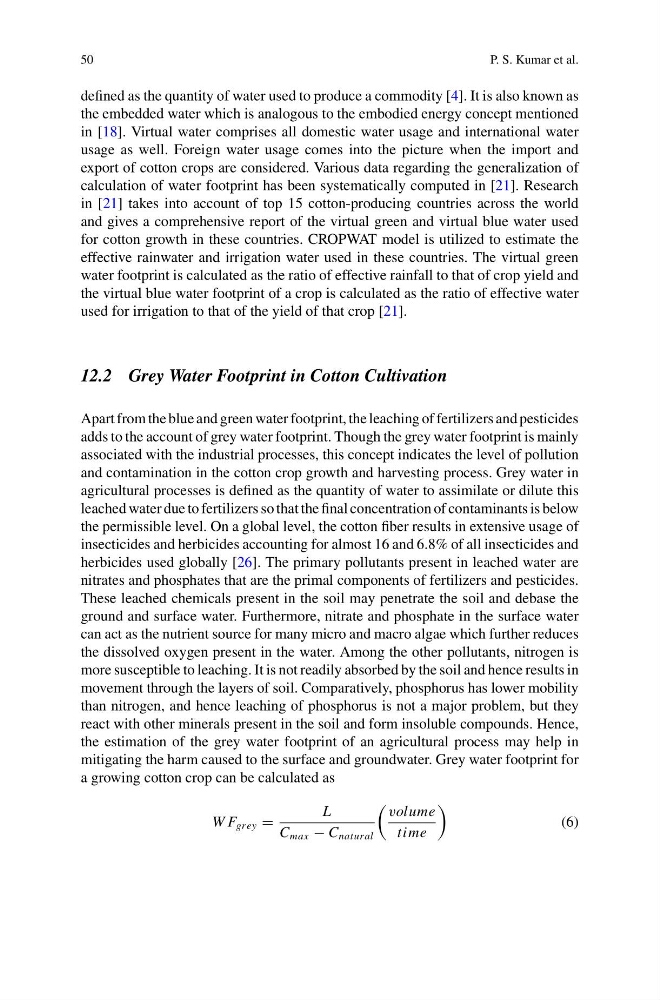
mitigating the harm caused to the surface and groundwater. Grey water footprint for
a growing cotton crop can be calculated as
W F grey =
L
C max − C natural
volume
time
(6)
P. S. Kumar et al.
defined as the quantity of water used to produce a commodity [4]. It is also known as
the embedded water which is analogous to the embodied energy concept mentioned
in [18]. Virtual water comprises all domestic water usage and international water
usage as well. Foreign water usage comes into the picture when the import and
export of cotton crops are considered. Various data regarding the generalization of
calculation of water footprint has been systematically computed in [21]. Research
in [21] takes into account of top 15 cotton-producing countries across the world
and gives a comprehensive report of the virtual green and virtual blue water used
for cotton growth in these countries. CROPWAT model is utilized to estimate the
effective rainwater and irrigation water used in these countries. The virtual green
water footprint is calculated as the ratio of effective rainfall to that of crop yield and
the virtual blue water footprint of a crop is calculated as the ratio of effective water
used for irrigation to that of the yield of that crop [21].
12.2 Grey Water Footprint in Cotton Cultivation
Apart from the blue and green water footprint, the leaching of fertilizers and pesticides
adds to the account of grey water footprint. Though the grey water footprint is mainly
associated with the industrial processes, this concept indicates the level of pollution
and contamination in the cotton crop growth and harvesting process. Grey water in
agricultural processes is defined as the quantity of water to assimilate or dilute this
leached water due to fertilizers so that the final concentration of contaminants is below
the permissible level. On a global level, the cotton fiber results in extensive usage of
insecticides and herbicides accounting for almost 16 and 6.8% of all insecticides and
herbicides used globally [26]. The primary pollutants present in leached water are
nitrates and phosphates that are the primal components of fertilizers and pesticides.
These leached chemicals present in the soil may penetrate the soil and debase the
ground and surface water. Furthermore, nitrate and phosphate in the surface water
can act as the nutrient source for many micro and macro algae which further reduces
the dissolved oxygen present in the water. Among the other pollutants, nitrogen is
more susceptible to leaching. It is not readily absorbed by the soil and hence results in
movement through the layers of soil. Comparatively, phosphorus has lower mobility
than nitrogen, and hence leaching of phosphorus is not a major problem, but they
react with other minerals present in the soil and form insoluble compounds. Hence,
the estimation of the grey water footprint of an agricultural process may help in
mitigating the harm caused to the surface and groundwater. Grey water footprint for
a growing cotton crop can be calculated as
W F grey =
L
C max − C natural
volume
time
(6)