

48
P. S. Kumar et al.
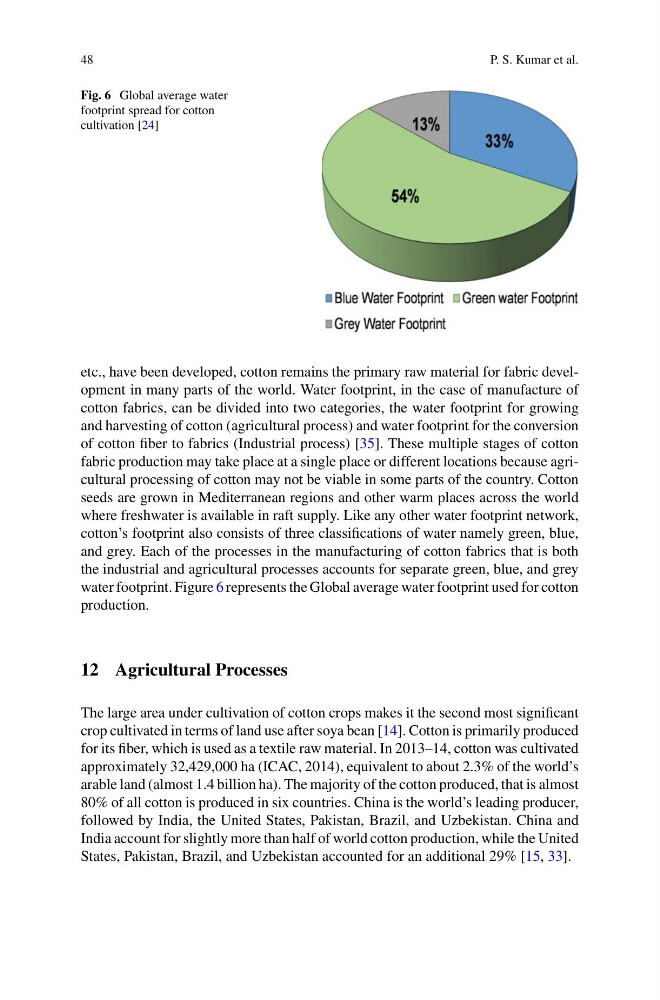
Fig. 6 Global average water
footprint spread for cotton
cultivation [24]
etc., have been developed, cotton remains the primary raw material for fabric development in many parts of the world. Water footprint, in the case of manufacture of
cotton fabrics, can be divided into two categories, the water footprint for growing
and harvesting of cotton (agricultural process) and water footprint for the conversion
of cotton fiber to fabrics (Industrial process) [35]. These multiple stages of cotton
fabric production may take place at a single place or different locations because agricultural processing of cotton may not be viable in some parts of the country. Cotton
seeds are grown in Mediterranean regions and other warm places across the world
where freshwater is available in raft supply. Like any other water footprint network,
cotton’s footprint also consists of three classifications of water namely green, blue,
and grey. Each of the processes in the manufacturing of cotton fabrics that is both
the industrial and agricultural processes accounts for separate green, blue, and grey
water footprint. Figure 6 represents the Global average water footprint used for cotton
production.
12 Agricultural Processes
The large area under cultivation of cotton crops makes it the second most significant
crop cultivated in terms of land use after soya bean [14]. Cotton is primarily produced
for its fiber, which is used as a textile raw material. In 2013–14, cotton was cultivated
approximately 32,429,000 ha (ICAC, 2014), equivalent to about 2.3% of the world’s
arable land (almost 1.4 billion ha). The majority of the cotton produced, that is almost
80% of all cotton is produced in six countries. China is the world’s leading producer,
followed by India, the United States, Pakistan, Brazil, and Uzbekistan. China and
India account for slightly more than half of world cotton production, while the United
States, Pakistan, Brazil, and Uzbekistan accounted for an additional 29% [15, 33].
P. S. Kumar et al.
Fig. 6 Global average water
footprint spread for cotton
cultivation [24]
etc., have been developed, cotton remains the primary raw material for fabric development in many parts of the world. Water footprint, in the case of manufacture of
cotton fabrics, can be divided into two categories, the water footprint for growing
and harvesting of cotton (agricultural process) and water footprint for the conversion
of cotton fiber to fabrics (Industrial process) [35]. These multiple stages of cotton
fabric production may take place at a single place or different locations because agricultural processing of cotton may not be viable in some parts of the country. Cotton
seeds are grown in Mediterranean regions and other warm places across the world
where freshwater is available in raft supply. Like any other water footprint network,
cotton’s footprint also consists of three classifications of water namely green, blue,
and grey. Each of the processes in the manufacturing of cotton fabrics that is both
the industrial and agricultural processes accounts for separate green, blue, and grey
water footprint. Figure 6 represents the Global average water footprint used for cotton
production.
12 Agricultural Processes
The large area under cultivation of cotton crops makes it the second most significant
crop cultivated in terms of land use after soya bean [14]. Cotton is primarily produced
for its fiber, which is used as a textile raw material. In 2013–14, cotton was cultivated
approximately 32,429,000 ha (ICAC, 2014), equivalent to about 2.3% of the world’s
arable land (almost 1.4 billion ha). The majority of the cotton produced, that is almost
80% of all cotton is produced in six countries. China is the world’s leading producer,
followed by India, the United States, Pakistan, Brazil, and Uzbekistan. China and
India account for slightly more than half of world cotton production, while the United
States, Pakistan, Brazil, and Uzbekistan accounted for an additional 29% [15, 33].