

Industrial Water Footprint: Case Study on Textile Industries
39
W F P G R = maximum
L[w]
C s [w] − C n [w]
(3)
The “maximum” outside standard brackets means that WFGR which is being
quantified by the most or the major critical pollutant contribution that is associated
with the largest pollutant-specific WFGR.
Water footprint network can be calculated and expressed in various forms
concerning the period of a requirement (per day or per month or per year) which
depends on the amount of data required and to what level the information of water
footprint is needed, and water footprint is always expressed as the quantity of water
in terms of volume per mass of product unit (liter/kg or m
3 /ton of products).
To estimate and quantify the water flow network and its network distribution of
corporations and products, Hoekstra in the year (2008), introduced the concept of
water footprint (WF) as a key performance indicator of the total freshwater volume
consumed for the actual process and the amount of water required for controlling
the contamination directly or indirectly across a product’s whole supply network
[19, 20, 29]. Hoekstra also developed a conclusive framework design with accurate
equations for quantifying the green, blue, and grey Water footprints of a product and
assessing their impact on environmental sustainability.
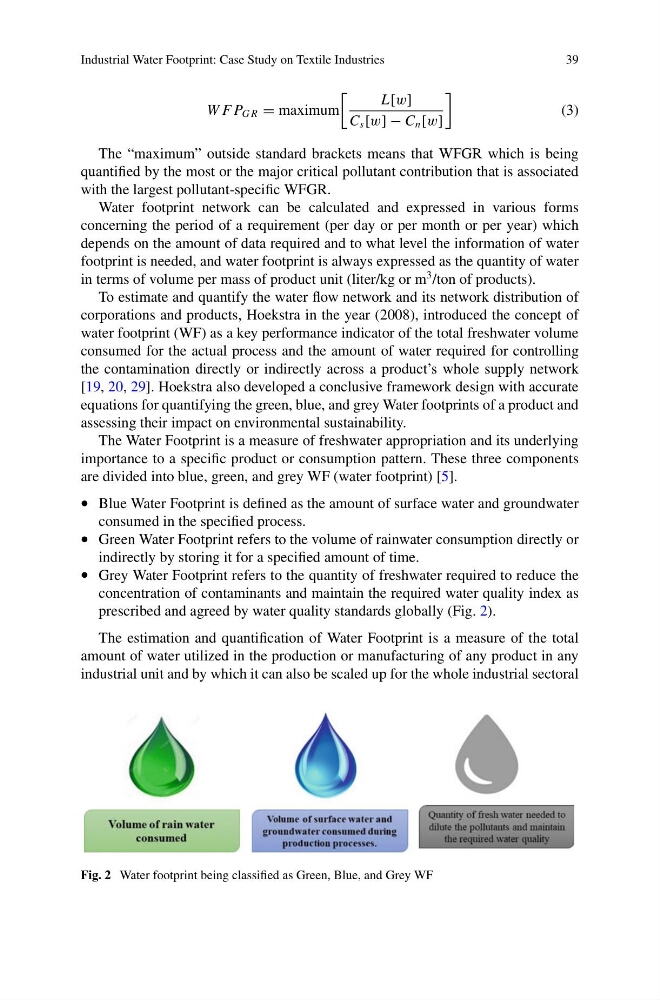
The Water Footprint is a measure of freshwater appropriation and its underlying
importance to a specific product or consumption pattern. These three components
are divided into blue, green, and grey WF (water footprint) [5].
• Blue Water Footprint is defined as the amount of surface water and groundwater
consumed in the specified process.
• Green Water Footprint refers to the volume of rainwater consumption directly or
indirectly by storing it for a specified amount of time.
• Grey Water Footprint refers to the quantity of freshwater required to reduce the
concentration of contaminants and maintain the required water quality index as
prescribed and agreed by water quality standards globally (Fig. 2).
The estimation and quantification of Water Footprint is a measure of the total
amount of water utilized in the production or manufacturing of any product in any
industrial unit and by which it can also be scaled up for the whole industrial sectoral
Fig. 2 Water footprint being classified as Green, Blue, and Grey WF
39
W F P G R = maximum
L[w]
C s [w] − C n [w]
(3)
The “maximum” outside standard brackets means that WFGR which is being
quantified by the most or the major critical pollutant contribution that is associated
with the largest pollutant-specific WFGR.
Water footprint network can be calculated and expressed in various forms
concerning the period of a requirement (per day or per month or per year) which
depends on the amount of data required and to what level the information of water
footprint is needed, and water footprint is always expressed as the quantity of water
in terms of volume per mass of product unit (liter/kg or m
3 /ton of products).
To estimate and quantify the water flow network and its network distribution of
corporations and products, Hoekstra in the year (2008), introduced the concept of
water footprint (WF) as a key performance indicator of the total freshwater volume
consumed for the actual process and the amount of water required for controlling
the contamination directly or indirectly across a product’s whole supply network
[19, 20, 29]. Hoekstra also developed a conclusive framework design with accurate
equations for quantifying the green, blue, and grey Water footprints of a product and
assessing their impact on environmental sustainability.
The Water Footprint is a measure of freshwater appropriation and its underlying
importance to a specific product or consumption pattern. These three components
are divided into blue, green, and grey WF (water footprint) [5].
• Blue Water Footprint is defined as the amount of surface water and groundwater
consumed in the specified process.
• Green Water Footprint refers to the volume of rainwater consumption directly or
indirectly by storing it for a specified amount of time.
• Grey Water Footprint refers to the quantity of freshwater required to reduce the
concentration of contaminants and maintain the required water quality index as
prescribed and agreed by water quality standards globally (Fig. 2).
The estimation and quantification of Water Footprint is a measure of the total
amount of water utilized in the production or manufacturing of any product in any
industrial unit and by which it can also be scaled up for the whole industrial sectoral
Fig. 2 Water footprint being classified as Green, Blue, and Grey WF