

40
P. S. Kumar et al.
unit. By the assessment of the water footprint network, the specific area where water
conservation methodologies are to be followed is easily identified and can be installed
to reduce the overall water footprint of the industry.
The virtual water concept is the trade-in embedded water which was first introduced by Tony Allan which is remarked as the hidden flow of water if food or other
commodities are traded from one place to another. Hoekstra has defined the water
footprint concept as the volume of freshwater required to produce a specified product.
To assess and compare whether the results from the Virtual Water concept and Water
Footprint network studies provide insight with complete description regarding the
topics of sustainability and its development, efficiency, and equity, we need to focus
on the discourse promoted by the Virtual Water concept and Water Footprint network
methodologies and towards the underlying ideas that lie at the heart of Virtual Water
and Water Footprint concepts.
4 Cotton Textile Industry
The whole textile industrial network is characterized and categorized by the economic
activities whose intention is the production of fibers, yarns, fabrics, clothing, and
textile products for home and decoration purposes, as well as technical and industrial
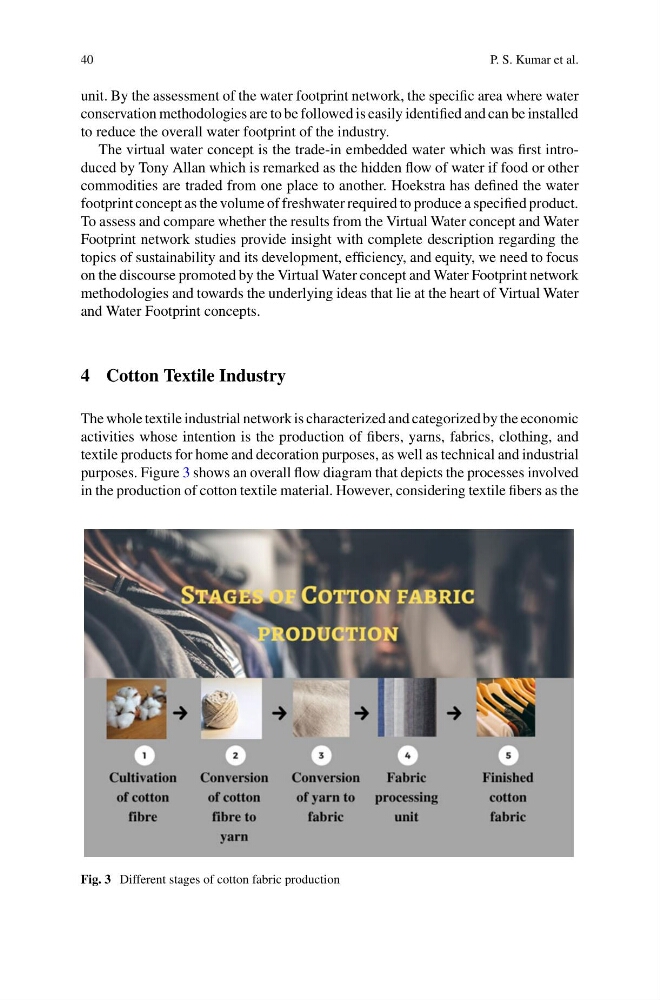
purposes. Figure 3 shows an overall flow diagram that depicts the processes involved
in the production of cotton textile material. However, considering textile fibers as the
Fig. 3 Different stages of cotton fabric production
P. S. Kumar et al.
unit. By the assessment of the water footprint network, the specific area where water
conservation methodologies are to be followed is easily identified and can be installed
to reduce the overall water footprint of the industry.
The virtual water concept is the trade-in embedded water which was first introduced by Tony Allan which is remarked as the hidden flow of water if food or other
commodities are traded from one place to another. Hoekstra has defined the water
footprint concept as the volume of freshwater required to produce a specified product.
To assess and compare whether the results from the Virtual Water concept and Water
Footprint network studies provide insight with complete description regarding the
topics of sustainability and its development, efficiency, and equity, we need to focus
on the discourse promoted by the Virtual Water concept and Water Footprint network
methodologies and towards the underlying ideas that lie at the heart of Virtual Water
and Water Footprint concepts.
4 Cotton Textile Industry
The whole textile industrial network is characterized and categorized by the economic
activities whose intention is the production of fibers, yarns, fabrics, clothing, and
textile products for home and decoration purposes, as well as technical and industrial
purposes. Figure 3 shows an overall flow diagram that depicts the processes involved
in the production of cotton textile material. However, considering textile fibers as the
Fig. 3 Different stages of cotton fabric production