

180
L. Chai et al.
The pollutant removal rate of the coal production industry is much lower, but the
expenditure on wastewater treatment is more. Other fossil fuel industries have a
high removal rate of PE and VP (97–99%), so technological innovation is needed to
further reduce the concentration of these pollutants.
Our scenario analysis shows that if STD2 is obeyed nationwide by all the fossil
fuel producers, then the VP pollutant discharge amount can be reduced by 88%.
Therefore, the energy industry, not only for water-scarce areas, needs to focus on
improving water resources utilization rate, enhance decontamination ability. At the
same time, the state should also formulate stricter discharge standards and strengthen
supervision on the basis of the original system to promote the health of the water
environment.
6 Case Study 3: Using Input–Output Model to Assess
the Water Footprint of Energy Consumption by Chinese
Households
In this case study, we introduce how to use the IO model to assess the water footprint
of energy from the perspective of household consumption. This can help us to understand how household energy consumption affects water resources. More detailed
analysis and results can be found in our previous published journal article [28].
6.1 Methodology
We used the IO analysis method to quantify the life cycle water consumption of
Chinese household energy demand from 2002 to 2015 and compared the difference
between rural and urban. Then through structural decomposition analysis, the impact
of the four driving factors of population, demand, economic structure, and technology
is clarified. The related methods are as follows:
First of all, the basic equation for quantifying the life cycle water consumption of
household energy consumption can be expressed as
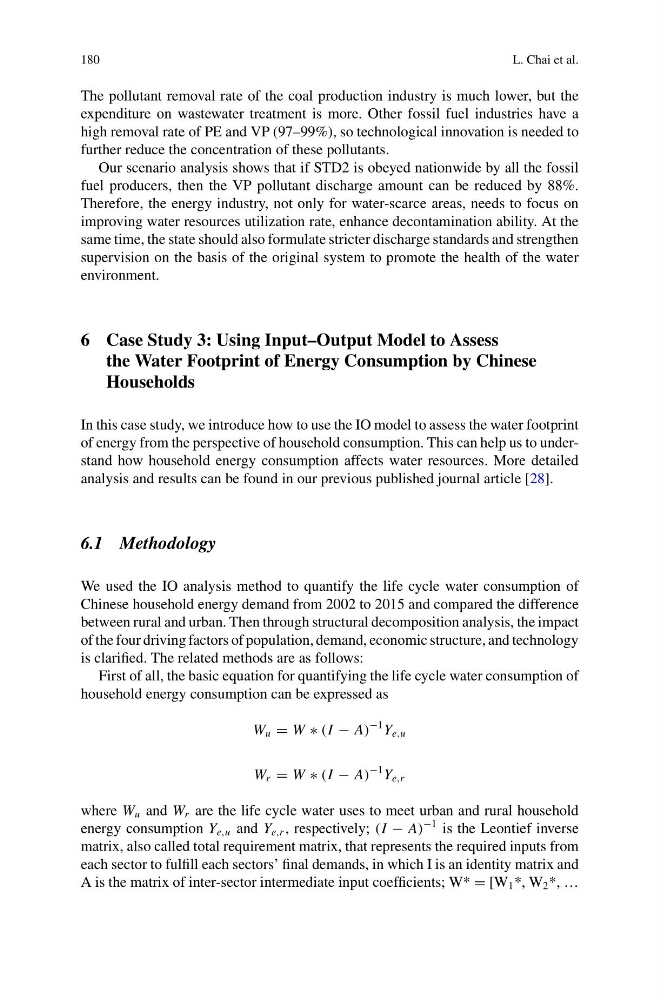
W u = W ∗ (I − A)
−1 Y e,u
W r = W ∗ (I − A)
−1 Y e,r
where W u and W r are the life cycle water uses to meet urban and rural household
energy consumption Y e,u and Y e,r , respectively; (I − A)
−1 is the Leontief inverse
matrix, also called total requirement matrix, that represents the required inputs from
each sector to fulfill each sectors’ final demands, in which I is an identity matrix and
A is the matrix of inter-sector intermediate input coefficients; W* = [W 1 *, W 2 *, …
L. Chai et al.
The pollutant removal rate of the coal production industry is much lower, but the
expenditure on wastewater treatment is more. Other fossil fuel industries have a
high removal rate of PE and VP (97–99%), so technological innovation is needed to
further reduce the concentration of these pollutants.
Our scenario analysis shows that if STD2 is obeyed nationwide by all the fossil
fuel producers, then the VP pollutant discharge amount can be reduced by 88%.
Therefore, the energy industry, not only for water-scarce areas, needs to focus on
improving water resources utilization rate, enhance decontamination ability. At the
same time, the state should also formulate stricter discharge standards and strengthen
supervision on the basis of the original system to promote the health of the water
environment.
6 Case Study 3: Using Input–Output Model to Assess
the Water Footprint of Energy Consumption by Chinese
Households
In this case study, we introduce how to use the IO model to assess the water footprint
of energy from the perspective of household consumption. This can help us to understand how household energy consumption affects water resources. More detailed
analysis and results can be found in our previous published journal article [28].
6.1 Methodology
We used the IO analysis method to quantify the life cycle water consumption of
Chinese household energy demand from 2002 to 2015 and compared the difference
between rural and urban. Then through structural decomposition analysis, the impact
of the four driving factors of population, demand, economic structure, and technology
is clarified. The related methods are as follows:
First of all, the basic equation for quantifying the life cycle water consumption of
household energy consumption can be expressed as
W u = W ∗ (I − A)
−1 Y e,u
W r = W ∗ (I − A)
−1 Y e,r
where W u and W r are the life cycle water uses to meet urban and rural household
energy consumption Y e,u and Y e,r , respectively; (I − A)
−1 is the Leontief inverse
matrix, also called total requirement matrix, that represents the required inputs from
each sector to fulfill each sectors’ final demands, in which I is an identity matrix and
A is the matrix of inter-sector intermediate input coefficients; W* = [W 1 *, W 2 *, …