

Employing Input-Output Model to Assess …
179
S0 S1 S2
S0 S1 S2
S0 S1 S2
S0 S1 S2
COD
AN
PE
VP
0
100
200
300
400
Dilution water ( billion m
3
)
Coal
Crude oil
Natural gas
Coke
Petroleum products
Other sectors
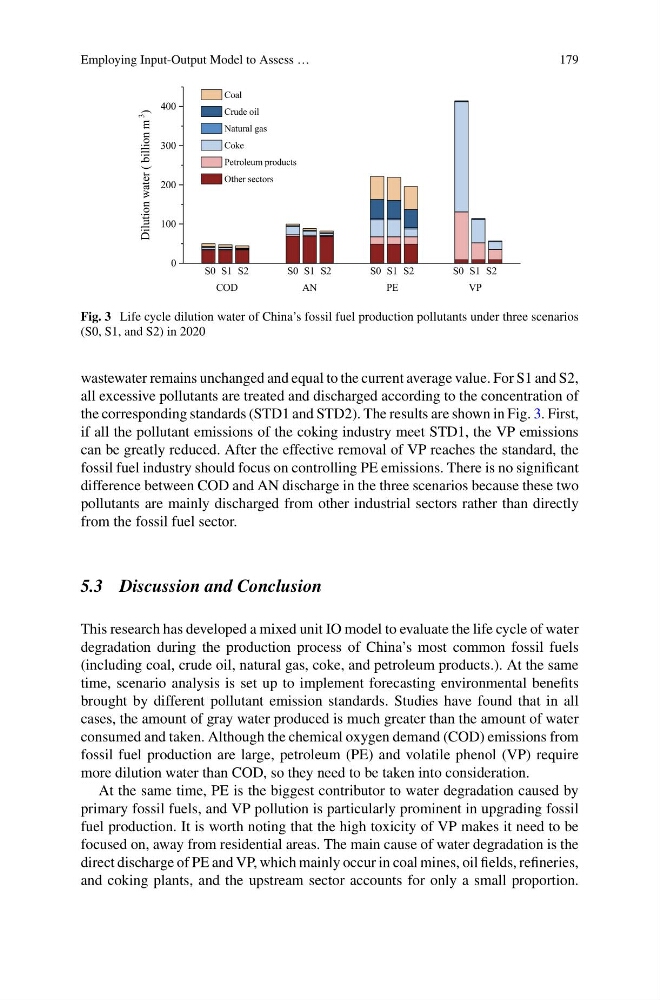
Fig. 3 Life cycle dilution water of China’s fossil fuel production pollutants under three scenarios
(S0, S1, and S2) in 2020
wastewater remains unchanged and equal to the current average value. For S1 and S2,
all excessive pollutants are treated and discharged according to the concentration of
the corresponding standards (STD1 and STD2). The results are shown in Fig. 3. First,
if all the pollutant emissions of the coking industry meet STD1, the VP emissions
can be greatly reduced. After the effective removal of VP reaches the standard, the
fossil fuel industry should focus on controlling PE emissions. There is no significant
difference between COD and AN discharge in the three scenarios because these two
pollutants are mainly discharged from other industrial sectors rather than directly
from the fossil fuel sector.
5.3 Discussion and Conclusion
This research has developed a mixed unit IO model to evaluate the life cycle of water
degradation during the production process of China’s most common fossil fuels
(including coal, crude oil, natural gas, coke, and petroleum products.). At the same
time, scenario analysis is set up to implement forecasting environmental benefits
brought by different pollutant emission standards. Studies have found that in all
cases, the amount of gray water produced is much greater than the amount of water
consumed and taken. Although the chemical oxygen demand (COD) emissions from
fossil fuel production are large, petroleum (PE) and volatile phenol (VP) require
more dilution water than COD, so they need to be taken into consideration.
At the same time, PE is the biggest contributor to water degradation caused by
primary fossil fuels, and VP pollution is particularly prominent in upgrading fossil
fuel production. It is worth noting that the high toxicity of VP makes it need to be
focused on, away from residential areas. The main cause of water degradation is the
direct discharge of PE and VP, which mainly occur in coal mines, oil fields, refineries,
and coking plants, and the upstream sector accounts for only a small proportion.
179
S0 S1 S2
S0 S1 S2
S0 S1 S2
S0 S1 S2
COD
AN
PE
VP
0
100
200
300
400
Dilution water ( billion m
3
)
Coal
Crude oil
Natural gas
Coke
Petroleum products
Other sectors
Fig. 3 Life cycle dilution water of China’s fossil fuel production pollutants under three scenarios
(S0, S1, and S2) in 2020
wastewater remains unchanged and equal to the current average value. For S1 and S2,
all excessive pollutants are treated and discharged according to the concentration of
the corresponding standards (STD1 and STD2). The results are shown in Fig. 3. First,
if all the pollutant emissions of the coking industry meet STD1, the VP emissions
can be greatly reduced. After the effective removal of VP reaches the standard, the
fossil fuel industry should focus on controlling PE emissions. There is no significant
difference between COD and AN discharge in the three scenarios because these two
pollutants are mainly discharged from other industrial sectors rather than directly
from the fossil fuel sector.
5.3 Discussion and Conclusion
This research has developed a mixed unit IO model to evaluate the life cycle of water
degradation during the production process of China’s most common fossil fuels
(including coal, crude oil, natural gas, coke, and petroleum products.). At the same
time, scenario analysis is set up to implement forecasting environmental benefits
brought by different pollutant emission standards. Studies have found that in all
cases, the amount of gray water produced is much greater than the amount of water
consumed and taken. Although the chemical oxygen demand (COD) emissions from
fossil fuel production are large, petroleum (PE) and volatile phenol (VP) require
more dilution water than COD, so they need to be taken into consideration.
At the same time, PE is the biggest contributor to water degradation caused by
primary fossil fuels, and VP pollution is particularly prominent in upgrading fossil
fuel production. It is worth noting that the high toxicity of VP makes it need to be
focused on, away from residential areas. The main cause of water degradation is the
direct discharge of PE and VP, which mainly occur in coal mines, oil fields, refineries,
and coking plants, and the upstream sector accounts for only a small proportion.