

118
M. B. Johnson and M. Mehrvar
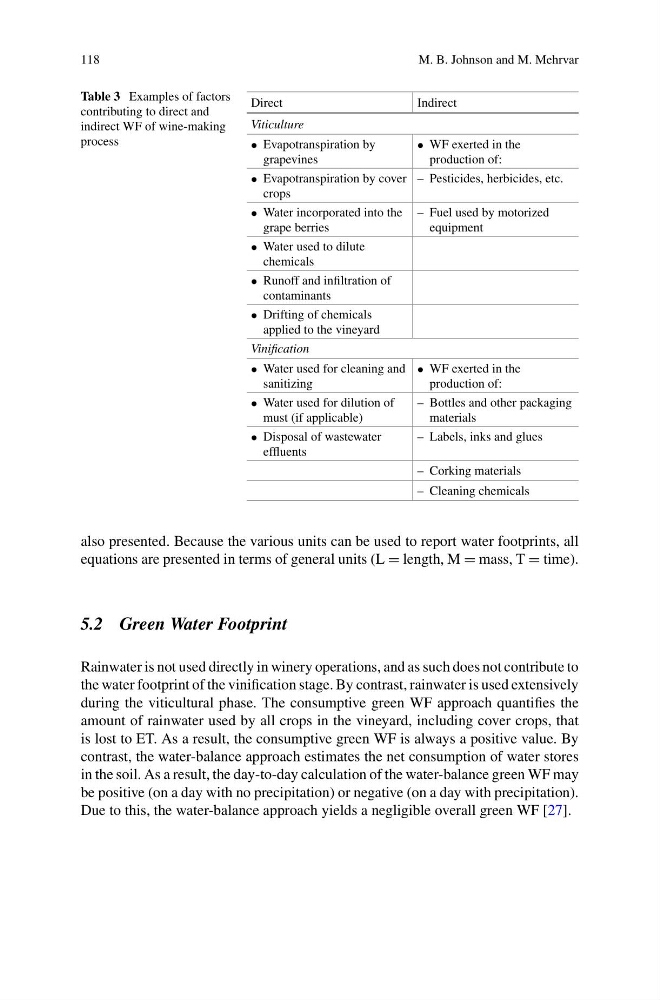
Table 3 Examples of factors
contributing to direct and
indirect WF of wine-making
process
Direct
Indirect
Viticulture
• Evapotranspiration by
grapevines
• WF exerted in the
production of:
• Evapotranspiration by cover
crops
– Pesticides, herbicides, etc.
• Water incorporated into the
grape berries
– Fuel used by motorized
equipment
• Water used to dilute
chemicals
• Runoff and infiltration of
contaminants
• Drifting of chemicals
applied to the vineyard
Vinification
• Water used for cleaning and
sanitizing
• WF exerted in the
production of:
• Water used for dilution of
must (if applicable)
– Bottles and other packaging
materials
• Disposal of wastewater
effluents
– Labels, inks and glues
– Corking materials
– Cleaning chemicals
also presented. Because the various units can be used to report water footprints, all
equations are presented in terms of general units (L = length, M = mass, T = time).
5.2 Green Water Footprint
Rainwater is not used directly in winery operations, and as such does not contribute to
the water footprint of the vinification stage. By contrast, rainwater is used extensively
during the viticultural phase. The consumptive green WF approach quantifies the
amount of rainwater used by all crops in the vineyard, including cover crops, that
is lost to ET. As a result, the consumptive green WF is always a positive value. By
contrast, the water-balance approach estimates the net consumption of water stores
in the soil. As a result, the day-to-day calculation of the water-balance green WF may
be positive (on a day with no precipitation) or negative (on a day with precipitation).
Due to this, the water-balance approach yields a negligible overall green WF [27].
M. B. Johnson and M. Mehrvar
Table 3 Examples of factors
contributing to direct and
indirect WF of wine-making
process
Direct
Indirect
Viticulture
• Evapotranspiration by
grapevines
• WF exerted in the
production of:
• Evapotranspiration by cover
crops
– Pesticides, herbicides, etc.
• Water incorporated into the
grape berries
– Fuel used by motorized
equipment
• Water used to dilute
chemicals
• Runoff and infiltration of
contaminants
• Drifting of chemicals
applied to the vineyard
Vinification
• Water used for cleaning and
sanitizing
• WF exerted in the
production of:
• Water used for dilution of
must (if applicable)
– Bottles and other packaging
materials
• Disposal of wastewater
effluents
– Labels, inks and glues
– Corking materials
– Cleaning chemicals
also presented. Because the various units can be used to report water footprints, all
equations are presented in terms of general units (L = length, M = mass, T = time).
5.2 Green Water Footprint
Rainwater is not used directly in winery operations, and as such does not contribute to
the water footprint of the vinification stage. By contrast, rainwater is used extensively
during the viticultural phase. The consumptive green WF approach quantifies the
amount of rainwater used by all crops in the vineyard, including cover crops, that
is lost to ET. As a result, the consumptive green WF is always a positive value. By
contrast, the water-balance approach estimates the net consumption of water stores
in the soil. As a result, the day-to-day calculation of the water-balance green WF may
be positive (on a day with no precipitation) or negative (on a day with precipitation).
Due to this, the water-balance approach yields a negligible overall green WF [27].