

From Field to Bottle: Water Footprint Estimation …
119
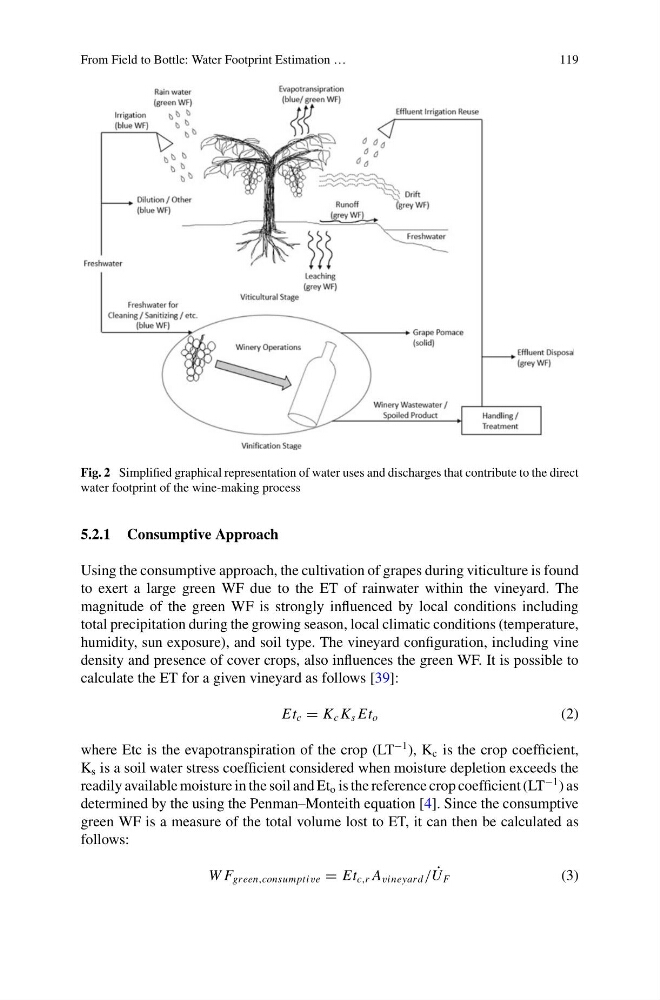
Fig. 2 Simplified graphical representation of water uses and discharges that contribute to the direct
water footprint of the wine-making process
5.2.1 Consumptive Approach
Using the consumptive approach, the cultivation of grapes during viticulture is found
to exert a large green WF due to the ET of rainwater within the vineyard. The
magnitude of the green WF is strongly influenced by local conditions including
total precipitation during the growing season, local climatic conditions (temperature,
humidity, sun exposure), and soil type. The vineyard configuration, including vine
density and presence of cover crops, also influences the green WF. It is possible to
calculate the ET for a given vineyard as follows [39]:
Et c = K c K s Et o
(2)
where Etc is the evapotranspiration of the crop (LT
−1 ), K c is the crop coefficient,
K s is a soil water stress coefficient considered when moisture depletion exceeds the
readily available moisture in the soil and Et o is the reference crop coefficient (LT
−1 ) as
determined by the using the Penman–Monteith equation [4]. Since the consumptive
green WF is a measure of the total volume lost to ET, it can then be calculated as
follows:
W F green,consumptive = Et c,r A vineyard / ˙
U F
(3)
119
Fig. 2 Simplified graphical representation of water uses and discharges that contribute to the direct
water footprint of the wine-making process
5.2.1 Consumptive Approach
Using the consumptive approach, the cultivation of grapes during viticulture is found
to exert a large green WF due to the ET of rainwater within the vineyard. The
magnitude of the green WF is strongly influenced by local conditions including
total precipitation during the growing season, local climatic conditions (temperature,
humidity, sun exposure), and soil type. The vineyard configuration, including vine
density and presence of cover crops, also influences the green WF. It is possible to
calculate the ET for a given vineyard as follows [39]:
Et c = K c K s Et o
(2)
where Etc is the evapotranspiration of the crop (LT
−1 ), K c is the crop coefficient,
K s is a soil water stress coefficient considered when moisture depletion exceeds the
readily available moisture in the soil and Et o is the reference crop coefficient (LT
−1 ) as
determined by the using the Penman–Monteith equation [4]. Since the consumptive
green WF is a measure of the total volume lost to ET, it can then be calculated as
follows:
W F green,consumptive = Et c,r A vineyard / ˙
U F
(3)