

From Field to Bottle: Water Footprint Estimation …
117
5 Water Footprint Calculations
5.1 Overview and Definitions
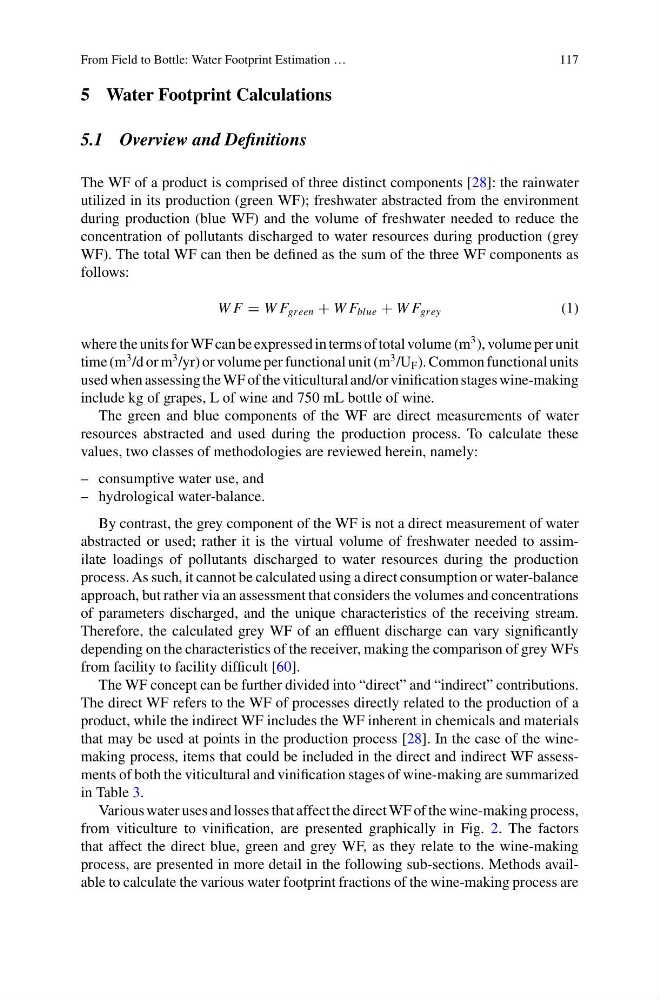
The WF of a product is comprised of three distinct components [28]: the rainwater
utilized in its production (green WF); freshwater abstracted from the environment
during production (blue WF) and the volume of freshwater needed to reduce the
concentration of pollutants discharged to water resources during production (grey
WF). The total WF can then be defined as the sum of the three WF components as
follows:
W F = W F green + W F blue + W F grey
(1)
where the units for WF can be expressed in terms of total volume (m
3 ), volume per unit
time (m
3 /d or m
3 /yr) or volume per functional unit (m
3 /U F ). Common functional units
used when assessing the WF of the viticultural and/or vinification stages wine-making
include kg of grapes, L of wine and 750 mL bottle of wine.
The green and blue components of the WF are direct measurements of water
resources abstracted and used during the production process. To calculate these
values, two classes of methodologies are reviewed herein, namely:
– consumptive water use, and
– hydrological water-balance.
By contrast, the grey component of the WF is not a direct measurement of water
abstracted or used; rather it is the virtual volume of freshwater needed to assimilate loadings of pollutants discharged to water resources during the production
process. As such, it cannot be calculated using a direct consumption or water-balance
approach, but rather via an assessment that considers the volumes and concentrations
of parameters discharged, and the unique characteristics of the receiving stream.
Therefore, the calculated grey WF of an effluent discharge can vary significantly
depending on the characteristics of the receiver, making the comparison of grey WFs
from facility to facility difficult [60].
The WF concept can be further divided into “direct” and “indirect” contributions.
The direct WF refers to the WF of processes directly related to the production of a
product, while the indirect WF includes the WF inherent in chemicals and materials
that may be used at points in the production process [28]. In the case of the winemaking process, items that could be included in the direct and indirect WF assessments of both the viticultural and vinification stages of wine-making are summarized
in Table 3.
Various water uses and losses that affect the direct WF of the wine-making process,
from viticulture to vinification, are presented graphically in Fig. 2. The factors
that affect the direct blue, green and grey WF, as they relate to the wine-making
process, are presented in more detail in the following sub-sections. Methods available to calculate the various water footprint fractions of the wine-making process are
117
5 Water Footprint Calculations
5.1 Overview and Definitions
The WF of a product is comprised of three distinct components [28]: the rainwater
utilized in its production (green WF); freshwater abstracted from the environment
during production (blue WF) and the volume of freshwater needed to reduce the
concentration of pollutants discharged to water resources during production (grey
WF). The total WF can then be defined as the sum of the three WF components as
follows:
W F = W F green + W F blue + W F grey
(1)
where the units for WF can be expressed in terms of total volume (m
3 ), volume per unit
time (m
3 /d or m
3 /yr) or volume per functional unit (m
3 /U F ). Common functional units
used when assessing the WF of the viticultural and/or vinification stages wine-making
include kg of grapes, L of wine and 750 mL bottle of wine.
The green and blue components of the WF are direct measurements of water
resources abstracted and used during the production process. To calculate these
values, two classes of methodologies are reviewed herein, namely:
– consumptive water use, and
– hydrological water-balance.
By contrast, the grey component of the WF is not a direct measurement of water
abstracted or used; rather it is the virtual volume of freshwater needed to assimilate loadings of pollutants discharged to water resources during the production
process. As such, it cannot be calculated using a direct consumption or water-balance
approach, but rather via an assessment that considers the volumes and concentrations
of parameters discharged, and the unique characteristics of the receiving stream.
Therefore, the calculated grey WF of an effluent discharge can vary significantly
depending on the characteristics of the receiver, making the comparison of grey WFs
from facility to facility difficult [60].
The WF concept can be further divided into “direct” and “indirect” contributions.
The direct WF refers to the WF of processes directly related to the production of a
product, while the indirect WF includes the WF inherent in chemicals and materials
that may be used at points in the production process [28]. In the case of the winemaking process, items that could be included in the direct and indirect WF assessments of both the viticultural and vinification stages of wine-making are summarized
in Table 3.
Various water uses and losses that affect the direct WF of the wine-making process,
from viticulture to vinification, are presented graphically in Fig. 2. The factors
that affect the direct blue, green and grey WF, as they relate to the wine-making
process, are presented in more detail in the following sub-sections. Methods available to calculate the various water footprint fractions of the wine-making process are