

rapid growth, root biomass generation, higher lateral root forming, and improved
accumulation of bioactive compounds (Chandra and Chandra 2011; Mukundan and
Hjortso 1990).
4 Conclusion and Way Forward
Considering these backgrounds, it is concluded that, HRs, enzymes, or metabolites
of HRCs provides complementary information to understand the industrial cleanup
process. However, the broad research on HRs, and the complete transformation of
toxic to nontoxic is still unknown. The use of HRs extracts or enzymes definitely can
be a substitute to pure enzymes since these are highly expensive to acquire and might
be deactivated more promptly in the course of reaction with a subsequent decrease of
its activity. These results will not only help in understanding about the enzymatic
process that involved in phytoremediation of phenols, HMs, explosives, and dyes
but also helps in the understanding of the complex interaction between toxic
chemicals, plant cells, and microorganisms to clean up the environment and to
design the novel transgenic plants with improved remediation traits.
In order for their future application, it is important and necessary to select an
optimal condition to obtain the most effective removal by considering the economy
of the process. In addition, transgenic plants also help in mineralize major complex
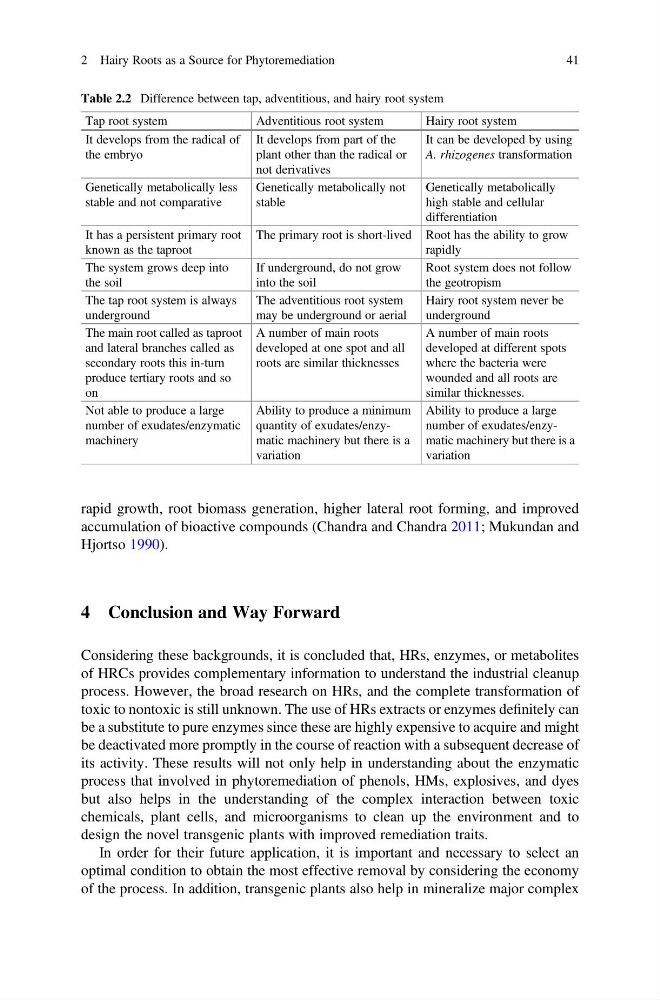
Table 2.2 Difference between tap, adventitious, and hairy root system
Tap root system
Adventitious root system
Hairy root system
It develops from the radical of
the embryo
It develops from part of the
plant other than the radical or
not derivatives
It can be developed by using
A. rhizogenes transformation
Genetically metabolically less
stable and not comparative
Genetically metabolically not
stable
Genetically metabolically
high stable and cellular
differentiation
It has a persistent primary root
known as the taproot
The primary root is short-lived Root has the ability to grow
rapidly
The system grows deep into
the soil
If underground, do not grow
into the soil
Root system does not follow
the geotropism
The tap root system is always
underground
The adventitious root system
may be underground or aerial
Hairy root system never be
underground
The main root called as taproot
and lateral branches called as
secondary roots this in-turn
produce tertiary roots and so
on
A number of main roots
developed at one spot and all
roots are similar thicknesses
A number of main roots
developed at different spots
where the bacteria were
wounded and all roots are
similar thicknesses.
Not able to produce a large
number of exudates/enzymatic
machinery
Ability to produce a minimum
quantity of exudates/enzymatic machinery but there is a
variation
Ability to produce a large
number of exudates/enzymatic machinery but there is a
variation
2 Hairy Roots as a Source for Phytoremediation
41
accumulation of bioactive compounds (Chandra and Chandra 2011; Mukundan and
Hjortso 1990).
4 Conclusion and Way Forward
Considering these backgrounds, it is concluded that, HRs, enzymes, or metabolites
of HRCs provides complementary information to understand the industrial cleanup
process. However, the broad research on HRs, and the complete transformation of
toxic to nontoxic is still unknown. The use of HRs extracts or enzymes definitely can
be a substitute to pure enzymes since these are highly expensive to acquire and might
be deactivated more promptly in the course of reaction with a subsequent decrease of
its activity. These results will not only help in understanding about the enzymatic
process that involved in phytoremediation of phenols, HMs, explosives, and dyes
but also helps in the understanding of the complex interaction between toxic
chemicals, plant cells, and microorganisms to clean up the environment and to
design the novel transgenic plants with improved remediation traits.
In order for their future application, it is important and necessary to select an
optimal condition to obtain the most effective removal by considering the economy
of the process. In addition, transgenic plants also help in mineralize major complex
Table 2.2 Difference between tap, adventitious, and hairy root system
Tap root system
Adventitious root system
Hairy root system
It develops from the radical of
the embryo
It develops from part of the
plant other than the radical or
not derivatives
It can be developed by using
A. rhizogenes transformation
Genetically metabolically less
stable and not comparative
Genetically metabolically not
stable
Genetically metabolically
high stable and cellular
differentiation
It has a persistent primary root
known as the taproot
The primary root is short-lived Root has the ability to grow
rapidly
The system grows deep into
the soil
If underground, do not grow
into the soil
Root system does not follow
the geotropism
The tap root system is always
underground
The adventitious root system
may be underground or aerial
Hairy root system never be
underground
The main root called as taproot
and lateral branches called as
secondary roots this in-turn
produce tertiary roots and so
on
A number of main roots
developed at one spot and all
roots are similar thicknesses
A number of main roots
developed at different spots
where the bacteria were
wounded and all roots are
similar thicknesses.
Not able to produce a large
number of exudates/enzymatic
machinery
Ability to produce a minimum
quantity of exudates/enzymatic machinery but there is a
variation
Ability to produce a large
number of exudates/enzymatic machinery but there is a
variation
2 Hairy Roots as a Source for Phytoremediation
41