

4.3 Plant Genetic Manipulation for Reduction
of Agrochemical Usage
4.3.1 Transgenic Crop for Herbicide and Insecticide Minimization
Transgenic crop or genetically modified crop (GMC) has been widely used since it
first commercialized in the mid-1990s at several countries for four major crops such
as cotton, canola, soybean, and maize. Since the main traits of commercialized
transgenic crops are genetically modified for insect resistance (GM IR) tolerance
to insecticides and Genetically modified for herbicide resistance (GM HR) tolerant to
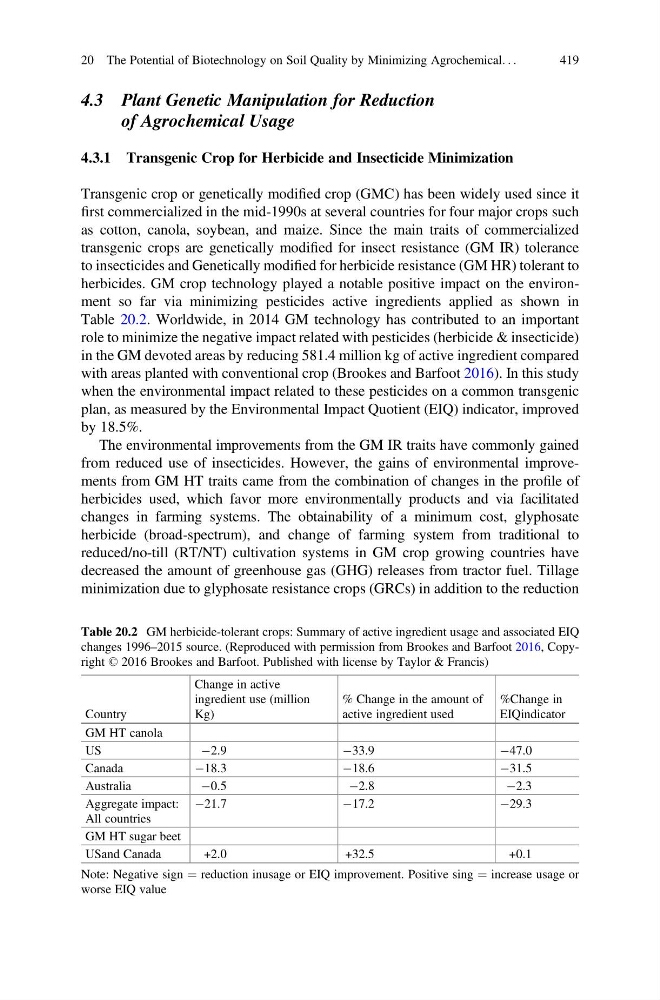
herbicides. GM crop technology played a notable positive impact on the environment so far via minimizing pesticides active ingredients applied as shown in
Table 20.2. Worldwide, in 2014 GM technology has contributed to an important
role to minimize the negative impact related with pesticides (herbicide & insecticide)
in the GM devoted areas by reducing 581.4 million kg of active ingredient compared
with areas planted with conventional crop (Brookes and Barfoot 2016). In this study
when the environmental impact related to these pesticides on a common transgenic
plan, as measured by the Environmental Impact Quotient (EIQ) indicator, improved
by 18.5%.
The environmental improvements from the GM IR traits have commonly gained
from reduced use of insecticides. However, the gains of environmental improvements from GM HT traits came from the combination of changes in the profile of
herbicides used, which favor more environmentally products and via facilitated
changes in farming systems. The obtainability of a minimum cost, glyphosate
herbicide (broad-spectrum), and change of farming system from traditional to
reduced/no-till (RT/NT) cultivation systems in GM crop growing countries have
decreased the amount of greenhouse gas (GHG) releases from tractor fuel. Tillage
minimization due to glyphosate resistance crops (GRCs) in addition to the reduction
Table 20.2 GM herbicide-tolerant crops: Summary of active ingredient usage and associated EIQ
changes 1996–2015 source. (Reproduced with permission from Brookes and Barfoot 2016, Copyright © 2016 Brookes and Barfoot. Published with license by Taylor & Francis)
Country
Change in active
ingredient use (million
Kg)
% Change in the amount of
active ingredient used
%Change in
EIQindicator
GM HT canola
US
À2.9
À33.9
À47.0
Canada
À18.3
À18.6
À31.5
Australia
À0.5
À2.8
À2.3
Aggregate impact:
All countries
À21.7
À17.2
À29.3
GM HT sugar beet
USand Canada
+2.0
+32.5
+0.1
Note: Negative sign ¼ reduction inusage or EIQ improvement. Positive sing ¼ increase usage or
worse EIQ value
20 The Potential of Biotechnology on Soil Quality by Minimizing Agrochemical. . .
419
of Agrochemical Usage
4.3.1 Transgenic Crop for Herbicide and Insecticide Minimization
Transgenic crop or genetically modified crop (GMC) has been widely used since it
first commercialized in the mid-1990s at several countries for four major crops such
as cotton, canola, soybean, and maize. Since the main traits of commercialized
transgenic crops are genetically modified for insect resistance (GM IR) tolerance
to insecticides and Genetically modified for herbicide resistance (GM HR) tolerant to
herbicides. GM crop technology played a notable positive impact on the environment so far via minimizing pesticides active ingredients applied as shown in
Table 20.2. Worldwide, in 2014 GM technology has contributed to an important
role to minimize the negative impact related with pesticides (herbicide & insecticide)
in the GM devoted areas by reducing 581.4 million kg of active ingredient compared
with areas planted with conventional crop (Brookes and Barfoot 2016). In this study
when the environmental impact related to these pesticides on a common transgenic
plan, as measured by the Environmental Impact Quotient (EIQ) indicator, improved
by 18.5%.
The environmental improvements from the GM IR traits have commonly gained
from reduced use of insecticides. However, the gains of environmental improvements from GM HT traits came from the combination of changes in the profile of
herbicides used, which favor more environmentally products and via facilitated
changes in farming systems. The obtainability of a minimum cost, glyphosate
herbicide (broad-spectrum), and change of farming system from traditional to
reduced/no-till (RT/NT) cultivation systems in GM crop growing countries have
decreased the amount of greenhouse gas (GHG) releases from tractor fuel. Tillage
minimization due to glyphosate resistance crops (GRCs) in addition to the reduction
Table 20.2 GM herbicide-tolerant crops: Summary of active ingredient usage and associated EIQ
changes 1996–2015 source. (Reproduced with permission from Brookes and Barfoot 2016, Copyright © 2016 Brookes and Barfoot. Published with license by Taylor & Francis)
Country
Change in active
ingredient use (million
Kg)
% Change in the amount of
active ingredient used
%Change in
EIQindicator
GM HT canola
US
À2.9
À33.9
À47.0
Canada
À18.3
À18.6
À31.5
Australia
À0.5
À2.8
À2.3
Aggregate impact:
All countries
À21.7
À17.2
À29.3
GM HT sugar beet
USand Canada
+2.0
+32.5
+0.1
Note: Negative sign ¼ reduction inusage or EIQ improvement. Positive sing ¼ increase usage or
worse EIQ value
20 The Potential of Biotechnology on Soil Quality by Minimizing Agrochemical. . .
419