

4 Model Specification
Studies have shown unsafe water sources, inadequate sanitation, and rainfall have
interdependent effects on diarrhoea (Fink et al. 2011; Bhavnani et al. 2014). As
diarrhoea is the most common waterborne disease in India, it is all the more
important to estimate the risk of diarrhoea from those variables. In this study, a
multiple regression was carried out to probe whether water from unprotected well/
spring, annual rainfall, latrine usage method, and types of household drainage
system could significantly predict diarrhoeal cases in India. The study was carried
out for the year, 2018. The data used in the analysis were sourced from the India
Meteorological Department, National Sample Survey 76th round on Drinking
Water, Sanitation, Hygiene, and Housing Condition in India and National Health
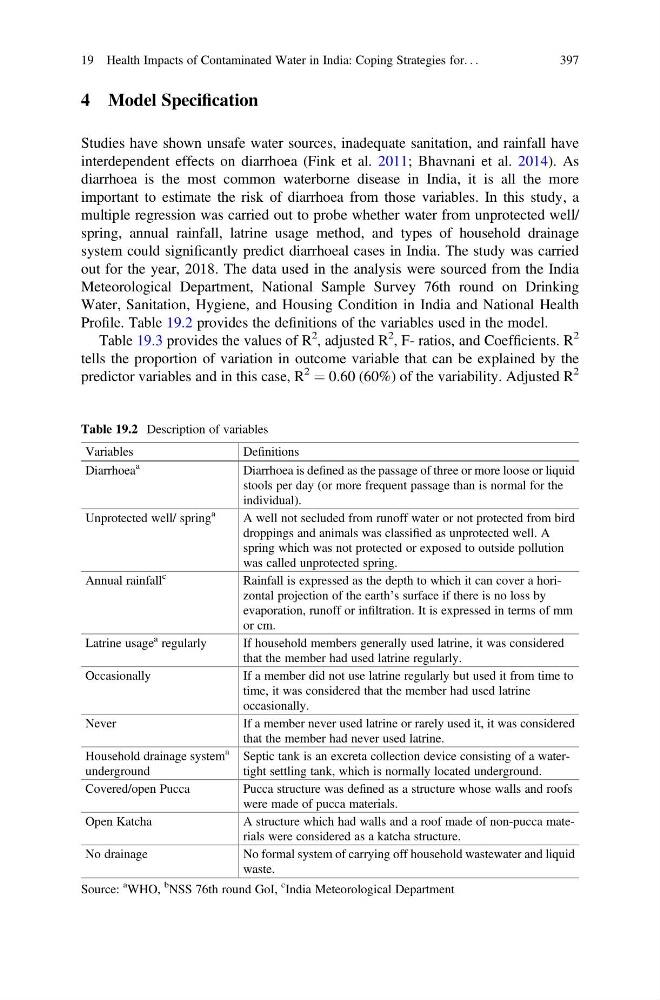
Profile. Table 19.2 provides the definitions of the variables used in the model.
Table 19.3 provides the values of R
2 , adjusted R
2 , F- ratios, and Coefficients. R
2
tells the proportion of variation in outcome variable that can be explained by the
predictor variables and in this case, R
2
¼ 0.60 (60%) of the variability. Adjusted R
2
Table 19.2 Description of variables
Variables
Definitions
Diarrhoea
a
Diarrhoea is defined as the passage of three or more loose or liquid
stools per day (or more frequent passage than is normal for the
individual).
Unprotected well/ spring
a
A well not secluded from runoff water or not protected from bird
droppings and animals was classified as unprotected well. A
spring which was not protected or exposed to outside pollution
was called unprotected spring.
Annual rainfall
c
Rainfall is expressed as the depth to which it can cover a horizontal projection of the earth’s surface if there is no loss by
evaporation, runoff or infiltration. It is expressed in terms of mm
or cm.
Latrine usage
a regularly
If household members generally used latrine, it was considered
that the member had used latrine regularly.
Occasionally
If a member did not use latrine regularly but used it from time to
time, it was considered that the member had used latrine
occasionally.
Never
If a member never used latrine or rarely used it, it was considered
that the member had never used latrine.
Household drainage system
a
underground
Septic tank is an excreta collection device consisting of a watertight settling tank, which is normally located underground.
Covered/open Pucca
Pucca structure was defined as a structure whose walls and roofs
were made of pucca materials.
Open Katcha
A structure which had walls and a roof made of non-pucca materials were considered as a katcha structure.
No drainage
No formal system of carrying off household wastewater and liquid
waste.
Source:
a WHO,
b
NSS 76th round GoI,
c India Meteorological Department
19 Health Impacts of Contaminated Water in India: Coping Strategies for. . .
397
Studies have shown unsafe water sources, inadequate sanitation, and rainfall have
interdependent effects on diarrhoea (Fink et al. 2011; Bhavnani et al. 2014). As
diarrhoea is the most common waterborne disease in India, it is all the more
important to estimate the risk of diarrhoea from those variables. In this study, a
multiple regression was carried out to probe whether water from unprotected well/
spring, annual rainfall, latrine usage method, and types of household drainage
system could significantly predict diarrhoeal cases in India. The study was carried
out for the year, 2018. The data used in the analysis were sourced from the India
Meteorological Department, National Sample Survey 76th round on Drinking
Water, Sanitation, Hygiene, and Housing Condition in India and National Health
Profile. Table 19.2 provides the definitions of the variables used in the model.
Table 19.3 provides the values of R
2 , adjusted R
2 , F- ratios, and Coefficients. R
2
tells the proportion of variation in outcome variable that can be explained by the
predictor variables and in this case, R
2
¼ 0.60 (60%) of the variability. Adjusted R
2
Table 19.2 Description of variables
Variables
Definitions
Diarrhoea
a
Diarrhoea is defined as the passage of three or more loose or liquid
stools per day (or more frequent passage than is normal for the
individual).
Unprotected well/ spring
a
A well not secluded from runoff water or not protected from bird
droppings and animals was classified as unprotected well. A
spring which was not protected or exposed to outside pollution
was called unprotected spring.
Annual rainfall
c
Rainfall is expressed as the depth to which it can cover a horizontal projection of the earth’s surface if there is no loss by
evaporation, runoff or infiltration. It is expressed in terms of mm
or cm.
Latrine usage
a regularly
If household members generally used latrine, it was considered
that the member had used latrine regularly.
Occasionally
If a member did not use latrine regularly but used it from time to
time, it was considered that the member had used latrine
occasionally.
Never
If a member never used latrine or rarely used it, it was considered
that the member had never used latrine.
Household drainage system
a
underground
Septic tank is an excreta collection device consisting of a watertight settling tank, which is normally located underground.
Covered/open Pucca
Pucca structure was defined as a structure whose walls and roofs
were made of pucca materials.
Open Katcha
A structure which had walls and a roof made of non-pucca materials were considered as a katcha structure.
No drainage
No formal system of carrying off household wastewater and liquid
waste.
Source:
a WHO,
b
NSS 76th round GoI,
c India Meteorological Department
19 Health Impacts of Contaminated Water in India: Coping Strategies for. . .
397