

partly due to excess runoff during monsoon season and water contamination caused
by pathogens such as E-coli. In 2018, West Bengal (17.06%) followed by Uttar
Pradesh (9.91%) is the states with the most number of diarrhoeal cases and in the
case of Typhoid, West Bengal (10.89%) trailed Uttar Pradesh (33.11%). As far as
Cholera is concerned, it is higher in the states of Uttar Pradesh, Delhi, and West
Bengal with a percentage of 23.50%, 20.58%, and 19.35% respectively (NHP 2019).
Put together, Uttar Pradesh is the worst affected state with a large number of cases
whereas water borne diseases are the common morbidity among the flood-prone
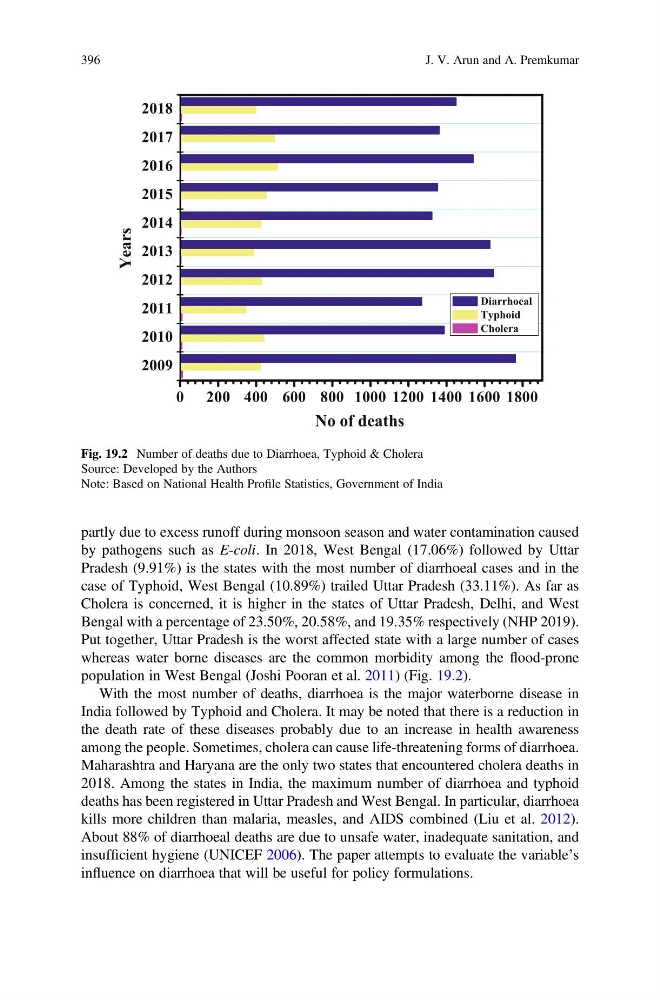
population in West Bengal (Joshi Pooran et al. 2011) (Fig. 19.2).
With the most number of deaths, diarrhoea is the major waterborne disease in
India followed by Typhoid and Cholera. It may be noted that there is a reduction in
the death rate of these diseases probably due to an increase in health awareness
among the people. Sometimes, cholera can cause life-threatening forms of diarrhoea.
Maharashtra and Haryana are the only two states that encountered cholera deaths in
2018. Among the states in India, the maximum number of diarrhoea and typhoid
deaths has been registered in Uttar Pradesh and West Bengal. In particular, diarrhoea
kills more children than malaria, measles, and AIDS combined (Liu et al. 2012).
About 88% of diarrhoeal deaths are due to unsafe water, inadequate sanitation, and
insufficient hygiene (UNICEF 2006). The paper attempts to evaluate the variable’s
influence on diarrhoea that will be useful for policy formulations.
2009
2010
2011
2012
2013
2014
2015
2016
2017
2018
0 200 400 600 800 1000 1200 1400 1600 1800
No of deaths
Years
Diarrhoeal
Typhoid
Cholera
Fig. 19.2 Number of deaths due to Diarrhoea, Typhoid & Cholera
Source: Developed by the Authors
Note: Based on National Health Profile Statistics, Government of India
396
J. V. Arun and A. Premkumar
by pathogens such as E-coli. In 2018, West Bengal (17.06%) followed by Uttar
Pradesh (9.91%) is the states with the most number of diarrhoeal cases and in the
case of Typhoid, West Bengal (10.89%) trailed Uttar Pradesh (33.11%). As far as
Cholera is concerned, it is higher in the states of Uttar Pradesh, Delhi, and West
Bengal with a percentage of 23.50%, 20.58%, and 19.35% respectively (NHP 2019).
Put together, Uttar Pradesh is the worst affected state with a large number of cases
whereas water borne diseases are the common morbidity among the flood-prone
population in West Bengal (Joshi Pooran et al. 2011) (Fig. 19.2).
With the most number of deaths, diarrhoea is the major waterborne disease in
India followed by Typhoid and Cholera. It may be noted that there is a reduction in
the death rate of these diseases probably due to an increase in health awareness
among the people. Sometimes, cholera can cause life-threatening forms of diarrhoea.
Maharashtra and Haryana are the only two states that encountered cholera deaths in
2018. Among the states in India, the maximum number of diarrhoea and typhoid
deaths has been registered in Uttar Pradesh and West Bengal. In particular, diarrhoea
kills more children than malaria, measles, and AIDS combined (Liu et al. 2012).
About 88% of diarrhoeal deaths are due to unsafe water, inadequate sanitation, and
insufficient hygiene (UNICEF 2006). The paper attempts to evaluate the variable’s
influence on diarrhoea that will be useful for policy formulations.
2009
2010
2011
2012
2013
2014
2015
2016
2017
2018
0 200 400 600 800 1000 1200 1400 1600 1800
No of deaths
Years
Diarrhoeal
Typhoid
Cholera
Fig. 19.2 Number of deaths due to Diarrhoea, Typhoid & Cholera
Source: Developed by the Authors
Note: Based on National Health Profile Statistics, Government of India
396
J. V. Arun and A. Premkumar