

3 Health Impacts of Water Pollution
It is a well-known fact that polluted water leads to water-borne diseases and its
burden on human health is heavy and sometimes fatal. Furthermore, health costs
incurred due to water pollution are quite substantial. The presence of geogenic
pollutant arsenic in groundwater causes cancer, endocrine disruptor, and skin problems. Drinking water sources contaminated with fluoride ion creates disorders such
as dental and skeletal fluorosis. In India alone, 0.87 million dental and 0.26 million
skeletal suspected cases were identified. Out of these, Karnataka itself accounts for
62.67% of dental cases followed by Rajasthan and Tamil Nadu with 27.07% and
2.27% respectively. The same scenario prevails for skeletal cases; Karnataka has
73.7%, Rajasthan 14.10%, and Tamil Nadu 5.16% (NHP 2019). Besides, pesticides
and other hazardous chemical contaminants in water result in reproductive and
developmental problems (WHO 2003). Globally, 1.8 million people consume
fecally contaminated water for drinking purposes (WHO/UNICEF 2014). Approximately 3.1% of all deaths and 3.7% of DALYs (Disability Adjusted Life Years)
were caused due to unsafe water, sanitation, and hygiene (WHO 2013). Therefore,
Fecal Coli contamination is an important issue to be addressed.
Each year, contaminated water causes 4 billion diarrhoeal cases and as a result,
2.2 million deaths occur (WHO 2000). In India, half a million children die every year
because of diarrhoea (UNICEF 2000). Cholera, Dysentery, Hepatitis, Typhoid and
Acute Diarrhoeal Disease (ADD) is the most common water-borne diseases that
affect a large population in the tropical regions. Out of which, the prevalence of
Acute Diarrhoeal Disease, Typhoid and Cholera are predominant in India. To
completely understand the enormity of the situation, those three major health
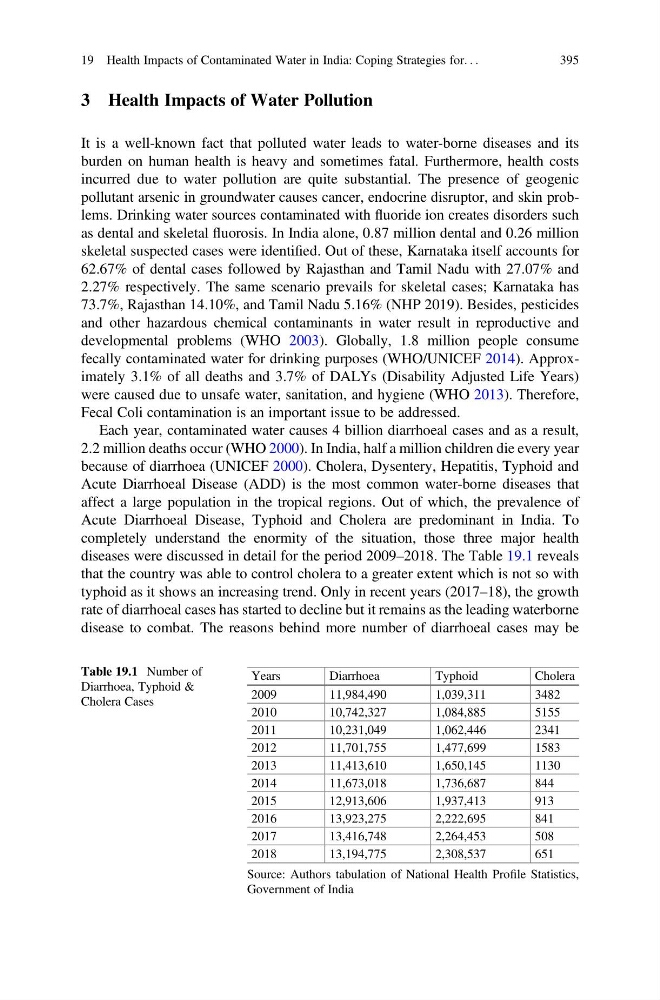
diseases were discussed in detail for the period 2009–2018. The Table 19.1 reveals
that the country was able to control cholera to a greater extent which is not so with
typhoid as it shows an increasing trend. Only in recent years (2017–18), the growth
rate of diarrhoeal cases has started to decline but it remains as the leading waterborne
disease to combat. The reasons behind more number of diarrhoeal cases may be
Table 19.1 Number of
Diarrhoea, Typhoid &
Cholera Cases
Years
Diarrhoea
Typhoid
Cholera
2009
11,984,490
1,039,311
3482
2010
10,742,327
1,084,885
5155
2011
10,231,049
1,062,446
2341
2012
11,701,755
1,477,699
1583
2013
11,413,610
1,650,145
1130
2014
11,673,018
1,736,687
844
2015
12,913,606
1,937,413
913
2016
13,923,275
2,222,695
841
2017
13,416,748
2,264,453
508
2018
13,194,775
2,308,537
651
Source: Authors tabulation of National Health Profile Statistics,
Government of India
19 Health Impacts of Contaminated Water in India: Coping Strategies for. . .
395
It is a well-known fact that polluted water leads to water-borne diseases and its
burden on human health is heavy and sometimes fatal. Furthermore, health costs
incurred due to water pollution are quite substantial. The presence of geogenic
pollutant arsenic in groundwater causes cancer, endocrine disruptor, and skin problems. Drinking water sources contaminated with fluoride ion creates disorders such
as dental and skeletal fluorosis. In India alone, 0.87 million dental and 0.26 million
skeletal suspected cases were identified. Out of these, Karnataka itself accounts for
62.67% of dental cases followed by Rajasthan and Tamil Nadu with 27.07% and
2.27% respectively. The same scenario prevails for skeletal cases; Karnataka has
73.7%, Rajasthan 14.10%, and Tamil Nadu 5.16% (NHP 2019). Besides, pesticides
and other hazardous chemical contaminants in water result in reproductive and
developmental problems (WHO 2003). Globally, 1.8 million people consume
fecally contaminated water for drinking purposes (WHO/UNICEF 2014). Approximately 3.1% of all deaths and 3.7% of DALYs (Disability Adjusted Life Years)
were caused due to unsafe water, sanitation, and hygiene (WHO 2013). Therefore,
Fecal Coli contamination is an important issue to be addressed.
Each year, contaminated water causes 4 billion diarrhoeal cases and as a result,
2.2 million deaths occur (WHO 2000). In India, half a million children die every year
because of diarrhoea (UNICEF 2000). Cholera, Dysentery, Hepatitis, Typhoid and
Acute Diarrhoeal Disease (ADD) is the most common water-borne diseases that
affect a large population in the tropical regions. Out of which, the prevalence of
Acute Diarrhoeal Disease, Typhoid and Cholera are predominant in India. To
completely understand the enormity of the situation, those three major health
diseases were discussed in detail for the period 2009–2018. The Table 19.1 reveals
that the country was able to control cholera to a greater extent which is not so with
typhoid as it shows an increasing trend. Only in recent years (2017–18), the growth
rate of diarrhoeal cases has started to decline but it remains as the leading waterborne
disease to combat. The reasons behind more number of diarrhoeal cases may be
Table 19.1 Number of
Diarrhoea, Typhoid &
Cholera Cases
Years
Diarrhoea
Typhoid
Cholera
2009
11,984,490
1,039,311
3482
2010
10,742,327
1,084,885
5155
2011
10,231,049
1,062,446
2341
2012
11,701,755
1,477,699
1583
2013
11,413,610
1,650,145
1130
2014
11,673,018
1,736,687
844
2015
12,913,606
1,937,413
913
2016
13,923,275
2,222,695
841
2017
13,416,748
2,264,453
508
2018
13,194,775
2,308,537
651
Source: Authors tabulation of National Health Profile Statistics,
Government of India
19 Health Impacts of Contaminated Water in India: Coping Strategies for. . .
395