

fern) are an excellent accumulator of Iron, Cadmium, Nickel, Manganese, Zinc, and
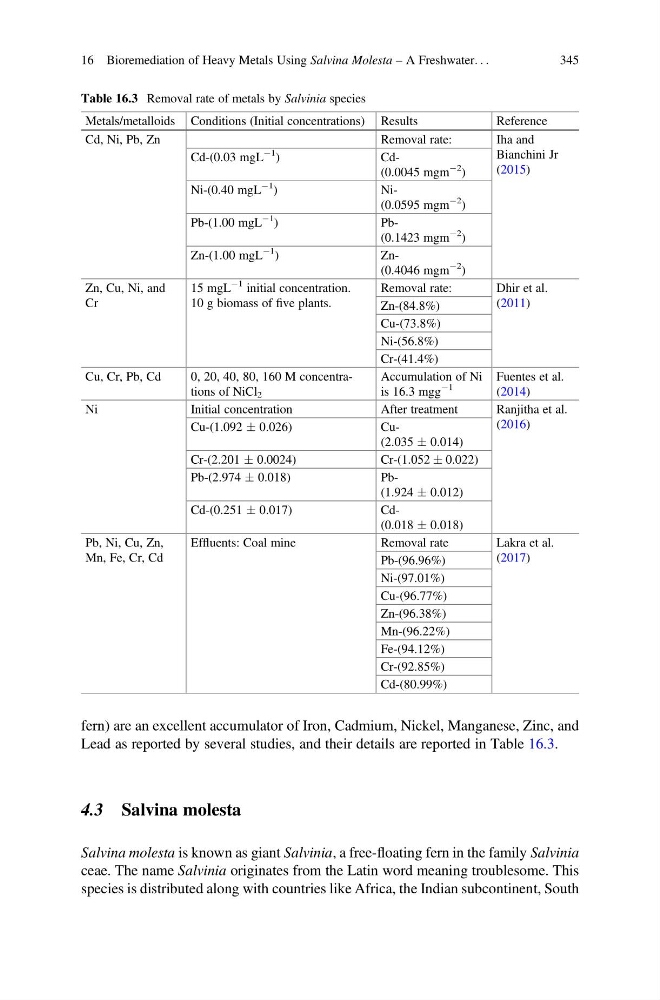
Lead as reported by several studies, and their details are reported in Table 16.3.
4.3 Salvina molesta
Salvina molesta is known as giant Salvinia, a free-floating fern in the family Salvinia
ceae. The name Salvinia originates from the Latin word meaning troublesome. This
species is distributed along with countries like Africa, the Indian subcontinent, South
Table 16.3 Removal rate of metals by Salvinia species
Metals/metalloids Conditions (Initial concentrations) Results
Reference
Cd, Ni, Pb, Zn
Removal rate:
Iha and
Bianchini Jr
(2015)
Cd-(0.03 mgL
À1
)
Cd(0.0045 mgm
À2
)
Ni-(0.40 mgL
À1
)
Ni(0.0595 mgm
À2
)
Pb-(1.00 mgL
À1
)
Pb(0.1423 mgm
À2
)
Zn-(1.00 mgL
À1
)
Zn(0.4046 mgm
À2
)
Zn, Cu, Ni, and
Cr
15 mgL
À1 initial concentration.
10 g biomass of five plants.
Removal rate:
Dhir et al.
(2011)
Zn-(84.8%)
Cu-(73.8%)
Ni-(56.8%)
Cr-(41.4%)
Cu, Cr, Pb, Cd
0, 20, 40, 80, 160 M concentrations of NiCl 2
Accumulation of Ni
is 16.3 mgg
À1
Fuentes et al.
(2014)
Ni
Initial concentration
After treatment
Ranjitha et al.
(2016)
Cu-(1.092 Æ 0.026)
Cu(2.035 Æ 0.014)
Cr-(2.201 Æ 0.0024)
Cr-(1.052 Æ 0.022)
Pb-(2.974 Æ 0.018)
Pb(1.924 Æ 0.012)
Cd-(0.251 Æ 0.017)
Cd(0.018 Æ 0.018)
Pb, Ni, Cu, Zn,
Mn, Fe, Cr, Cd
Effluents: Coal mine
Removal rate
Lakra et al.
(2017)
Pb-(96.96%)
Ni-(97.01%)
Cu-(96.77%)
Zn-(96.38%)
Mn-(96.22%)
Fe-(94.12%)
Cr-(92.85%)
Cd-(80.99%)
16 Bioremediation of Heavy Metals Using Salvina Molesta – A Freshwater. . .
345
Lead as reported by several studies, and their details are reported in Table 16.3.
4.3 Salvina molesta
Salvina molesta is known as giant Salvinia, a free-floating fern in the family Salvinia
ceae. The name Salvinia originates from the Latin word meaning troublesome. This
species is distributed along with countries like Africa, the Indian subcontinent, South
Table 16.3 Removal rate of metals by Salvinia species
Metals/metalloids Conditions (Initial concentrations) Results
Reference
Cd, Ni, Pb, Zn
Removal rate:
Iha and
Bianchini Jr
(2015)
Cd-(0.03 mgL
À1
)
Cd(0.0045 mgm
À2
)
Ni-(0.40 mgL
À1
)
Ni(0.0595 mgm
À2
)
Pb-(1.00 mgL
À1
)
Pb(0.1423 mgm
À2
)
Zn-(1.00 mgL
À1
)
Zn(0.4046 mgm
À2
)
Zn, Cu, Ni, and
Cr
15 mgL
À1 initial concentration.
10 g biomass of five plants.
Removal rate:
Dhir et al.
(2011)
Zn-(84.8%)
Cu-(73.8%)
Ni-(56.8%)
Cr-(41.4%)
Cu, Cr, Pb, Cd
0, 20, 40, 80, 160 M concentrations of NiCl 2
Accumulation of Ni
is 16.3 mgg
À1
Fuentes et al.
(2014)
Ni
Initial concentration
After treatment
Ranjitha et al.
(2016)
Cu-(1.092 Æ 0.026)
Cu(2.035 Æ 0.014)
Cr-(2.201 Æ 0.0024)
Cr-(1.052 Æ 0.022)
Pb-(2.974 Æ 0.018)
Pb(1.924 Æ 0.012)
Cd-(0.251 Æ 0.017)
Cd(0.018 Æ 0.018)
Pb, Ni, Cu, Zn,
Mn, Fe, Cr, Cd
Effluents: Coal mine
Removal rate
Lakra et al.
(2017)
Pb-(96.96%)
Ni-(97.01%)
Cu-(96.77%)
Zn-(96.38%)
Mn-(96.22%)
Fe-(94.12%)
Cr-(92.85%)
Cd-(80.99%)
16 Bioremediation of Heavy Metals Using Salvina Molesta – A Freshwater. . .
345