

East Asia, Australia, southern USA, and New Zealand. In India, the Salvinia molesta
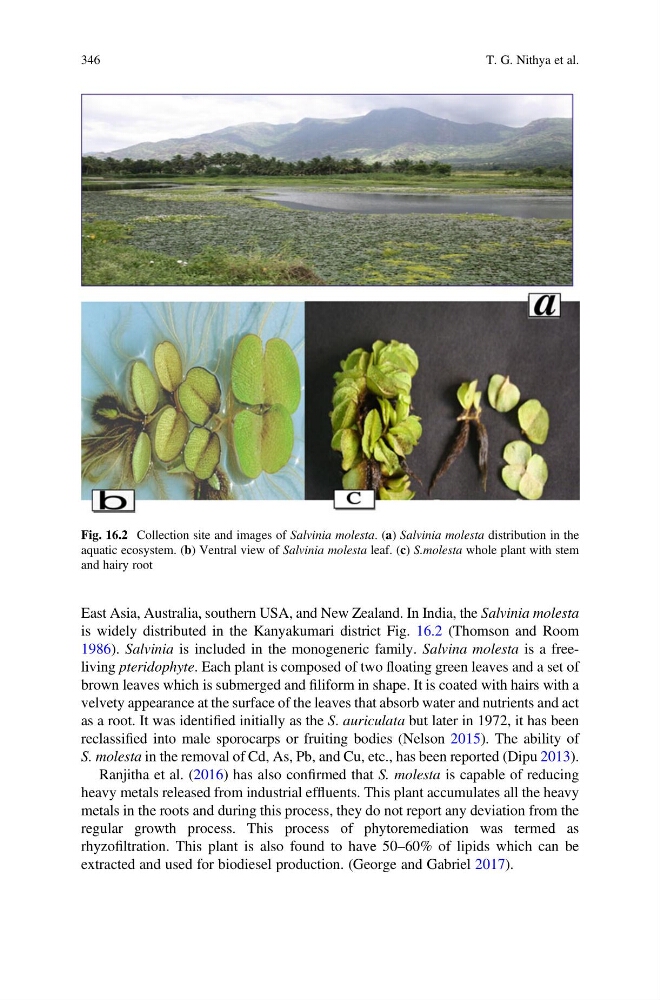
is widely distributed in the Kanyakumari district Fig. 16.2 (Thomson and Room
1986). Salvinia is included in the monogeneric family. Salvina molesta is a freeliving pteridophyte. Each plant is composed of two floating green leaves and a set of
brown leaves which is submerged and filiform in shape. It is coated with hairs with a
velvety appearance at the surface of the leaves that absorb water and nutrients and act
as a root. It was identified initially as the S. auriculata but later in 1972, it has been
reclassified into male sporocarps or fruiting bodies (Nelson 2015). The ability of
S. molesta in the removal of Cd, As, Pb, and Cu, etc., has been reported (Dipu 2013).
Ranjitha et al. (2016) has also confirmed that S. molesta is capable of reducing
heavy metals released from industrial effluents. This plant accumulates all the heavy
metals in the roots and during this process, they do not report any deviation from the
regular growth process. This process of phytoremediation was termed as
rhyzofiltration. This plant is also found to have 50–60% of lipids which can be
extracted and used for biodiesel production. (George and Gabriel 2017).
Fig. 16.2 Collection site and images of Salvinia molesta. (a) Salvinia molesta distribution in the
aquatic ecosystem. (b) Ventral view of Salvinia molesta leaf. (c) S.molesta whole plant with stem
and hairy root
346
T. G. Nithya et al.
is widely distributed in the Kanyakumari district Fig. 16.2 (Thomson and Room
1986). Salvinia is included in the monogeneric family. Salvina molesta is a freeliving pteridophyte. Each plant is composed of two floating green leaves and a set of
brown leaves which is submerged and filiform in shape. It is coated with hairs with a
velvety appearance at the surface of the leaves that absorb water and nutrients and act
as a root. It was identified initially as the S. auriculata but later in 1972, it has been
reclassified into male sporocarps or fruiting bodies (Nelson 2015). The ability of
S. molesta in the removal of Cd, As, Pb, and Cu, etc., has been reported (Dipu 2013).
Ranjitha et al. (2016) has also confirmed that S. molesta is capable of reducing
heavy metals released from industrial effluents. This plant accumulates all the heavy
metals in the roots and during this process, they do not report any deviation from the
regular growth process. This process of phytoremediation was termed as
rhyzofiltration. This plant is also found to have 50–60% of lipids which can be
extracted and used for biodiesel production. (George and Gabriel 2017).
Fig. 16.2 Collection site and images of Salvinia molesta. (a) Salvinia molesta distribution in the
aquatic ecosystem. (b) Ventral view of Salvinia molesta leaf. (c) S.molesta whole plant with stem
and hairy root
346
T. G. Nithya et al.