

contaminated with heavy metals like Fe, Cu, Cd, Zn, Ni, Pb etc. (Ali and Zyada
2015).
By calculating BAF, one can identify metal hyperaccumulator plant species. It
provides scope for decontamination of Aquatic bodies from metal pollution thereby
reducing pollution load. The plant species especially those which have BAF values
greater than one, are appropriate for phytoextraction. The BAF values for
hyperaccumulators is >1 mg/kg
À1 whereas for accumulator and excluder plant
species, it is <1 mg/kg
À1 .
For any aquatic ecosystem, the amount of metals in water / sediments are referred
as sensitive indicators (Jain et al. 2005). This is because the amount/concentration is
directly related to their toxic impacts on that particular ecosystem. Therefore various
measures such as Contamination factor (Cf), (Edet and Ofong 2002); Contamination
index (Cd) (Nayek et al. 2010), modified degree contamination index (mCd)
Devanesan et al. (2017) and Metal accumulation index (MAI) (Yasser et al. 2018)
are used either singly or in combination with assessment of heavy metal enrichment
and contamination in water and sediments. In particular, MAI is used to evaluate
comprehensive pursuance of heavy metal accumulation in plants (Fig. 15.2).
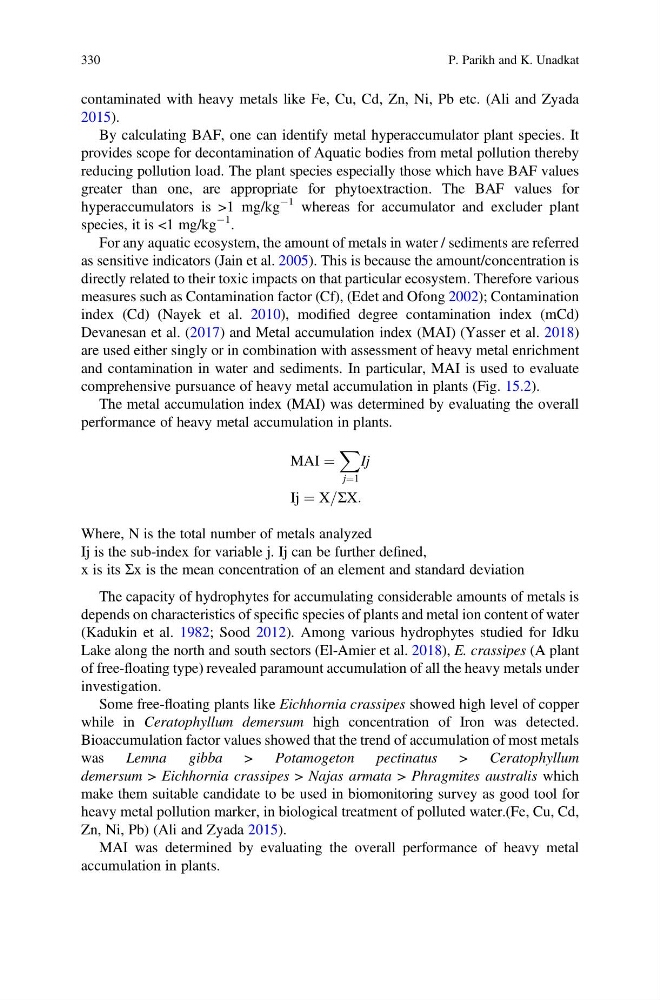
The metal accumulation index (MAI) was determined by evaluating the overall
performance of heavy metal accumulation in plants.
MAI ¼
X
j¼1
Ij
Ij ¼ X=ΣX:
Where, N is the total number of metals analyzed
Ij is the sub-index for variable j. Ij can be further defined,
x is its Σx is the mean concentration of an element and standard deviation
The capacity of hydrophytes for accumulating considerable amounts of metals is
depends on characteristics of specific species of plants and metal ion content of water
(Kadukin et al. 1982; Sood 2012). Among various hydrophytes studied for Idku
Lake along the north and south sectors (El-Amier et al. 2018), E. crassipes (A plant
of free-floating type) revealed paramount accumulation of all the heavy metals under
investigation.
Some free-floating plants like Eichhornia crassipes showed high level of copper
while in Ceratophyllum demersum high concentration of Iron was detected.
Bioaccumulation factor values showed that the trend of accumulation of most metals
was Lemna gibba > Potamogeton pectinatus > Ceratophyllum
demersum > Eichhornia crassipes > Najas armata > Phragmites australis which
make them suitable candidate to be used in biomonitoring survey as good tool for
heavy metal pollution marker, in biological treatment of polluted water.(Fe, Cu, Cd,
Zn, Ni, Pb) (Ali and Zyada 2015).
MAI was determined by evaluating the overall performance of heavy metal
accumulation in plants.
330
P. Parikh and K. Unadkat
2015).
By calculating BAF, one can identify metal hyperaccumulator plant species. It
provides scope for decontamination of Aquatic bodies from metal pollution thereby
reducing pollution load. The plant species especially those which have BAF values
greater than one, are appropriate for phytoextraction. The BAF values for
hyperaccumulators is >1 mg/kg
À1 whereas for accumulator and excluder plant
species, it is <1 mg/kg
À1 .
For any aquatic ecosystem, the amount of metals in water / sediments are referred
as sensitive indicators (Jain et al. 2005). This is because the amount/concentration is
directly related to their toxic impacts on that particular ecosystem. Therefore various
measures such as Contamination factor (Cf), (Edet and Ofong 2002); Contamination
index (Cd) (Nayek et al. 2010), modified degree contamination index (mCd)
Devanesan et al. (2017) and Metal accumulation index (MAI) (Yasser et al. 2018)
are used either singly or in combination with assessment of heavy metal enrichment
and contamination in water and sediments. In particular, MAI is used to evaluate
comprehensive pursuance of heavy metal accumulation in plants (Fig. 15.2).
The metal accumulation index (MAI) was determined by evaluating the overall
performance of heavy metal accumulation in plants.
MAI ¼
X
j¼1
Ij
Ij ¼ X=ΣX:
Where, N is the total number of metals analyzed
Ij is the sub-index for variable j. Ij can be further defined,
x is its Σx is the mean concentration of an element and standard deviation
The capacity of hydrophytes for accumulating considerable amounts of metals is
depends on characteristics of specific species of plants and metal ion content of water
(Kadukin et al. 1982; Sood 2012). Among various hydrophytes studied for Idku
Lake along the north and south sectors (El-Amier et al. 2018), E. crassipes (A plant
of free-floating type) revealed paramount accumulation of all the heavy metals under
investigation.
Some free-floating plants like Eichhornia crassipes showed high level of copper
while in Ceratophyllum demersum high concentration of Iron was detected.
Bioaccumulation factor values showed that the trend of accumulation of most metals
was Lemna gibba > Potamogeton pectinatus > Ceratophyllum
demersum > Eichhornia crassipes > Najas armata > Phragmites australis which
make them suitable candidate to be used in biomonitoring survey as good tool for
heavy metal pollution marker, in biological treatment of polluted water.(Fe, Cu, Cd,
Zn, Ni, Pb) (Ali and Zyada 2015).
MAI was determined by evaluating the overall performance of heavy metal
accumulation in plants.
330
P. Parikh and K. Unadkat