

laboratory experiments, where they obtained high absorption values in all the plants.
Although the L. minor species did not survive at the end of the experiment due to
vegetal cover in the water layer that prevents the increase of oxygen dissolved in the
recipient, Pbing to the death of individuals (Miretzky et al. 2004).
1.3.3 Bioaccumulation Factor and Metal Accumulation Index
One of the important concepts in environmental risk assessment is Bioaccumulation
Factor and Bio-Concentration Factor as they offer quantitative information regarding
capability of an organism to take up a pollutant from the water.
Bioaccumulation factor is defined as the capacity of a particular plant species to
concentrate/accumulate metal ion into its tissue from the metal contaminated environment (Ladislas et al. 2012). While calculating BAF dry weight of metal ion
accumulating plant species is taken into account. On the basis of substratum i.e. from
soil to Terrestrial plants; from sediments to Rooted Hydrophytes and from Aquatic
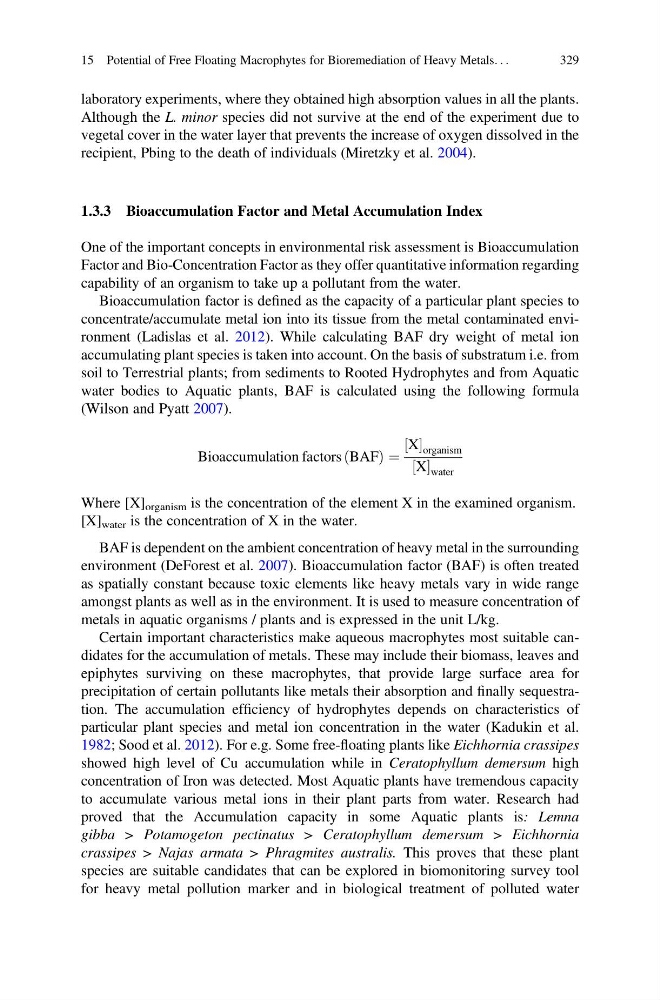
water bodies to Aquatic plants, BAF is calculated using the following formula
(Wilson and Pyatt 2007).
Bioaccumulation factors BAF
ð
Þ¼
X
½ organism
X
½ water
Where [X] organism is the concentration of the element X in the examined organism.
[X] water is the concentration of X in the water.
BAF is dependent on the ambient concentration of heavy metal in the surrounding
environment (DeForest et al. 2007). Bioaccumulation factor (BAF) is often treated
as spatially constant because toxic elements like heavy metals vary in wide range
amongst plants as well as in the environment. It is used to measure concentration of
metals in aquatic organisms / plants and is expressed in the unit L/kg.
Certain important characteristics make aqueous macrophytes most suitable candidates for the accumulation of metals. These may include their biomass, leaves and
epiphytes surviving on these macrophytes, that provide large surface area for
precipitation of certain pollutants like metals their absorption and finally sequestration. The accumulation efficiency of hydrophytes depends on characteristics of
particular plant species and metal ion concentration in the water (Kadukin et al.
1982; Sood et al. 2012). For e.g. Some free-floating plants like Eichhornia crassipes
showed high level of Cu accumulation while in Ceratophyllum demersum high
concentration of Iron was detected. Most Aquatic plants have tremendous capacity
to accumulate various metal ions in their plant parts from water. Research had
proved that the Accumulation capacity in some Aquatic plants is: Lemna
gibba > Potamogeton pectinatus > Ceratophyllum demersum > Eichhornia
crassipes > Najas armata > Phragmites australis. This proves that these plant
species are suitable candidates that can be explored in biomonitoring survey tool
for heavy metal pollution marker and in biological treatment of polluted water
15 Potential of Free Floating Macrophytes for Bioremediation of Heavy Metals. . .
329
Although the L. minor species did not survive at the end of the experiment due to
vegetal cover in the water layer that prevents the increase of oxygen dissolved in the
recipient, Pbing to the death of individuals (Miretzky et al. 2004).
1.3.3 Bioaccumulation Factor and Metal Accumulation Index
One of the important concepts in environmental risk assessment is Bioaccumulation
Factor and Bio-Concentration Factor as they offer quantitative information regarding
capability of an organism to take up a pollutant from the water.
Bioaccumulation factor is defined as the capacity of a particular plant species to
concentrate/accumulate metal ion into its tissue from the metal contaminated environment (Ladislas et al. 2012). While calculating BAF dry weight of metal ion
accumulating plant species is taken into account. On the basis of substratum i.e. from
soil to Terrestrial plants; from sediments to Rooted Hydrophytes and from Aquatic
water bodies to Aquatic plants, BAF is calculated using the following formula
(Wilson and Pyatt 2007).
Bioaccumulation factors BAF
ð
Þ¼
X
½ organism
X
½ water
Where [X] organism is the concentration of the element X in the examined organism.
[X] water is the concentration of X in the water.
BAF is dependent on the ambient concentration of heavy metal in the surrounding
environment (DeForest et al. 2007). Bioaccumulation factor (BAF) is often treated
as spatially constant because toxic elements like heavy metals vary in wide range
amongst plants as well as in the environment. It is used to measure concentration of
metals in aquatic organisms / plants and is expressed in the unit L/kg.
Certain important characteristics make aqueous macrophytes most suitable candidates for the accumulation of metals. These may include their biomass, leaves and
epiphytes surviving on these macrophytes, that provide large surface area for
precipitation of certain pollutants like metals their absorption and finally sequestration. The accumulation efficiency of hydrophytes depends on characteristics of
particular plant species and metal ion concentration in the water (Kadukin et al.
1982; Sood et al. 2012). For e.g. Some free-floating plants like Eichhornia crassipes
showed high level of Cu accumulation while in Ceratophyllum demersum high
concentration of Iron was detected. Most Aquatic plants have tremendous capacity
to accumulate various metal ions in their plant parts from water. Research had
proved that the Accumulation capacity in some Aquatic plants is: Lemna
gibba > Potamogeton pectinatus > Ceratophyllum demersum > Eichhornia
crassipes > Najas armata > Phragmites australis. This proves that these plant
species are suitable candidates that can be explored in biomonitoring survey tool
for heavy metal pollution marker and in biological treatment of polluted water
15 Potential of Free Floating Macrophytes for Bioremediation of Heavy Metals. . .
329