

11 The Functional Groups of Algae for Heavy Metal
Uptake
As mentioned, that the algal cell wall plays a vital role in heavy metal uptake as it
contains macromolecules of polysaccharides, proteins, lipids, and lignin. It is pertinent to note that the glucosamine group is an important surface sugar constituent of
various algal species (Takeda 1996). Furthermore, protonation of an amino group
under low pH, could be associated with metal adsorption (Boddu et al. 2003; Bai and
Abraham 2002). These contribute to various anionic functional groups (carboxyl,
hydroxyl, phosphate, amino, sulfhydryl, amide, alkyl, and aromatic compound) and
conserve an overall negative charge to the cell surface (Raize et al. 2004; Javanbakht
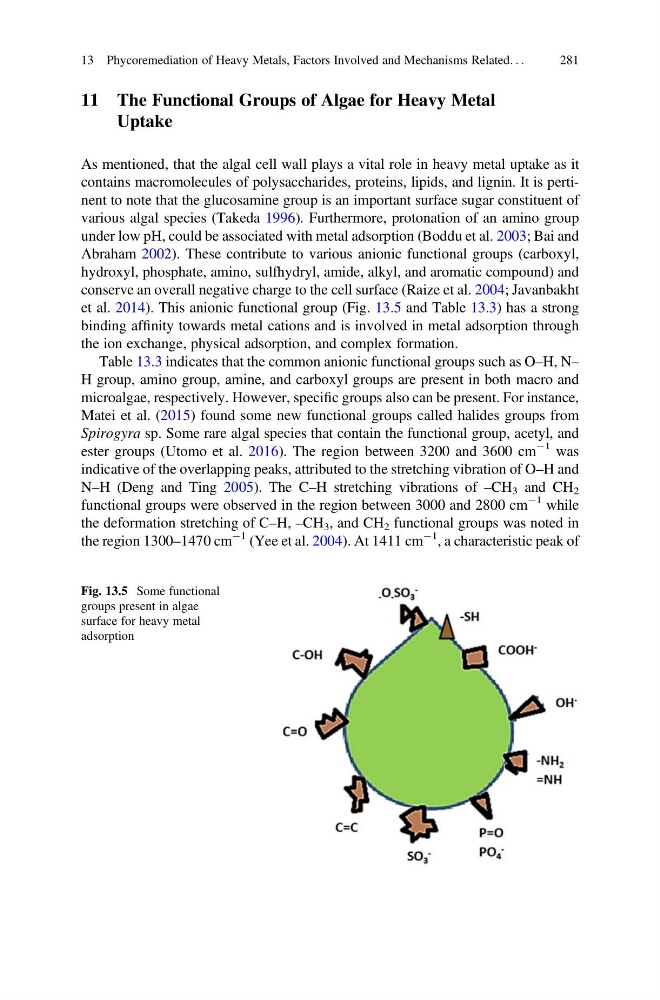
et al. 2014). This anionic functional group (Fig. 13.5 and Table 13.3) has a strong
binding affinity towards metal cations and is involved in metal adsorption through
the ion exchange, physical adsorption, and complex formation.
Table 13.3 indicates that the common anionic functional groups such as O–H, N–
H group, amino group, amine, and carboxyl groups are present in both macro and
microalgae, respectively. However, specific groups also can be present. For instance,
Matei et al. (2015) found some new functional groups called halides groups from
Spirogyra sp. Some rare algal species that contain the functional group, acetyl, and
ester groups (Utomo et al. 2016). The region between 3200 and 3600 cm
À1 was
indicative of the overlapping peaks, attributed to the stretching vibration of O–H and
N–H (Deng and Ting 2005). The C–H stretching vibrations of –CH 3 and CH 2
functional groups were observed in the region between 3000 and 2800 cm
À1 while
the deformation stretching of C–H, –CH 3 , and CH 2 functional groups was noted in
the region 1300–1470 cm
À1 (Yee et al. 2004). At 1411 cm
À1 , a characteristic peak of
Fig. 13.5 Some functional
groups present in algae
surface for heavy metal
adsorption
13 Phycoremediation of Heavy Metals, Factors Involved and Mechanisms Related. . .
281
Uptake
As mentioned, that the algal cell wall plays a vital role in heavy metal uptake as it
contains macromolecules of polysaccharides, proteins, lipids, and lignin. It is pertinent to note that the glucosamine group is an important surface sugar constituent of
various algal species (Takeda 1996). Furthermore, protonation of an amino group
under low pH, could be associated with metal adsorption (Boddu et al. 2003; Bai and
Abraham 2002). These contribute to various anionic functional groups (carboxyl,
hydroxyl, phosphate, amino, sulfhydryl, amide, alkyl, and aromatic compound) and
conserve an overall negative charge to the cell surface (Raize et al. 2004; Javanbakht
et al. 2014). This anionic functional group (Fig. 13.5 and Table 13.3) has a strong
binding affinity towards metal cations and is involved in metal adsorption through
the ion exchange, physical adsorption, and complex formation.
Table 13.3 indicates that the common anionic functional groups such as O–H, N–
H group, amino group, amine, and carboxyl groups are present in both macro and
microalgae, respectively. However, specific groups also can be present. For instance,
Matei et al. (2015) found some new functional groups called halides groups from
Spirogyra sp. Some rare algal species that contain the functional group, acetyl, and
ester groups (Utomo et al. 2016). The region between 3200 and 3600 cm
À1 was
indicative of the overlapping peaks, attributed to the stretching vibration of O–H and
N–H (Deng and Ting 2005). The C–H stretching vibrations of –CH 3 and CH 2
functional groups were observed in the region between 3000 and 2800 cm
À1 while
the deformation stretching of C–H, –CH 3 , and CH 2 functional groups was noted in
the region 1300–1470 cm
À1 (Yee et al. 2004). At 1411 cm
À1 , a characteristic peak of
Fig. 13.5 Some functional
groups present in algae
surface for heavy metal
adsorption
13 Phycoremediation of Heavy Metals, Factors Involved and Mechanisms Related. . .
281