

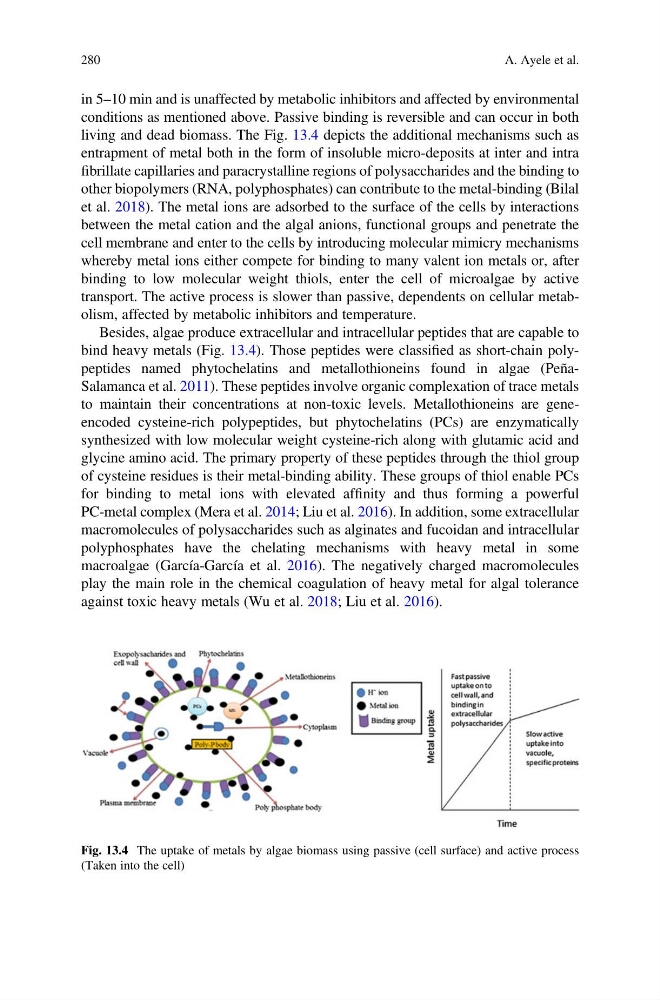
in 5–10 min and is unaffected by metabolic inhibitors and affected by environmental
conditions as mentioned above. Passive binding is reversible and can occur in both
living and dead biomass. The Fig. 13.4 depicts the additional mechanisms such as
entrapment of metal both in the form of insoluble micro-deposits at inter and intra
fibrillate capillaries and paracrystalline regions of polysaccharides and the binding to
other biopolymers (RNA, polyphosphates) can contribute to the metal-binding (Bilal
et al. 2018). The metal ions are adsorbed to the surface of the cells by interactions
between the metal cation and the algal anions, functional groups and penetrate the
cell membrane and enter to the cells by introducing molecular mimicry mechanisms
whereby metal ions either compete for binding to many valent ion metals or, after
binding to low molecular weight thiols, enter the cell of microalgae by active
transport. The active process is slower than passive, dependents on cellular metabolism, affected by metabolic inhibitors and temperature.
Besides, algae produce extracellular and intracellular peptides that are capable to
bind heavy metals (Fig. 13.4). Those peptides were classified as short-chain polypeptides named phytochelatins and metallothioneins found in algae (PeñaSalamanca et al. 2011). These peptides involve organic complexation of trace metals
to maintain their concentrations at non-toxic levels. Metallothioneins are geneencoded cysteine-rich polypeptides, but phytochelatins (PCs) are enzymatically
synthesized with low molecular weight cysteine-rich along with glutamic acid and
glycine amino acid. The primary property of these peptides through the thiol group
of cysteine residues is their metal-binding ability. These groups of thiol enable PCs
for binding to metal ions with elevated affinity and thus forming a powerful
PC-metal complex (Mera et al. 2014; Liu et al. 2016). In addition, some extracellular
macromolecules of polysaccharides such as alginates and fucoidan and intracellular
polyphosphates have the chelating mechanisms with heavy metal in some
macroalgae (García-García et al. 2016). The negatively charged macromolecules
play the main role in the chemical coagulation of heavy metal for algal tolerance
against toxic heavy metals (Wu et al. 2018; Liu et al. 2016).
Fig. 13.4 The uptake of metals by algae biomass using passive (cell surface) and active process
(Taken into the cell)
280
A. Ayele et al.
conditions as mentioned above. Passive binding is reversible and can occur in both
living and dead biomass. The Fig. 13.4 depicts the additional mechanisms such as
entrapment of metal both in the form of insoluble micro-deposits at inter and intra
fibrillate capillaries and paracrystalline regions of polysaccharides and the binding to
other biopolymers (RNA, polyphosphates) can contribute to the metal-binding (Bilal
et al. 2018). The metal ions are adsorbed to the surface of the cells by interactions
between the metal cation and the algal anions, functional groups and penetrate the
cell membrane and enter to the cells by introducing molecular mimicry mechanisms
whereby metal ions either compete for binding to many valent ion metals or, after
binding to low molecular weight thiols, enter the cell of microalgae by active
transport. The active process is slower than passive, dependents on cellular metabolism, affected by metabolic inhibitors and temperature.
Besides, algae produce extracellular and intracellular peptides that are capable to
bind heavy metals (Fig. 13.4). Those peptides were classified as short-chain polypeptides named phytochelatins and metallothioneins found in algae (PeñaSalamanca et al. 2011). These peptides involve organic complexation of trace metals
to maintain their concentrations at non-toxic levels. Metallothioneins are geneencoded cysteine-rich polypeptides, but phytochelatins (PCs) are enzymatically
synthesized with low molecular weight cysteine-rich along with glutamic acid and
glycine amino acid. The primary property of these peptides through the thiol group
of cysteine residues is their metal-binding ability. These groups of thiol enable PCs
for binding to metal ions with elevated affinity and thus forming a powerful
PC-metal complex (Mera et al. 2014; Liu et al. 2016). In addition, some extracellular
macromolecules of polysaccharides such as alginates and fucoidan and intracellular
polyphosphates have the chelating mechanisms with heavy metal in some
macroalgae (García-García et al. 2016). The negatively charged macromolecules
play the main role in the chemical coagulation of heavy metal for algal tolerance
against toxic heavy metals (Wu et al. 2018; Liu et al. 2016).
Fig. 13.4 The uptake of metals by algae biomass using passive (cell surface) and active process
(Taken into the cell)
280
A. Ayele et al.