

cathode chambers. Outcome results of MFCs are highly affected by different
parameters, such as permeability, biological factors, density of the medium, and
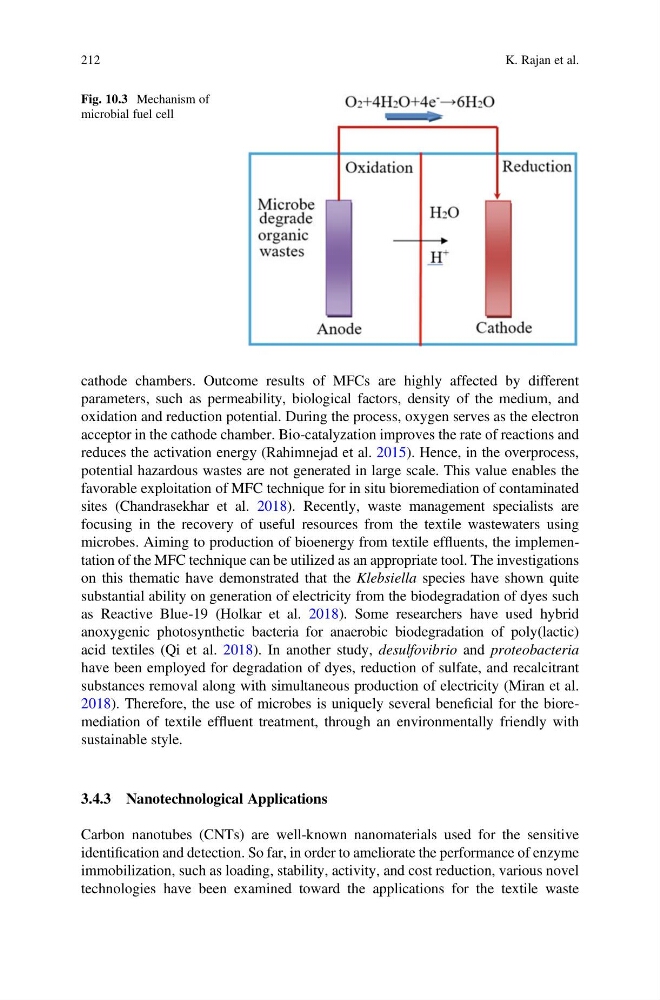
oxidation and reduction potential. During the process, oxygen serves as the electron
acceptor in the cathode chamber. Bio-catalyzation improves the rate of reactions and
reduces the activation energy (Rahimnejad et al. 2015). Hence, in the overprocess,
potential hazardous wastes are not generated in large scale. This value enables the
favorable exploitation of MFC technique for in situ bioremediation of contaminated
sites (Chandrasekhar et al. 2018). Recently, waste management specialists are
focusing in the recovery of useful resources from the textile wastewaters using
microbes. Aiming to production of bioenergy from textile effluents, the implementation of the MFC technique can be utilized as an appropriate tool. The investigations
on this thematic have demonstrated that the Klebsiella species have shown quite
substantial ability on generation of electricity from the biodegradation of dyes such
as Reactive Blue-19 (Holkar et al. 2018). Some researchers have used hybrid
anoxygenic photosynthetic bacteria for anaerobic biodegradation of poly(lactic)
acid textiles (Qi et al. 2018). In another study, desulfovibrio and proteobacteria
have been employed for degradation of dyes, reduction of sulfate, and recalcitrant
substances removal along with simultaneous production of electricity (Miran et al.
2018). Therefore, the use of microbes is uniquely several beneficial for the bioremediation of textile effluent treatment, through an environmentally friendly with
sustainable style.
3.4.3 Nanotechnological Applications
Carbon nanotubes (CNTs) are well-known nanomaterials used for the sensitive
identification and detection. So far, in order to ameliorate the performance of enzyme
immobilization, such as loading, stability, activity, and cost reduction, various novel
technologies have been examined toward the applications for the textile waste
Fig. 10.3 Mechanism of
microbial fuel cell
212
K. Rajan et al.
parameters, such as permeability, biological factors, density of the medium, and
oxidation and reduction potential. During the process, oxygen serves as the electron
acceptor in the cathode chamber. Bio-catalyzation improves the rate of reactions and
reduces the activation energy (Rahimnejad et al. 2015). Hence, in the overprocess,
potential hazardous wastes are not generated in large scale. This value enables the
favorable exploitation of MFC technique for in situ bioremediation of contaminated
sites (Chandrasekhar et al. 2018). Recently, waste management specialists are
focusing in the recovery of useful resources from the textile wastewaters using
microbes. Aiming to production of bioenergy from textile effluents, the implementation of the MFC technique can be utilized as an appropriate tool. The investigations
on this thematic have demonstrated that the Klebsiella species have shown quite
substantial ability on generation of electricity from the biodegradation of dyes such
as Reactive Blue-19 (Holkar et al. 2018). Some researchers have used hybrid
anoxygenic photosynthetic bacteria for anaerobic biodegradation of poly(lactic)
acid textiles (Qi et al. 2018). In another study, desulfovibrio and proteobacteria
have been employed for degradation of dyes, reduction of sulfate, and recalcitrant
substances removal along with simultaneous production of electricity (Miran et al.
2018). Therefore, the use of microbes is uniquely several beneficial for the bioremediation of textile effluent treatment, through an environmentally friendly with
sustainable style.
3.4.3 Nanotechnological Applications
Carbon nanotubes (CNTs) are well-known nanomaterials used for the sensitive
identification and detection. So far, in order to ameliorate the performance of enzyme
immobilization, such as loading, stability, activity, and cost reduction, various novel
technologies have been examined toward the applications for the textile waste
Fig. 10.3 Mechanism of
microbial fuel cell
212
K. Rajan et al.